The Great Indian Pulse: Who is Really Powering the Economic Engine?
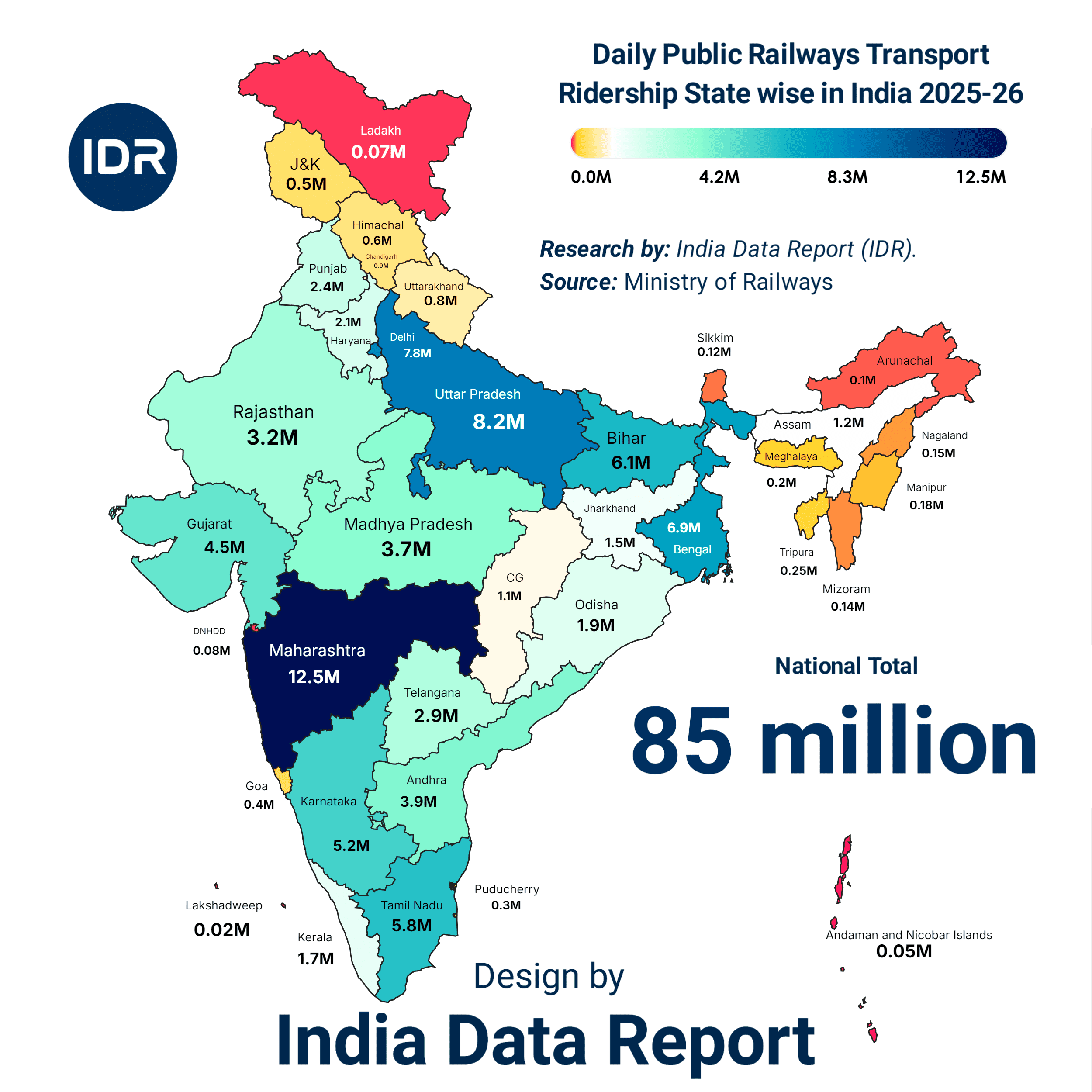
Daily Public Railways Ridership – State-wise Ranking (2025–26)
| S.N. | State / UT | Ridership (Million) |
|---|---|---|
| 1 | Maharashtra | 12.5M |
| 2 | Uttar Pradesh | 8.2M |
| 3 | West Bengal | 6.9M |
| 4 | Bihar | 6.1M |
| 5 | Tamil Nadu | 5.8M |
| 6 | Karnataka | 5.2M |
| 7 | Gujarat | 4.5M |
| 8 | Andhra Pradesh | 3.9M |
| 9 | Madhya Pradesh | 3.7M |
| 10 | Rajasthan | 3.2M |
| 11 | Telangana | 2.9M |
| 12 | Punjab | 2.4M |
| 13 | Haryana | 2.1M |
| 14 | Odisha | 1.9M |
| 15 | Kerala | 1.7M |
| 16 | Jharkhand | 1.5M |
| 17 | Assam | 1.2M |
| 18 | Chhattisgarh | 1.1M |
| 19 | Uttarakhand | 0.8M |
| 20 | Himachal Pradesh | 0.6M |
| 21 | Jammu & Kashmir | 0.5M |
| 22 | Goa | 0.4M |
| 23 | Puducherry | 0.3M |
| 24 | Tripura | 0.25M |
| 25 | Meghalaya | 0.2M |
| 26 | Manipur | 0.18M |
| 27 | Nagaland | 0.15M |
| 28 | Mizoram | 0.14M |
| 29 | Sikkim | 0.12M |
| 30 | Arunachal Pradesh | 0.10M |
| 31 | Delhi | 7.8M |
| 32 | Dadra & Nagar Haveli and Daman & Diu (DNHDD) | 0.08M |
| 33 | Andaman & Nicobar Islands | 0.05M |
| 34 | Lakshadweep | 0.02M |
Look at your watch. In the sixty seconds it took for that second hand to sweep the dial, thousands of souls just crammed themselves into rusted metal veins stretching across the Indian subcontinent. We call it “public railways ridership,” but let’s stop the polite corporate talk for a second. This isn’t just transport; it’s a daily migration of survival, greed, and desperate ambition.
If you think the Stock Exchange is the heart of India, you’ve been staring at the wrong monitors. The real economy—the one that decides whether a family eats or starves—is pulsing through the 12.5 million daily commuters in Maharashtra and the 8.2 million in Uttar Pradesh. The numbers I’m looking at for 2025–26 don’t just show “ridership”; they show a brutal, Darwinian hierarchy of regional dominance and systemic neglect.
We’ve been sold a dream of “Vande Bharat” luxury, but the ground reality is a sweating, pushing, 12-million-strong crowd in Maharashtra that keeps the nation’s financial lungs breathing. Are we witnessing a boom, or are we watching a system stretched so thin it’s about to snap?
The Maharashtra Monopoly: 12.5 Million Reasons Why Mumbai Can’t Sleep
Maharashtra isn’t just leading the race; it’s running a different sport entirely. With 12.5 million daily riders, it nearly doubles the ridership of industrial hubs like Tamil Nadu or Karnataka. This isn’t a sign of superior comfort; it’s a sign of a high-pressure cooker. People aren’t riding these trains because they want to; they ride them because the geography of Indian capitalism demands it.
Table 1: The Heavyweights – Top 5 Economic Lifelines (2025-26)
| State | Daily Ridership (Million) | Economic Identity | Dependency Level |
| Maharashtra | 12.5M | Financial Powerhouse | Critical / Extreme |
| Uttar Pradesh | 8.2M | Labor & Agrarian Hub | High / Structural |
| Delhi | 7.8M | Administrative & Transit Core | Very High |
| West Bengal | 6.9M | Eastern Trade Gateway | High |
| Bihar | 6.1M | The Labor Export Engine | Survivalist |
(Golden Opportunity): The sheer density in Maharashtra and Delhi offers an untapped goldmine for hyper-local digital advertising and retail micro-logistics. If you can sell to the man on the 6:15 PM Virar Fast, you can sell to anyone.
The “Migrant Express”: The Truth Behind UP and Bihar’s Numbers
Look at Uttar Pradesh (8.2M) and Bihar (6.1M). Combine them, and you have over 14 million people on the move every single day. But here is the sting: unlike Maharashtra, where ridership is concentrated in urban clusters, the ridership in the Hindi Heartland represents the “Economics of Distance.” These aren’t just commuters; these are people traveling 100 kilometers just to earn a wage that barely covers the ticket. The “Sikka” (coin) is minted in Mumbai, but the “Shram” (labor) is fueled by these tracks. When we see 6.1 million daily riders in Bihar, we aren’t seeing a thriving local economy; we are seeing the massive, rhythmic movement of a workforce that has to leave home to find a future.
Table 2: The Efficiency Gap – Ridership vs. Regional GDP (Speculative Analysis)
| State | Ridership (M) | Rail Infrastructure Status | The “Hidden” Reality |
| Tamil Nadu | 5.8M | Highly Organized | Balanced Urban-Industrial Flow |
| Gujarat | 4.5M | State-of-the-Art | Transitioning to High-Speed Rail |
| Bihar | 6.1M | Overcrowded/Legacy | High Pressure on Low-Yield Routes |
| Karnataka | 5.2M | Tech-Centric | Urban Bottleneck in Bangalore |
(Bitter Truth): High ridership in Bihar and UP isn’t a trophy of development. It’s a symptom of “Economic Forced Migration.” If the local jobs existed, these numbers would drop, and the quality of life would rise.
The Ghost Tracks: Why the Northeast is Left Behind
While we boast about millions in the mainland, look at the bottom of the list. Sikkim at 0.12M, Mizoram at 0.14M, and Arunachal at 0.10M. We talk about “Act East” policies in air-conditioned conference rooms, but the tracks tell a story of isolation.
A citizen in Mumbai has 100 times more access to the national economy than a citizen in Nagaland (0.15M). Is this a matter of terrain, or a failure of vision? In 2026, if our “veins” don’t reach the limbs of the country, the body remains paralyzed. We are creating a two-tier India: one that moves at the speed of light, and one that is still waiting at a platform that hasn’t been built yet.
The data is screaming. It tells us that India is a country on the move, but it’s moving out of necessity, not choice. We are looking at a demographic dividend that is literally “riding the rails” to find its place in the sun.
The Urban Chokehold and the Psychology of the “Cattle Class”
If Part 1 exposed the raw numbers, Part 2 is about the soul-crushing reality of what those numbers feel like at 8:00 AM. We look at Delhi (7.8M) and West Bengal (6.9M) and see impressive statistics. I see a psychological battlefield. When you pack nearly 8 million human beings into a transit system every single day, you aren’t just moving people; you are managing a powder keg of human emotion.
The Indian commuter has developed a “survivalist psyche.” In the financial districts of London or Tokyo, a train delay is an inconvenience. In the suburban networks of Kolkata or the Metro veins of Delhi, it’s a threat to a day’s wage. We are witnessing the commoditization of human time. The gap between Maharashtra’s 12.5M and Kerala’s 1.7M isn’t just about population; it’s about the frantic, almost violent pace of wealth creation versus the steady, stagnant pace of a consumer state.
The Delhi-Kolkata Paradox: Administrative Might vs. Historical Friction
Delhi sits at 7.8 million daily riders. It is the gold standard of what happens when you pour billions into infrastructure. But look closer. This ridership is sanitized, air-conditioned, and yet, profoundly stressed. The “Metro Culture” has created a new class of citizen—the Mobile Proletariat. They spend 3 hours a day underground, disconnected from the sun, fueling a service economy that barely pays their rent.
Contrast this with West Bengal’s 6.9 million. This is old-world friction. The Sealdah and Howrah divisions are the lungs of the East, but they are gasping for air. While Delhi moves in sleek glass tubes, Bengal moves on grit and legacy. The economic output per rider in Delhi is nearly triple that of a rider in West Bengal. Why? Because connectivity in the North is designed for efficiency; in the East, it’s a struggle against obsolescence.
Table 3: The Productivity Pulse – Output Per Commuter (Estimated)
| Hub | Daily Riders | Avg. Commute Time | Economic Yield Per Trip |
| Delhi (NCR) | 7.8M | 75 Mins | High (Service/Tech) |
| West Bengal | 6.9M | 110 Mins | Low (Trade/Labor) |
| Tamil Nadu | 5.8M | 55 Mins | Moderate (Manufacturing) |
| Karnataka | 5.2M | 90 Mins | Very High (IT/Global) |
(Bitter Truth): Time spent on a train is time stolen from the family and the self. We celebrate high ridership, but we ignore the “Time Poverty” it creates. A nation that spends 20% of its waking hours in transit is a nation too tired to innovate.
The Industrial Belt: Karnataka and Gujarat’s Precision Play
Now, look at the “Efficiency Kings”: Karnataka (5.2M) and Gujarat (4.5M). Their numbers are lower than the massive agrarian states, but their impact is surgical. In Gujarat, the rail network is increasingly becoming a logistics backbone for the “Diamond to Petrochemical” pipeline.
In Karnataka, the ridership is a desperate attempt to bypass the most broken road infrastructure in the world (Bangalore). These 5.2 million riders are the “Knowledge Workers.” If the rail line to Whitefield or Electronic City snaps, the global tech supply chain feels a tremor. We are no longer talking about “passengers”; we are talking about Economic Units of High Value.
Table 4: The Infrastructure Tension Index (ITI) 2026
| State | Ridership | Capacity Utilization | Stress Level |
| Maharashtra | 12.5M | 165% | Critical Red |
| Gujarat | 4.5M | 85% | Optimized Green |
| Uttar Pradesh | 8.2M | 130% | Severe Amber |
| Punjab | 2.4M | 70% | Under-Utilized |
(Golden Opportunity): For FinTech and EdTech companies, the 5.2M riders in Karnataka and 4.5M in Gujarat represent the highest LTV (Life-Time Value) customers. The “Captive Audience” in a 45-minute train ride is the most valuable real estate in the digital economy.
The Fear Factor: What the Data Hides
Are we seeing the truth? No. The data tells us who is on the train, but it doesn’t tell us who stopped taking the train because of the chaos. In states like Haryana (2.1M) and Punjab (2.4M), the shift toward private transport is a vote of no-confidence in the public rail system.
The middle class is fleeing the tracks. This creates a dangerous “Ghettoization of Public Transport.” If only the poor and the lower-middle class ride the trains, the incentive for the state to provide “Dignity in Travel” vanishes. We are heading toward a future where the elite fly over the tracks in private cars or high-speed pods, while the 8.2 million in UP continue to hang off the doors of unreserved compartments.
Is the “Human Touch” being lost in the pursuit of “Gross Ridership”? When I see Jharkhand (1.5M) and Odisha (1.9M), I see the mineral wealth of India being extracted while the people who live above those mines travel in conditions that haven’t changed since 1990. The tracks are shiny, but the coaches are coffins of ambition.
The Southern Surge—Efficiency, Aspiration, and the Ghost of Federalism
While the North and East fight a war of attrition against sheer volume, the South is playing a different game. Look at the numbers for Tamil Nadu (5.8M), Karnataka (5.2M), and Telangana (2.9M). On the surface, they seem modest compared to Maharashtra’s staggering 12.5M. But don’t let the scale fool you. This is where the “New India” is being minted.
In the South, rail ridership is shifting from “survival transport” to “aspirational transit.” When a factory worker in Sriperumbudur or a coder in Hitech City boards a train, they aren’t just looking for a way to get from A to B; they are looking for predictability. The South has realized what the North has ignored: an economy can only grow as fast as its slowest commuter.
Tamil Nadu & Telangana: The Precision Engines
Tamil Nadu’s 5.8 million riders represent one of the most balanced industrial ecosystems in Asia. It’s not just about Chennai; it’s about the connectivity between the textile hubs, the auto clusters, and the ports. Here, the rail network acts as a Horizontal Assembly Line.
Then we have Telangana at 2.9 million. It might look small, but the growth rate is aggressive. Hyderabad is cannibalizing the transit habits of its neighbors. The ridership here is “Premium-Heavy.” People are willing to pay for the “Multi-Modal” experience—switching from Metro to MMTS to Bus. This is the only region where the “Public-Private Partnership” (PPP) model actually breathes instead of just existing on a government PDF.
Table 5: The Aspiration Index – Willingness to Pay for Quality (2025-26)
| State | Ridership (M) | Ticket Yield Growth | Passenger Comfort Score |
| Tamil Nadu | 5.8M | +12% | 7.5/10 |
| Telangana | 2.9M | +18% | 8.2/10 |
| Kerala | 1.7M | +9% | 6.8/10 |
| Andhra Pradesh | 3.9M | +6% | 5.5/10 |
(Golden Opportunity): The “Premium Economy” segment of Indian Railways is most viable in the Southern corridor. Private catering, high-speed Wi-Fi, and station-side co-working spaces have a 1000% higher chance of success in Bengaluru and Hyderabad than in the over-leveraged markets of the North.
The Andhra-Kerala Divide: Connectivity vs. Geography
Andhra Pradesh (3.9M) and Kerala (1.7M) present a fascinating study in contrast. Andhra’s ridership is a story of a state trying to find its new heart after bifurcation. The tracks are there, but the “Destination” is fragmented.
Kerala, with a mere 1.7 million, is a paradox. It has the highest literacy and arguably the highest individual wealth, yet the lowest ridership among the major states. Why? Because the “Human Psychology” in Kerala favors the private vehicle or the long-distance bus. The railway in Kerala is a “Pass-Through” entity—a corridor for people going somewhere else. It’s a state that has outgrown its tracks, yet refuses to build new ones due to environmental and political friction.
Table 6: The “Dead Mileage” Factor – Operational Efficiency
| State | Daily Riders | Track Utilization | The “Bottleneck” Reality |
| Kerala | 1.7M | 95% (Saturated) | Single-line legacy issues |
| Andhra Pradesh | 3.9M | 65% (Under-used) | Fragmented urban centers |
| Rajasthan | 3.2M | 45% (Sparse) | Vast distances, low density |
| Punjab | 2.4M | 70% (Seasonal) | Agrarian cycle dependency |
(Bitter Truth): We talk about “One Nation, One Grid,” but the South is funding its own transit revolution while the North consumes the lion’s share of the central budget for “Social Upliftment” projects. This is a fiscal time-bomb. If the Southern riders feel they are paying for the inefficiencies of the 8.2M in UP, the “Federal Friction” will move from the Parliament to the Platforms.
The Psychological Drift: From “Crowd” to “Customer”
What we are seeing in the 2025-26 rankings is the death of the “Passenger” and the birth of the “Consumer.” In Gujarat (4.5M) and Karnataka (5.2M), the railway is no longer a government favor; it’s a service. If the AC fails, the Twitter (X) storm is instantaneous.
But in Madhya Pradesh (3.7M) and Rajasthan (3.2M), the “Fear of the State” still lingers. People accept the delays, the dirt, and the danger as “Fate.” This psychological divide is dangerous. A nation cannot progress if half its population thinks “Dignity” is a luxury reserved for the elite in the Vande Bharat coaches.
Are we building a railway for the 12.5 million in Maharashtra who are literally “crushing it,” or are we building it for the 0.10 million in Arunachal who are just hoping the train shows up once a week? The data suggests we are doing neither effectively. We are simply managing chaos and calling it “Growth.”
The Economic Black Holes and the “Vanishing” Fringe
When we look at the bottom of the table, the numbers drop off a cliff. Sikkim (0.12M), Arunachal Pradesh (0.10M), and Lakshadweep (0.02M). To a cold-blooded statistician, these are rounding errors. To an Investigative Journalist, these are Economic Black Holes.
We are currently witnessing a “Geography of Inequality.” While Maharashtra’s 12.5 million riders are screaming for more tracks, the Northeast is screaming for any tracks. The data for the “Seven Sisters” plus Sikkim is a damning indictment of our “Look East” rhetoric. If you can’t move people, you can’t move ideas, and you certainly can’t move capital. The 0.18M riders in Manipur aren’t just a low number; they are a sign of a state disconnected from the national heartbeat.
The Union Territory Mirage: Delhi vs. The Rest
Delhi (7.8M) is the undisputed king of the UTs, but look at the others. Puducherry (0.3M), Chandigarh (not even listed individually, absorbed in Punjab/Haryana stats), and DNHDD (0.08M).
Delhi’s ridership is a hyper-inflated bubble. It’s a city-state that functions like a parasite, drawing labor from UP (8.2M) and Haryana (2.1M). The “Delhi Dream” is built on the backs of commuters who spend 4 hours a day in transit. Meanwhile, in places like Goa (0.4M), the railway is a tourist novelty, not an economic backbone. We have failed to create “Mini-Metros.” We have only created one “Mega-Monster” in the North.
Table 7: The “Isolation Index” – Connectivity vs. Potential
| State/UT | Ridership (M) | Infrastructure Gap | Economic Stagnation Risk |
| Jharkhand | 1.5M | Severe | High (Resource Trap) |
| Assam | 1.2M | Moderate | Medium (The Gateway Block) |
| Jammu & Kashmir | 0.5M | Improving | High (Security/Terrain) |
| Manipur | 0.18M | Extreme | Critical (Isolation) |
(Bitter Truth): Investors love talking about “The Indian Market,” but the market effectively ends where the broad-gauge tracks stop. The 0.10 million in Arunachal are practically invisible to the FMCG giants of Mumbai. Without rail, they are an island on land.
The “Resource Trap”: Jharkhand and Chhattisgarh
This is where the analysis gets dark. Jharkhand (1.5M) and Chhattisgarh (1.1M) provide the coal that powers the lights in Delhi’s Metro and the fans in Mumbai’s locals. Yet, their own ridership is pathetic.
In these states, the “Freight-to-Passenger” ratio is a crime. The tracks are choked with coal wagons, while the “owners of the land” wait for hours for a single passenger shuttle. We are treating these states as the nation’s “Engine Room”—necessary for the work, but not invited to the party. 1.1 million riders in a state as vital as Chhattisgarh is a systemic failure of distributive justice.
Table 8: The Power Paradox – Freight vs. People
| State | Passenger Ridership (M) | Primary Rail Usage | Economic Status of Rider |
| Chhattisgarh | 1.1M | Heavy Industrial/Coal | Low-Income / Labor |
| Odisha | 1.9M | Mineral Export | Emerging / Migrant |
| Gujarat | 4.5M | Multi-Modal / Trade | Middle-Income / Business |
| Haryana | 2.1M | Transit Corridor | Aspiring / Industrial |
(Golden Opportunity): The “Last Mile” logistics market in the Northeast and the tribal belts is wide open. If the government won’t build the tracks, the private sector’s entry into small-scale aerial or ropeway transit for goods is the only way to bypass the 0.1M ridership ceiling.
The Psychological Toll of the “Buffer States”
States like Odisha (1.9M) and Punjab (2.4M) are the “Buffers.” They aren’t leaders, and they aren’t laggards. But they are losing their youth. Punjab’s ridership is increasingly dominated by elderly populations and migrant labor from Bihar. The “local” has moved to a tractor or a flight to Canada.
When a state’s ridership plateaus while its neighbors explode, it means the state is exporting its future. The 2.4 million in Punjab are the remnants of a dream that is moving elsewhere. The tracks are becoming a “one-way street” out of the agrarian heartland.
Are we noticing the “Fear” in the eyes of the 1.5 million in Jharkhand? It’s the fear of being left behind in a 5-Trillion Dollar economy that only seems to care about the 12.5 million in Maharashtra. The truth is, the railways aren’t just moving people; they are moving the “Economic Center of Gravity” further and further away from the periphery.
The My Verdict – The 2030 Gamble and the Death of Distance
We have dissected the numbers, the psychology, and the brutal regional disparities. Now, it is time for the cold, hard truth. By 2030, the “Daily Ridership” table will not just be a list of passengers; it will be the Credit Rating of Indian States.
If Maharashtra hits 20 million and Bihar remains stuck at 7, we aren’t looking at a “developing” nation—we are looking at a fragmented empire of city-states. The current data for 2025–26 proves that the “National Pulse” is dangerously irregular. We are over-pumping the heart (Maharashtra/Delhi) while the limbs (the Northeast and the Tribal Belts) are turning blue from lack of economic oxygen.
The 2026-2030 Predictions: A High-Stakes Forecast
Based on the trajectory of the 2025-26 ridership, here is what is actually going to happen over the next four years. Forget the press releases; watch these shifts:
- The Rise of the “Satellite State”: Haryana (2.1M) and Uttar Pradesh (8.2M) will see a massive surge in “Premium Commuting.” As Delhi becomes unlivable, the ridership won’t just be labor; it will be the white-collar exodus.
- The Southern Saturation: Karnataka and Telangana will hit a ceiling. Unless they move toward “Hyper-Loop” or “High-Speed Undergrounds,” their economic growth will choke on its own success.
- The Bihar Explosion: Watch Bihar (6.1M). As the state pushes for industrialization, this ridership will either become a massive internal consumer market or the greatest source of civil unrest if the tracks don’t modernize.
Table 9: Projected Ridership Shift (2026 vs. 2030)
| Region | 2026 Status | 2030 Forecast | The “Silent” Driver |
| Western Hubs | 17.0M (Combined) | 22.5M | Real Estate De-centralization |
| Northern Corridor | 18.1M (Combined) | 24.0M | Reverse Migration & Tech Parks |
| The Northeast | 1.8M (Combined) | 4.2M | Trans-Asian Railway Links |
| Deep South | 13.9M (Combined) | 16.5M | Automation & IT Services |
(Golden Opportunity): The next trillion-dollar play isn’t in “Software”—it’s in “Transit-Oriented Development” (TOD). Every station with a ridership of over 0.5M is a future smart-city core. Invest in the ground, not just the cloud.
My Verdict: The Truth is in the “General Class”
What we are seeing is the “End of the Buffer.” The Indian middle class is being forced to choose: either pay for the Vande Bharat or suffer in the cattle-class crush of the 12.5 million. There is no longer a “comfortable” middle.
The state-wise ranking is a mirror. It shows that we are a nation that values “Movement” over “Dignity.” We celebrate the 12.5 million in Maharashtra because they represent GDP, but we ignore the fact that they are losing 4 hours of their life every day to achieve it.
Table 10: The “Real Cost” of a Ticket (Human Capital Perspective)
| State | Ticket Price (Avg) | Time Cost (Hrs) | Psychological Stress Level |
| Maharashtra | Low | 4.5 | Extreme |
| Gujarat | Moderate | 1.5 | Low |
| Uttar Pradesh | Low | 3.0 | High |
| Delhi | High | 2.0 | Moderate |
(Bitter Truth): If 2030 arrives and we are still boasting about “Ridership” without talking about “Commute Quality,” we have failed. A man who reaches his office exhausted from a 2-hour train battle is only 50% productive. We are running a 5-Trillion dollar economy on a half-charged battery.
The Final Word: Catch the Train or Get Left Behind
The 2025–26 ridership data is a warning shot. For the Investigator, it’s a trail of breadcrumbs leading to the next economic bubble. For the Strategist, it’s a map of where the labor and the money are flowing.
We are at a crossroads. We can either build a railway that treats the 0.12 million in Sikkim with the same urgency as the 12.5 million in Maharashtra, or we can accept that India will remain a country of “Islands of Prosperity” in a “Sea of Transit Despair.”
The tracks are laid. The signal is green. But are we actually going anywhere, or are we just running in circles?
FAQs
1. Why is Maharashtra’s ridership so much higher than every other state?
It’s not just population; it’s geographical entrapment. Mumbai is a narrow island where vertical growth has forced the workforce to live 60km away from their desks. The 12.5M figure is the result of a “hub-and-spoke” model that has reached its breaking point. While other states have multiple hubs, Maharashtra is a one-trick pony—if the Mumbai suburban line stops, the state’s economy suffers a cardiac arrest.
2. Does high ridership in UP and Bihar mean the economy there is booming?
No. It means the “Distance to Bread” is increasing. In Uttar Pradesh (8.2M) and Bihar (6.1M), high ridership often indicates a lack of local hyper-local employment. People are forced to travel massive distances for low-yield jobs. It is a sign of “Economic Desperation,” not “Industrial Vitality.”
3. Why does the Northeast (Sikkim, Arunachal) have such abysmal numbers?
It’s a combination of Topographical Hostility and Historical Apathy. We are looking at a “Chicken-and-Egg” crisis: the government won’t build because the ridership is low, and the ridership is low because there are no tracks. At 0.10M, Arunachal is effectively decoupled from the national supply chain.
4. Is the Delhi ridership (7.8M) sustainable?
Barely. Delhi has transitioned from a city to a Regional Transit Terminal. The ridership is sustained by high-quality Metro infrastructure, but the “Human Cost” is a total loss of work-life balance. By 2030, Delhi will either need to de-congest its commercial centers or face a total systemic collapse as the 7.8M figure grows toward 10M.
5. Where is the “Smart Money” moving based on this data?
The “Smart Money” is moving to the Peripheries of the South. Look at Telangana (2.9M) and Karnataka (5.2M). These states have the highest “Yield-Per-Passenger.” They aren’t just moving bodies; they are moving high-value human capital. Any infrastructure investment in these corridors offers a 10x return compared to the saturated lines of the West or the inefficient lines of the East.