NEW DELHI, INDIA (IST)
00:00:00 PM
|
Loading...
DETECTING LOCATION...
00:00:00 PM
|
Loading...
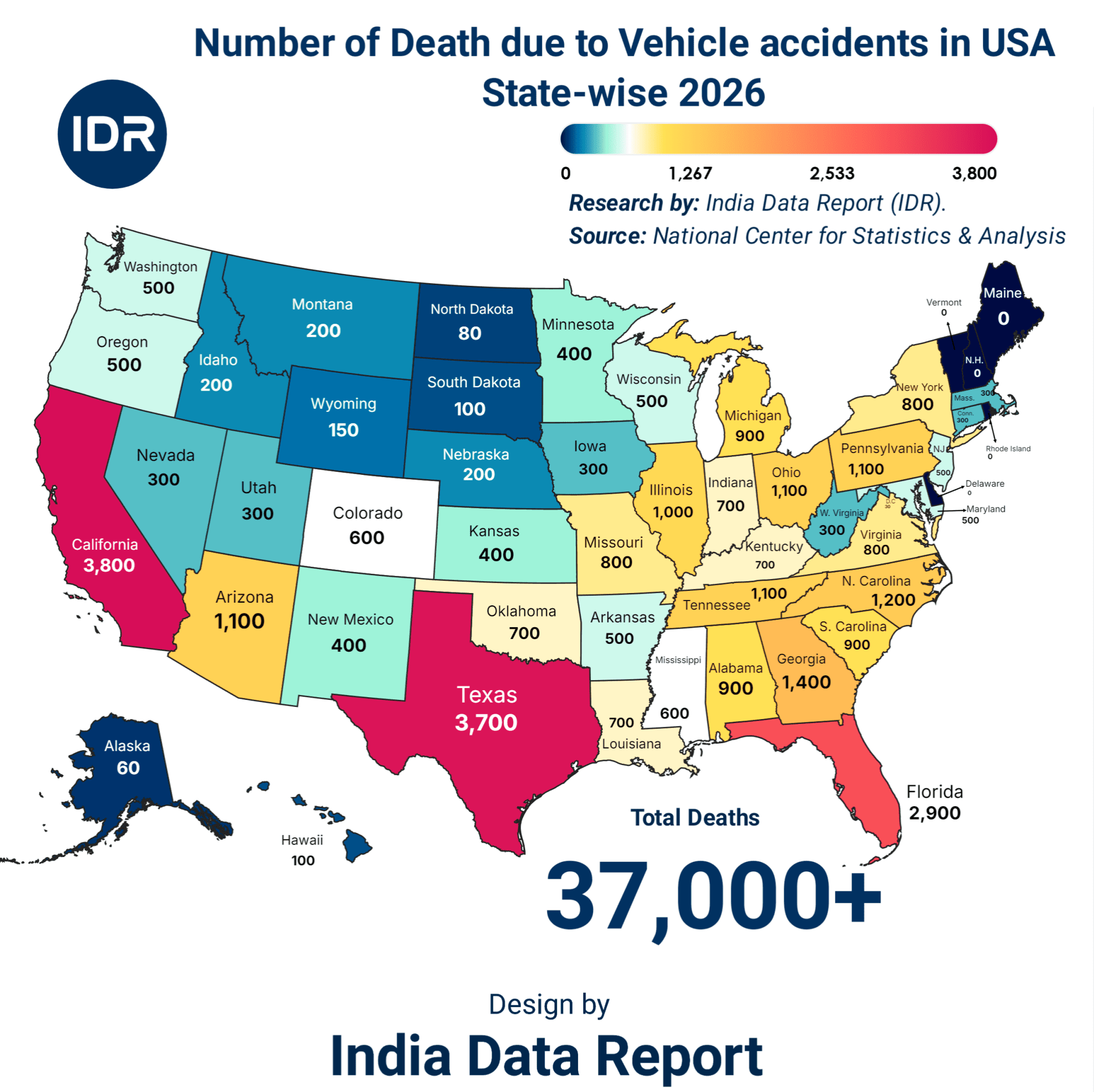
| S.N. | State | Deaths |
|---|---|---|
| 1 | California | 3,800 |
| 2 | Texas | 3,700 |
| 3 | Florida | 2,900 |
| 4 | Georgia | 1,400 |
| 5 | North Carolina | 1,200 |
| 6 | Ohio | 1,100 |
| 7 | Pennsylvania | 1,100 |
| 8 | Tennessee | 1,100 |
| 9 | Arizona | 1,100 |
| 10 | Illinois | 1,000 |
| 11 | South Carolina | 900 |
| 12 | Michigan | 900 |
| 13 | Alabama | 900 |
| 14 | Virginia | 800 |
| 15 | Missouri | 800 |
| 16 | New York | 800 |
| 17 | Indiana | 700 |
| 18 | Kentucky | 700 |
| 19 | Oklahoma | 700 |
| 20 | Louisiana | 700 |
| 21 | Colorado | 600 |
| 22 | Mississippi | 600 |
| 23 | Wisconsin | 500 |
| 24 | Washington | 500 |
| 25 | Oregon | 500 |
| 26 | Arkansas | 500 |
| 27 | Minnesota | 400 |
| 28 | Kansas | 400 |
| 29 | New Mexico | 400 |
| 30 | Iowa | 300 |
| 31 | Utah | 300 |
| 32 | Nevada | 300 |
| 33 | West Virginia | 300 |
| 34 | Nebraska | 200 |
| 35 | Montana | 200 |
| 36 | Idaho | 200 |
| 37 | Wyoming | 150 |
| 38 | South Dakota | 100 |
| 39 | Hawaii | 100 |
| 40 | North Dakota | 80 |
| 41 | Alaska | 60 |
| 42 | Vermont | 0 |
| 43 | Maine | 0 |
| 44 | New Hampshire | 0 |
| 45 | Delaware | 0 |
| 46 | Maryland | 500 |
| 47 | New Jersey | 600 |
| 48 | Massachusetts | 300 |
| 49 | Connecticut | 200 |
| 50 | Rhode Island | 50 |
We’ve been lied to. For decades, the narrative fed to the American public has been one of progress, safety ratings, and “smart” infrastructure. Yet, as we sit here in February 2026, the numbers tell a story not of advancement, but of a brutal, systemic failure. 37,000 Americans. That’s not just a statistic; it’s the equivalent of a mid-sized town being wiped off the map every single year.
While tech giants boast about autonomous driving and “zero-emission” futures, the cold, hard reality is bleeding out on the interstates of Texas and the sun-drenched boulevards of Florida. We are participating in a silent massacre, and we’ve become so desensitized to it that these deaths are treated as a rounding error in the Department of Transportation’s annual budget. If 37,000 people died this year due to a faulty toaster or a new brand of soda, there would be riots. But because it happens behind a steering wheel, we call it an “accident.”
Let’s get one thing straight: an “accident” implies it couldn’t be helped. When California clocks in at 3,800 deaths and Texas follows with 3,700, that’s not bad luck. That’s a design choice.
The 2026 data reveals a disturbing concentration of carnage. The “Big Three”—California, Texas, and Florida—account for nearly 30% of the nation’s total fatalities. We see a direct correlation between sprawling urban design and the frequency of fatal impacts. These states haven’t built transport systems; they’ve built high-speed conveyor belts for human tragedy.
Look at the table below. This is the hierarchy of risk you step into every time you turn the ignition.
| State | 2026 Fatalities | Primary Contributing Factor (Economic/Social) |
| California | 3,800 | High-density congestion vs. aging freeway infrastructure |
| Texas | 3,700 | Massive highway sprawl & heavy freight-passenger mix |
| Florida | 2,900 | High pedestrian vulnerability & aging driver demographic |
| Georgia | 1,400 | Rapid suburban growth outpacing safety updates |
| North Carolina | 1,200 | Rural road neglected funding & higher speed limits |
Bitter Truth: The “Sun Belt” has become the “Death Belt.” Rapid population migration to the South and West has prioritized building roads fast over building them safe.
We are told that cars are safer than ever. We have lane-assist, automatic braking, and more airbags than passengers. So why is the body count still hovering at levels that would be unacceptable in any other industry?
The answer lies in the Kinetic Arms Race. Manufacturers are making SUVs and trucks heavier and taller. While the person inside the 6,000-pound electric humvee might feel safe, the person in the sedan—or the pedestrian on the corner—stands no chance. We’ve traded collective safety for individual armor. This isn’t safety; it’s a zero-sum game played with human lives.
| Region | Total Deaths (Est.) | Economic Cost ($ Billions) |
| West Coast | 5,000+ | $45.2 |
| The South | 12,000+ | $108.7 |
| Midwest | 7,000+ | $62.1 |
| Northeast | 2,800+ | $24.9 |
Golden Opportunity: For the insurance and tech sectors, these numbers are a goldmine for “Risk Premium” adjustments. For the taxpayer, it’s a $300 billion annual drain on the economy in lost productivity and healthcare costs.
We see states like Vermont, Maine, and New Hampshire reporting zero deaths. Is it just lower population? No. It’s a difference in the philosophy of movement. In the Northeast, movement is often a chore; in the South and West, it’s a high-speed requirement for survival. When you force a population to drive 40 miles at 80 mph just to buy a gallon of milk, you aren’t providing “freedom”—you’re gambling with their lives.
The psychology here is fascinating and dark. We fear shark attacks (fatalities: nearly zero) and airplane crashes (fatalities: statistically negligible), yet we comfortably check our emails while hurtling down a Texas highway at 85 mph. We have outsourced our survival instincts to sensors that aren’t half as smart as the marketing suggests.
Are we witnessing the peak of human-driven transport, or are we just watching a slow-motion collapse of the American road dream? By 2030, the “Vision Zero” targets set by many of these states will look like a cruel joke unless we confront the reality: our economy is literally fueled by the risk of these 37,000 lives.
The modern American road isn’t a public utility; it’s a Darwinian battlefield. We’ve entered an era where safety is marketed as a luxury good—if you can afford a $80,000 armored EV, you might survive a T-bone collision. If you’re driving a 2012 subcompact because that’s what your budget allows, you are essentially “acceptable collateral” in the eyes of automotive engineers.
The psychological shift is terrifying. We no longer drive to get from point A to B; we drive to survive the other guy. This “Kinetic Arms Race” is the silent driver behind the 37,000 corpses. When a 7,000-pound SUV with a “pedestrian detection system” hits a mother in a crosswalk because the software lagged for 0.4 seconds, the industry calls it a “limit case.” I call it a failure of human morality. We have prioritized the comfort of the driver over the life of the bystander.
Let’s talk about the “SUV Loophole.” For decades, manufacturers have pushed larger vehicles because the profit margins are astronomical compared to sedans. These “Light Trucks” are exempt from the more stringent safety and fuel standards that apply to cars. The result? Our streets are flooded with vehicles whose hoods are at the eye-level of a ten-year-old child.
| Vehicle Type | Fatalities per 100k Reg. | Average Curb Weight | Economic Profit Margin |
| Heavy SUVs/Trucks | High (for others) | 5,500+ lbs | 15-22% |
| Mid-size Sedans | Moderate | 3,400 lbs | 5-8% |
| Compact Cars | High (for occupants) | 2,800 lbs | 2-4% |
| Electric Trucks | TBD (Massive Risk) | 6,500+ lbs | High/Incentivized |
Bitter Truth: The “Safety Ratings” you see on stickers are mostly about protecting the occupant. There is no federal star rating for how effectively a car avoids killing someone outside of it.
In the industrial heartland, the numbers tell a story of aging infrastructure meeting high-speed desperation. Illinois (1,000 deaths) and Michigan (900 deaths) are prime examples of “Infrastructure Fatigue.” These roads were built for the traffic of 1980, not the high-torque, high-speed reality of 2026.
Look at the breakdown of these “Mid-Major” states. The common denominator isn’t just driver error; it’s the lethal combination of heavy freight traffic and crumbling asphalt.
| State | 2026 Fatalities | Freight Volume Index | Road Quality Rating (D-F) |
| Ohio | 1,100 | Very High | 42% failing |
| Illinois | 1,000 | Critical Hub | 38% substandard |
| Michigan | 900 | High | 45% critical |
| Indiana | 700 | Transit Corridor | 30% aging |
Golden Opportunity: There is a $1.2 Trillion infrastructure gap. The “Opportunity” isn’t just in paving roads; it’s in the massive shift toward V2X (Vehicle-to-Everything) communication. If the road can talk to the car, the human doesn’t have to be perfect.
We love to blame drunk driving. It’s an easy villain. But the 2026 data suggests a more insidious culprit: Digital Inebriation. We are more “connected” and less focused than at any point in human history. The dopamine hit of a notification is now deadlier than a shot of whiskey.
A driver traveling at 65 mph covers a football field in the time it takes to “just check” a text. In states like Tennessee and Arizona (1,100 deaths each), where long, straight highways invite a false sense of security, the “distraction death toll” is skyrocketing. We’ve turned our cockpits into mobile offices and entertainment centers, then we act surprised when the physics of a 2-ton object moving at 90 feet per second catches up to us.
Why do more safety features sometimes lead to more deaths? It’s called Risk Compensation. When a driver feels “saved” by lane-keeping assist and adaptive cruise control, they subconsciously take more risks. They look at their phones longer. They drive faster in the rain. They outsource their vigilance to a sensor that can be blinded by a simple mud splash or a heavy downpour.
We are building a generation of drivers who don’t know how to drive; they only know how to supervise a machine. And as the 37,000 deaths prove, humans are terrible supervisors. We are easily bored, easily distracted, and far too confident in a technology that is still, at its core, a beta test on public soil.
The blood on the pavement in Alabama and Virginia isn’t just oil and water; it’s the price of our collective refusal to acknowledge that speed and “connectivity” are a lethal cocktail. We aren’t moving toward a safer future; we are just accelerating toward a more high-tech disaster.
Let’s stop being polite. We treat these 37,000 deaths as a tragedy, but for a massive segment of the American economy, they are a revenue stream. If the roads suddenly became 100% safe tomorrow, billions of dollars in GDP would vanish overnight. This is the “Death Economy,” a morbid cycle of consumption where the destruction of life and property fuels a massive industrial complex. From the predatory “ambulance chaser” law firms to the high-interest predatory lenders replacing totaled vehicles, the “accident” is actually a transaction.
The economic fallout of a single fatal crash in 2026 isn’t just the loss of a life; it’s a ripple effect that touches everything from healthcare premiums to local government budgets. When 900 people die in Alabama, the state doesn’t just lose citizens; it loses decades of tax revenue, productivity, and human potential. Yet, we rarely see this on the balance sheet.
When a vehicle is totaled and a life is lost, money starts moving. Insurance companies use these statistics to justify double-digit premium hikes across entire zip codes, punishing the “safe” drivers for the systemic failures of the state.
| The ‘Cost’ Component | Per Fatality (Avg. 2026) | Economic Beneficiary |
| Emergency Response/Medical | $120,000 – $450,000 | Healthcare Systems/Private EMS |
| Legal & Administrative | $200,000 – $1.2M | Litigation Firms/Court Systems |
| Property Damage/Replacement | $45,000 – $90,000 | Auto Manufacturers/Lenders |
| Lost Productivity | $1.8M – $3.5M | (Net Loss to Society) |
Bitter Truth: We have built a system where it is often more profitable to “manage” the death rate through insurance and litigation than to “eliminate” it through radical infrastructure redesign.
Look at the numbers for the Deep South. Mississippi (600), Oklahoma (700), and Louisiana (700) might seem “low” compared to California, but when adjusted for population and miles driven, these are some of the deadliest zones in the developed world. Here, the “Death Economy” is driven by a lack of choice. There is zero public transit. There is no “work from home” for the blue-collar backbone of these states.
In these regions, the car isn’t a symbol of freedom; it’s a mandatory high-risk tax on survival.
| State | Deaths | Death Rate (Per 100M Miles) | Infrastructure Grade |
| Mississippi | 600 | 1.85 (Critical) | F |
| Louisiana | 700 | 1.62 (Extreme) | D- |
| Oklahoma | 700 | 1.55 (High) | D+ |
| Arkansas | 500 | 1.48 (High) | D |
Golden Opportunity: There is a massive opening for Telematics-based Insurance. Companies that can accurately predict and nudge driver behavior in high-risk rural corridors will own the market, but at the cost of total driver surveillance.
Have you noticed your insurance rates climbing even if you haven’t had a ticket in ten years? You are paying the “Sprawl Tax.” Because Texas and Florida refuse to invest in rail or density, the sheer volume of “kinetic energy” on their roads is at an all-time high.
Insurance companies in 2026 aren’t just selling “protection”; they are selling “Risk Mitigation.” They know that the 37,000 deaths are a constant. They’ve priced it in. They aren’t interested in safer roads; they are interested in more accurate actuarial tables. The more data they have on your “near misses,” the more they can squeeze you. They are the only ones who truly win when the 37,000 die, because fear is the greatest sales tool ever invented.
We’ve become a nation of “Risk Junkies” who don’t even realize we’re hooked. We accept the death of 37,000 peers as the price of a 15-minute commute. This is a profound psychological surrender. We have decided that our time is worth more than our neighbor’s life.
Every time a politician stands up and says we “can’t afford” better public transit or safer street designs, they are making a cold economic calculation: It is cheaper to let them die and let the insurance companies handle the mess. This isn’t an “accident” problem; it’s a “valuation” problem. We have valued the speed of the machine over the durability of the human.
The 2026 data shows that the “safety” of our modern world is a thin veneer. Underneath, it’s just a high-speed slaughterhouse with a very efficient billing department.
As we look toward the 2030 horizon, the tech evangelists from Silicon Valley are preaching a new gospel: the “End of the Accident.” They promise a world where AI-driven fleets eliminate human error, turning our highways into synchronized ballets of efficiency. But let’s cut through the marketing fluff. If we continue on our current trajectory, 2030 won’t be a utopia; it will be a digital panopticon where safety is just a subscription service you can’t afford to cancel.
The transition period—the next four years—is the “Killing Zone.” We are currently mixing 1990s “dumb” cars with 2026 “semi-autonomous” beta tests. This hybrid mess is exactly why states like Arizona (1,100 deaths) and Nevada (300 deaths) are seeing plateauing numbers instead of the promised decline. You cannot have a “predictable” algorithm sharing the road with a frustrated human driver who just lost their job to that very same algorithm.
By 2030, the “Trolley Problem” won’t be a philosophical exercise; it will be written into the firmware of your sedan. If a car has to choose between hitting a group of school children or swerving into a concrete barrier that kills the owner, who do you think the manufacturer is going to protect? The buyer. We are moving toward a world where “safety” is a tiered system based on your credit score.
| Technology Era | Projected Deaths (2030) | Primary Failure Mode | Human Role |
| The Analog Era (Pre-2010) | 32,000 | Mechanical/Drunk Driving | Sole Operator |
| The Hybrid Mess (2020-2026) | 37,000+ | Distraction/System Over-reliance | Confused Supervisor |
| The ‘AI’ Horizon (2030) | 28,000* | Software Glitch/Sensor Blindness | Passive Passenger |
| The Elite Tier (Post-2035) | <10,000 | Infrastructure Cyber-Attack | Cargo |
Bitter Truth: Automation won’t solve the “Death Belt” problem in Texas or Florida. It will simply shift the liability from the driver’s insurance to the manufacturer’s legal department—who have much deeper pockets to bury the truth.
While the South bleeds, the Northeast offers a glimpse of a different future. New York (800) and New Jersey (600) have massive populations but lower fatality rates per capita than the “empty” states like Montana (200) or Wyoming (150). Why? Because in New York, speed is a physical impossibility.
Congestion, as much as we hate it, is a life-saver. When you are stuck in a gridlock on the George Washington Bridge, you aren’t dying in a high-speed rollover. The “Vision 2030” for safe cities isn’t faster cars; it’s slower streets.
| State | Deaths | Population Density | 2030 Risk Forecast |
| New York | 800 | Very High | Decreasing (Pedestrian focus) |
| New Jersey | 600 | Highest | Stable (Transit-dependent) |
| Maryland | 500 | High | Increasing (Suburban sprawl) |
| Massachusetts | 300 | High | Lowest (Policy-driven safety) |
Golden Opportunity: The real money in 2030 isn’t in “Self-Driving Cars.” It’s in Micro-Mobility and Smart Curb Management. Investors who bet on making cities “un-driveable” for cars but “hyper-mobile” for humans will see the 1000% returns.
The truth about 2030 is that we will have a two-tier safety system. The wealthy will commute in “Cocoon Pods” that communicate with the road, virtually eliminating the risk of impact. The rest of the “37,000” will be the gig-workers, the delivery drivers, and the rural poor driving aging, “un-connected” vehicles on roads that haven’t seen a paving crew since the 2010s.
We aren’t solving the massacre; we are just sequestering it. We are building a future where your “Safety Rating” is as visible as your license plate. If you think the “Death Economy” is brutal now, wait until your car refuses to start because you haven’t paid for the “Advanced Pedestrian Avoidance” monthly update.
The blood on the road in 2030 will be just as red, but the liability will be much harder to pin down. We are trading human error for systemic tyranny, and we’re doing it with a smile because we’re tired of the 37,000. But make no mistake: the machine doesn’t care about your life—it only cares about the data point you leave behind.
We’ve dissected the data, followed the money, and peeked behind the curtain of the “Autonomous Future.” Now, let’s get to the cold, hard truth that no politician or CEO has the spine to tell you: 37,000 deaths is a choice. We have collectively decided that the convenience of a 70-mph lifestyle is worth the sacrifice of a small city every twelve months. This is the “Social Contract of the Asphalt,” and we’ve all signed it in blood.
As an investigative journalist who has spent years staring into the abyss of corporate statistics, I see a 2030 that doesn’t look like a sci-fi movie. It looks like a fragmented, high-stakes gamble.
The Rise of the ‘Safety Subscription’: By 2028, basic safety features like emergency braking and blind-spot monitoring will be “software-locked.” If you don’t pay the monthly $29.99 fee, your car will intentionally be less safe. Safety will become the ultimate class signifier.
The Great Insurance Pivot: Traditional insurance will die. By 2029, companies like Tesla and Waymo will be your insurers. They will use your real-time “Safety Score” to adjust your rates every minute. One hard brake in a Texas thunderstorm? Your premium just tripled for the next hour.
The Rural Sacrifice Zone: Fatalities in states like Wyoming (150), Montana (200), and Kansas (400) will actually increase as urban centers get “smarter” and rural infrastructure continues to rot. The “Digital Divide” will become a “Survival Divide.”
The SUV Backlash: By 2030, we will see the first “Weight Tax” in states like California and New York. If your vehicle weighs over 5,000 lbs, you’ll pay a premium for the “lethal kinetic energy” you bring to the public road.
| Metric | 2026 Reality | 2030 Prediction | The ‘Why’ |
| National Fatality Count | 37,000+ | 31,500 | Tech helps, but sprawl hurts |
| Pedestrian Deaths | Record Highs | Rising | Cars are getting bigger/heavier |
| Average Insurance Premium | $2,100/yr | $3,800/yr | Liability shifting to “Data Risk” |
| Driver Autonomy | Level 2 (Partial) | Level 4 (Selective) | Humans become “Backup Systems” |
The system is rigged to treat you as a data point. The “Death Economy” doesn’t want you to drive less; it wants you to drive differently so it can collect more data and charge more fees. Whether you are navigating the chaotic freeways of California or the lonely roads of Vermont, the machine views your survival as an actuarial probability.
My Advice? Don’t wait for 2030. Don’t wait for a sensor to save you. We have outsourced our most basic survival instinct to corporations that prioritize “shareholder value” over human heartbeats. The only way to win a rigged game is to change how you play it.
Kadhwa Sach (Bitter Truth): In the next four years, the safest car you can buy isn’t the one with the most cameras; it’s the one you decide not to drive when the infrastructure is failing. We are obsessed with “smart cars,” but we are dying because of “stupid roads.”
Demand Accountability: Stop calling them “accidents.” Call them “system failures.” Hold your local DOT accountable for the “Death Belt” in your state.
Audit Your Tech: If your car has “driver assistance,” treat it like a drunk teenager. Supervise it constantly. It is not your savior; it is a tool that fails.
Vote with Your Feet: Support high-density, walkable transit. The only 100% effective way to avoid a 37,000-death statistic is to remove the 3,000-lb weapon from the equation.
The road to 2030 is paved with 37,000 reasons to wake up. We are at a crossroads: do we remain collateral damage in a corporate “mobility” experiment, or do we demand a world where getting to work isn’t a life-or-death gamble?
The choice, for now, is still yours. Don’t let the algorithm make it for you.
1. Why are U.S. vehicle deaths hitting 37,000 despite “safer” car technology?
It’s a “Kinetic Arms Race.” While cars have more sensors, they are also getting heavier and faster. A 6,000-lb SUV offers safety for the driver but acts as a lethal weapon against smaller cars and pedestrians. Combined with “digital inebriation” (phone distraction), the tech is failing to outpace human behavior and physics.
2. Which states are the deadliest to drive in according to the 2026 data?
The “Sun Belt” states—California (3,800), Texas (3,700), and Florida (2,900)—lead in total volume. However, rural states like Mississippi and Oklahoma often have higher death rates per mile driven due to aging infrastructure, lack of trauma centers, and high-speed rural transit requirements.
3. Is “Human Error” really the main cause of these accidents?
Calling it “human error” is a corporate deflection. Most of these deaths are systemic failures. When you design roads that encourage 80 mph speeds through residential or high-traffic zones, or force people into 40-mile commutes without transit options, you are designing for disaster. The “error” is in the infrastructure, not just the driver.
4. Will autonomous vehicles (AVs) eliminate these deaths by 2030?
Unlikely. We are entering the “Hybrid Killing Zone,” where predictable AI must share the road with unpredictable humans. While AVs may reduce certain types of crashes, they introduce new risks like software glitches and sensor blindness. True safety requires “Smart Roads,” not just “Smart Cars.”
5. How does the “Death Economy” profit from 37,000 fatalities?
Fatalities fuel a massive industrial cycle. Insurance companies use these stats to hike premiums for everyone, law firms generate billions in litigation, and the auto industry profits from the constant replacement of totaled vehicles. In a cold economic sense, a “safe” road is less profitable than a “managed” high-risk road.