NEW DELHI, INDIA (IST)
00:00:00 PM
|
Loading...
DETECTING LOCATION...
00:00:00 PM
|
Loading...
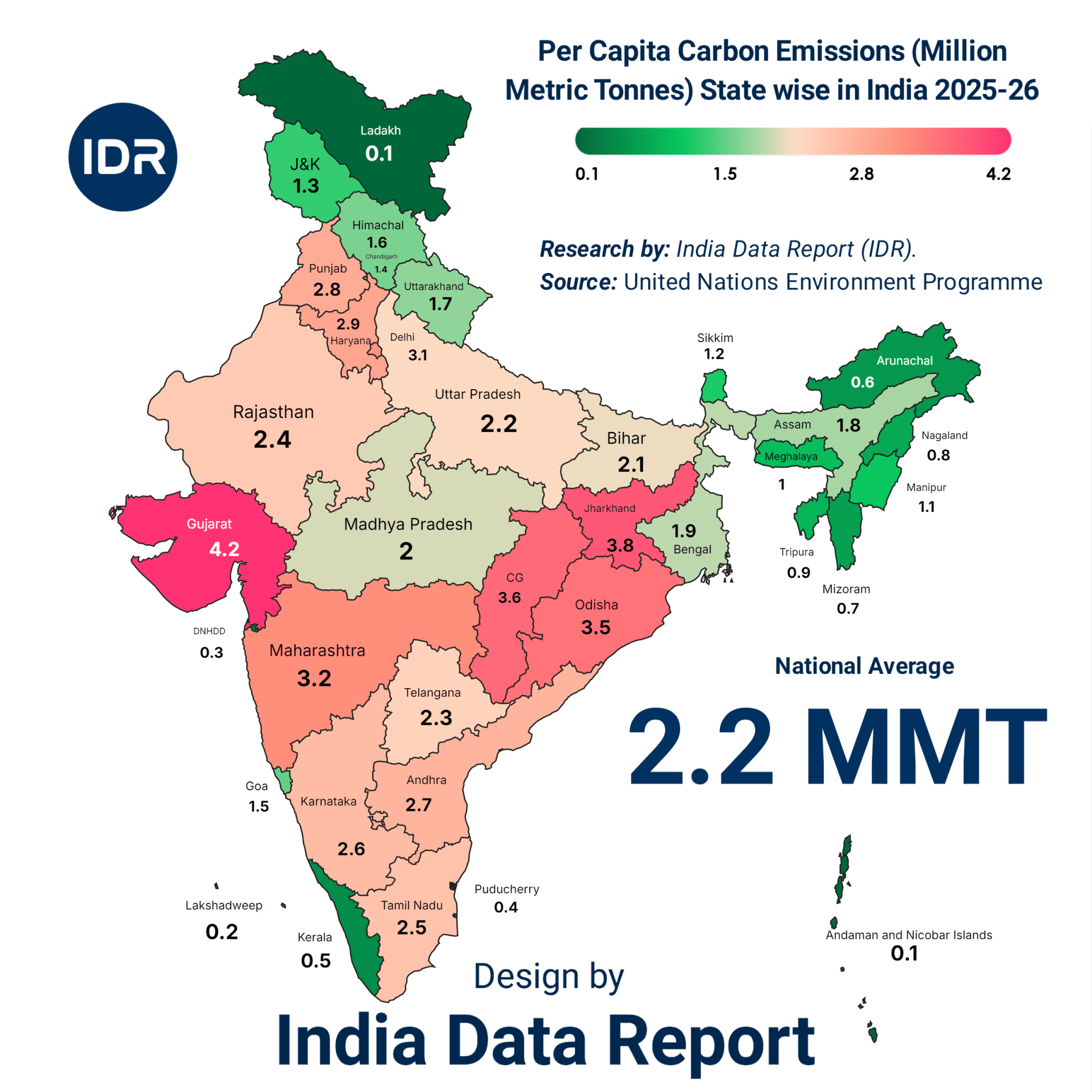
| S.N. | State / UT | Per Capita Emissions |
|---|---|---|
| 1 | Gujarat | 4.2 |
| 2 | Jharkhand | 3.8 |
| 3 | Chhattisgarh | 3.6 |
| 4 | Odisha | 3.5 |
| 5 | Maharashtra | 3.2 |
| 6 | Delhi | 3.1 |
| 7 | Haryana | 2.9 |
| 8 | Punjab | 2.8 |
| 9 | Andhra Pradesh | 2.7 |
| 10 | Karnataka | 2.6 |
| 11 | Tamil Nadu | 2.5 |
| 12 | Rajasthan | 2.4 |
| 13 | Telangana | 2.3 |
| 14 | Uttar Pradesh | 2.2 |
| 15 | Bihar | 2.1 |
| 16 | Madhya Pradesh | 2.0 |
| 17 | West Bengal | 1.9 |
| 18 | Assam | 1.8 |
| 19 | Uttarakhand | 1.7 |
| 20 | Himachal Pradesh | 1.6 |
| 21 | Goa | 1.5 |
| 22 | Jammu & Kashmir | 1.3 |
| 23 | Sikkim | 1.2 |
| 24 | Manipur | 1.1 |
| 25 | Meghalaya | 1.0 |
| 26 | Tripura | 0.9 |
| 27 | Nagaland | 0.8 |
| 28 | Mizoram | 0.7 |
| 29 | Arunachal Pradesh | 0.6 |
| 30 | Kerala | 0.5 |
| 31 | Puducherry | 0.4 |
| 32 | Dadra & Nagar Haveli and Daman & Diu (DNHDD) | 0.3 |
| 33 | Lakshadweep | 0.2 |
| 34 | Andaman & Nicobar Islands | 0.1 |
| 35 | Ladakh | 0.1 |
Let’s stop pretending. We are told that a rising tide lifts all boats, but in the case of India’s current economic trajectory, that tide is thick with industrial soot and carbon sludge. You’ve seen the glossy brochures of “Vibrant” states and “Industrial Hubs,” but the numbers I have on my desk tell a story of a nation cannibalizing its future for a momentary spike in the GDP graph. We aren’t just breathing air; we are inhaling the byproduct of an unholy marriage between desperate industrialization and archaic energy policies.
As we stand in 2026, the national average of 2.2 tonnes of $CO_2$ per capita looks “modest” on a global scale compared to the West. But that average is a lie. It is a statistical mask that hides a brutal internal disparity. While a farmer in Kerala or a shepherd in Ladakh lives a life that barely leaves a footprint, the industrial giants are stomping across the landscape like carbon-breathing behemoths.
Look at Gujarat. 4.22 tonnes per capita. That isn’t just a number; it’s an indictment. It is nearly double the national average. We are witnessing an economic model that treats the atmosphere as a free dumping ground for the sake of chemical and petrochemical dominance. Then look at the “Mineral Belt”—Jharkhand (3.8), Chhattisgarh (3.6), and Odisha (3.5). These states aren’t just powering India; they are being sacrificed. We extract the coal, we burn the carbon, and the local population pays the “respiratory tax” while the dividends flow to boardrooms in Mumbai and Delhi.
Is this development, or is it a slow-motion environmental suicide pact? The psychological toll is palpable. There is a “Carbon Anxiety” creeping into the middle class. People in Delhi (3.1) are buying air purifiers like they used to buy water filters two decades ago. We have normalized the idea that the air itself is a luxury item.
| State / Region | Per Capita Emissions (tCO2) | The “Growth” Narrative | The Harsh Reality |
| Gujarat | 4.22 | Global Industrial Hub | Environmental Debt Trap |
| Jharkhand | 3.80 | Powerhouse of India | Resource Curse Personified |
| Chhattisgarh | 3.60 | Energy Surplus State | Ecological Bankruptcy |
| Odisha | 3.50 | Mining Giant | Deforestation for Dollars |
| National Average | 2.20 | Sustainable Growth | A Statistical Illusion |
KADWA SACH (The Bitter Truth): India’s industrial “success” is currently subsidized by the lungs of its poorest citizens in the mineral belt. We are exporting carbon-heavy products and importing health crises.
The data reveals a terrifying pattern. The “richer” or more industrialized a state becomes under our current model, the more toxic it becomes. Maharashtra at 3.2 and Haryana at 2.9 are chasing the “Gujarat Model,” but at what cost? We are building smart cities in bubbles while the surrounding air becomes unbreathable.
On the flip side, look at the Northeast and Kerala. Kerala sits at 0.5. Is it because they are “behind”? Or have they found a way to exist without burning the house down to keep the stove lit? The irony is sharp enough to cut: the states with the lowest emissions are often the ones with the highest Human Development Indices (HDI). This proves that the “Carbon = Progress” equation is a fallacy pushed by lobbyists to avoid investing in expensive green transitions.
| State | Emissions (tCO2) | Lifestyle Archetype | Future Risk |
| Kerala | 0.5 | High Literacy, Low Carbon | Climate Vulnerability (Floods) |
| Arunachal | 0.6 | The Green Lung | Infrastructure Encroachment |
| Ladakh | 0.1 | The Pristine Frontier | Over-tourism & Warming |
| Delhi | 3.1 | The Urban Gas Chamber | Chronic Health Collapse |
SUNHARA AVSAR (The Golden Opportunity): The states at the bottom of this list aren’t “underdeveloped”—they are our blueprints for survival. If we can marry Kerala’s footprint with Karnataka’s (2.6) innovation, we might actually have a shot at a future that doesn’t involve oxygen tanks as a fashion accessory.
We are at a crossroads where greed meets gravity. The atmosphere doesn’t care about your quarterly earnings or your state-level MoUs. It only cares about the total mass of carbon being pumped into it. By 2030, if Gujarat hits 5.0 and the rest follow, no amount of GDP growth will be able to buy back a stable monsoon or a healthy workforce.
Are we ready to talk about the “Carbon Cess” on industrial giants, or are we going to keep pretending that 2.2 is a “safe” number? The data is screaming. Most people are just too busy coughing to hear it.
Let’s pull back the curtain. If you think the shift to “Green Energy” is being driven by some sudden moral awakening in India’s corporate boardrooms, you’re more than naive—you’re a target. The truth is far more cynical. The surge in emissions in states like Maharashtra (3.2) and Tamil Nadu (2.5) isn’t just a byproduct of “making things”; it is the result of a calculated delay. We are witnessing a strategic “Carbon Grabbing” phase where industries are pumping out as much as possible before the 2030 regulatory hammer falls.
The psychological game being played on you, the Indian citizen, is masterful. While high-per-capita states like Punjab (2.8) and Haryana (2.9) boast about agricultural productivity, they are drowning in the carbon debt of a fossil-fuel-dependent irrigation and logistics machine. They give you the “Green Revolution” labels, but the data shows a “Grey Reality.” We’ve traded the health of the soil and the air for a short-term yield that is now plateauing.
Look at the data again. Karnataka (2.6) and Telangana (2.3) are the darlings of the IT world. They present themselves as clean, tech-driven, and “future-ready.” But look at their per capita numbers. They are higher than the national average. Why? Because a server farm in Bangalore or a pharma plant in Hyderabad drinks electricity like a thirsty camel, and that electricity is still largely coming from the coal fires of Jharkhand and Chhattisgarh.
This is “Carbon Outsourcing.” The tech elite keep their offices air-conditioned and their air “clean,” while the thermal plants in the East belch out the 3.8 tonnes of $CO_2$ that make those “clean” jobs possible. It’s a classic master-servant dynamic disguised as a national grid.
| State | Per Capita CO2 | The “Clean” Image | The Hidden Power Source |
| Karnataka | 2.6 | Silicon Valley of India | Coal-heavy Inter-state Grid |
| Telangana | 2.3 | Pharma & Tech Hub | Thermal Power Dominance |
| Tamil Nadu | 2.5 | Manufacturing Giant | Lignite and Coal Dependency |
| Andhra | 2.7 | Infrastructure Leader | Coastal Thermal Clusters |
KADWA SACH (The Bitter Truth): Your “zero-emission” electric vehicle in Delhi or Bangalore is actually a “Coal-Powered Vehicle” whose exhaust pipe is located in a village in Odisha. We haven’t eliminated pollution; we’ve just moved it to where the poor live.
Why is there no massive public outcry when Bihar (2.1) and Uttar Pradesh (2.2)—states with massive populations—are inching closer to the national average despite having lower industrial density? It’s because of the “Aspiration Trap.” In these states, carbon is seen as a sign of life. A smoking chimney is a sign of a job. A diesel generator is a sign of a business staying open.
The human mind is hardwired to prioritize today’s hunger over tomorrow’s asthma. The strategist in me sees this as a ticking time bomb. When the “Aspirant States” (UP, Bihar, MP) decide they want the per-capita lifestyle of a Gujarati (4.22), the Indian carbon footprint won’t just grow; it will explode. We are sitting on a demographic pressure cooker fueled by carbon dreams.
| Metric | High Emission States (Top 5) | Low Emission States (Bottom 5) | The Disconnect |
| Avg. $CO_2$ | 3.68 $tCO_2$ | 0.22 $tCO_2$ | A 16x Wealth/Waste Gap |
| Energy Source | 80% Coal/Gas | Hydro/Manual/Solar | The “Poverty is Green” Myth |
| Health Spend | High (Respiratory) | Moderate (Infectious) | Carbon kills differently |
SUNHARA AVSAR (The Golden Opportunity): If India can leapfrog the “Gujarat Model” and move straight to a decentralized solar/wind grid for the Uttar Pradesh-Bihar belt, we can break the link between “Development” and “Destruction.” But that requires defeating the Coal Lobby, which has its hands deep in the pockets of our policy-makers.
The Senior Economic Strategist in me knows that money follows the path of least resistance. Currently, it is cheaper to pollute and pay a small fine than it is to innovate. This is the “Lobbyist’s Dividend.” They tell you that strict environmental laws will “kill jobs.” I tell you that the carbon levels in West Bengal (1.9) and Assam (1.8) are only low because of economic stagnation, not because of a plan.
Is the choice really between “Poor and Clean” or “Rich and Filthy”? That is the false binary sold to us by the elite. We are being gaslit into believing that soot is the smell of progress. It’s not. It’s the smell of a system that has run out of ideas and is now just burning the furniture to keep the lights on.
Let’s stop the polite applause for our “climate targets.” As a strategist, I look at the trajectory from Rajasthan (2.4) to Gujarat (4.22) and I don’t see progress—I see a geopolitical trap. While we pat ourselves on the back for being “better than the Americans” on a per-capita basis, the world is preparing to punish us. By 2030, “Carbon Border Taxes” won’t be a theory; they will be a financial guillotine. If your product is made in a state with a 3.0+ carbon footprint, it will be dead on arrival in the global market.
The psychology here is one of “Wilful Blindness.” We are building factories today that will be “stranded assets” tomorrow. We are pouring capital into a 20th-century energy model while the rest of the world is weaponizing the environment. If India doesn’t pivot, we aren’t just losing our breath; we are losing our seat at the high table of global trade.
Look at Odisha (3.5) and Chhattisgarh (3.6). These states are doubling down on coal. By 2030, as global capital flees “dirty” investments, these regions risk becoming the “Rust Belts” of Asia. The greed of today is creating the ghost towns of tomorrow. The “Resource Curse” is shifting from the ground to the air.
We see the fear in the eyes of the youth in Delhi (3.1) and Maharashtra (3.2). They aren’t just worried about “global warming” in the abstract; they are worried about their insurance premiums and their medical bills. We are creating a “Carbon Underclass”—people who work in high-emission industries but can’t afford the healthcare to survive them.
| State / UT | 2026 Emission (tCO2) | 2030 Projected (Business as Usual) | Geopolitical Risk Level |
| Gujarat | 4.22 | 5.15 | Critical: Export Bans Likely |
| Jharkhand | 3.80 | 4.40 | High: Investment Flight |
| Tamil Nadu | 2.50 | 3.10 | Moderate: Supply Chain Friction |
| Bihar | 2.10 | 2.95 | High: Rapid Unregulated Growth |
KADWA SACH (The Bitter Truth): Our “cheap labor” advantage is being wiped out by our “dirty energy” disadvantage. Soon, “Made in India” will mean “Taxed at the Border” unless we scrub the carbon out of our soul.
Why are Goa (1.5), Himachal (1.6), and Uttarakhand (1.7) keeping their heads above water? It’s not just geography; it’s a survival instinct. These states realize that their “Brand” is their purity. They are the only ones playing the long game. The rest of India is playing a high-stakes poker game with a deck that’s already on fire.
The investigative journalist in me has followed the money. The subsidies being poured into fossil fuels in the Punjab-Haryana belt (2.8-2.9) could have retrofitted every farm with solar-powered micro-grids twice over. Why wasn’t it done? Because you can’t put a meter on the sun as easily as you can on a coal shipment. This isn’t a technical failure; it’s a failure of “Political Will” versus “Corporate Greed.”
| Category | The “Waste” Economy (High Carbon) | The “Wealth” Economy (Low Carbon) | The Strategic Shift |
| Investment Focus | Heavy Industry / Coal | Services / Precision Mfg / RE | Capital is moving to “Clean” |
| Workforce | Vulnerable / Manual | Tech-enabled / Sustainable | Health = Productivity |
| Global Appeal | Low (Sanction Risk) | High (ESG Compliant) | The 2030 Market Reality |
SUNHARA AVSAR (The Golden Opportunity): If India mandates a “Carbon Transparency Score” for every product, states like Kerala (0.5) and Sikkim (1.2) will suddenly become the most attractive investment destinations in the country. We need to stop rewarding waste and start pricing it.
For decades, we’ve used the “Developing Nation” excuse to avoid hard choices. But in 2026, that shield is cracking. When Madhya Pradesh (2.0) and West Bengal (1.9) start feeling the heat—literally—the “Right to Pollute” will feel like a “Right to Drown.”
We are obsessed with “Per Capita” because it makes us feel small and innocent. But the atmosphere only cares about the “Total Load.” If 1.4 billion people each add just a “small” amount of 2.2 tonnes, the math leads to a global catastrophe. We are a “Carbon Superpower” whether we like it or not. The question is: will we use that power to lead the green revolution, or will we be the last ones clutching a lump of coal as the ship goes down?
We need to talk about the “Biological Debt” that nobody is putting on the balance sheet. As an Economic Strategist, I see a terrifying trend: the “Great Carbon Flight.” We are witnessing a silent, desperate migration. The wealthy in Delhi (3.1) and Maharashtra (3.2) are buying villas in Goa (1.5) and Uttarakhand (1.7), not for the view, but for the oxygen. This isn’t just “vacationing”; it is the beginning of Environmental Apartheid.
The psychology of greed has blinded us to the “Health-Wealth Correlation.” We think we are getting rich in the North and West, but we are simply liquidating our health to pay for our lifestyle. A child born in Gujarat (4.22) today starts life with a “Carbon Tax” already levied on their lungs. This is the ultimate betrayal—selling the next generation’s vitality to inflate this year’s industrial output.
Look at the numbers. There is a direct, agonizing link between high emissions and the “Invisible Costs” of doing business. In states like Punjab (2.8) and Haryana (2.9), the cost of respiratory illness is now eating up a significant portion of household savings. We are earning in rupees but paying in life expectancy.
| State Category | Avg. Emission (tCO2) | Workforce “Down-Time” | Long-term Economic Impact |
| The Smog Belt (DL, HR, PB, GJ) | 3.25 | High (Pollution Holidays) | Brain Drain to “Cleaner” Nations |
| The Survival Belt (UP, BR, MP) | 2.10 | Rising (Heat Stress) | Decreased Labor Productivity |
| The Green Haven (KL, SK, AR) | 0.76 | Low | High Potential for “Wellness” Economy |
KADWA SACH (The Bitter Truth): We are creating two Indias. One India that produces carbon and dies young, and another India that consumes the products and flees to the hills to escape the consequences. This is not a sustainable Republic; it’s a biological caste system.
Let’s dismantle the “victim” narrative in Jharkhand (3.8) and Odisha (3.5). The local elites in these states often argue that they must pollute to “catch up.” But who is catching up? The data shows that the per capita emission is high, but the per capita income in these regions remains stagnant.
This is Carbon Exploitation. The emissions are credited to the state, the profits are credited to multinational conglomerates, and the “Black Lung” is credited to the local tribal population. It is a colonial model of extraction dressed up in the language of “National Interest.” Why is Chhattisgarh (3.6) among the highest emitters while its people remain among the poorest? Because we are burning their future to power someone else’s “Smart City.”
By 2030, we won’t just have “Climate Refugees” from rising seas; we will have “Carbon Refugees” from the plains. As Bihar (2.1) and Uttar Pradesh (2.2) industrialize without green safeguards, the sheer mass of people will have nowhere to breathe.
| State | 2026 Status | The Psychological Shift | The 2030 Crisis |
| West Bengal | 1.9 | Stagnation as “Safety” | Rapid, Dirty Industrialization Risk |
| Assam | 1.8 | Fragile Balance | Infrastructure vs. Ecology Battle |
| Kerala | 0.5 | The “Model” of Sanity | Overwhelmed by “Eco-Migrants” |
| Ladakh | 0.1 | The Purest Frontier | Melting Glaciers & Military Carbon |
SUNHARA AVSAR (The Golden Opportunity): Imagine a “Green Migration” policy. If India incentivizes industries to move to states with high renewable potential like Rajasthan (2.4)—but with a strict “Net Zero” mandate—we can balance the national load. We need to stop the concentration of poison in the “Industrial Cartels.”
I’ve sat in rooms where CEOs discuss “Sustainability Reports” while their plants in Andhra Pradesh (2.7) are running on the dirtiest coal available. They use “Average” numbers to hide “Local” disasters. They tell you that 2.2 tonnes is “nothing” compared to the US (14+ tonnes).
But here is what they don’t tell you: The US has the infrastructure to mitigate the damage. India doesn’t. When the heatwaves hit Rajasthan (2.4) or the floods hit Tamil Nadu (2.5), the carbon we emitted makes those disasters exponentially more expensive. We are essentially taking out a high-interest loan from the environment, and the “Interest Rates” (in the form of disasters) are about to skyrocket.
We are not just “navigating” a transition; we are in a street fight for the air we breathe. The question isn’t whether we can afford to go green. The question is: who gave these states the right to spend our lives to balance their books?
Let’s cut the fluff. The data for 2025–26 isn’t just a list of numbers; it’s a death warrant for the status quo. As a Senior Economic Strategist, I see the writing on the wall, and it’s written in soot. We are currently operating on a “Burn Now, Pay Later” philosophy, but the “Later” has just arrived at our doorstep.
The national average of 2.2 $tCO_2$ is a sedative. It lulls us into thinking we have “room to grow.” But look at the Gujarat-Jharkhand-Chhattisgarh axis. These states are already living in a 2040 nightmare. If the rest of India follows their lead to reach “developed” status, we won’t be a superpower; we will be a wasteland with a high GDP.
The Rise of “Carbon Protectionism”: By 2027, the EU and the US will impose “Green Tariffs.” Products from states like Gujarat (4.22) and Odisha (3.5) will face 20-30% extra duties. The “cheap labor” advantage will be officially dead, murdered by high carbon intensity.
The “Air-Quality” Brain Drain: We will see a massive talent migration. The brightest minds won’t just leave for better salaries; they will leave Delhi (3.1) and Maharashtra (3.2) for the “Lungs of India” (Kerala, Sikkim, Arunachal). Companies that don’t relocate to low-carbon zones will lose their best people.
The Real Estate Crash: Properties in high-emission, heat-stressed zones will see a valuation collapse. Who wants to buy a luxury penthouse in a city where you can’t go outside for four months of the year?
The Energy Civil War: States like Tamil Nadu (2.5) and Karnataka (2.6) will start demanding “Carbon Credits” from the central pool, leading to a new kind of federal friction. The “Green” states will refuse to subsidize the “Dirty” ones.
We are at the end of the “Extraction Era.” My analysis is cold and calculated: India must decouple growth from carbon immediately, or face a systemic heart attack.
| Future Path | The “Business as Usual” Disaster | The “Green Sovereign” Strategy |
| National Avg 2030 | 3.1 $tCO_2$ (Projected) | 1.8 $tCO_2$ (Target) |
| Economic Status | Isolated, Taxed, Sick | Global Green Manufacturing Hub |
| Social Stability | High Conflict (Resource Wars) | Equitable Growth (Decentralized) |
KADWA SACH (The Bitter Truth): If we continue to worship the “Gujarat Model” of 4.22 tonnes, we are essentially choosing to be a “Rich Corpse.” True economic genius lies in achieving Kerala’s 0.5 footprint with Maharashtra’s 3.2 industrial ambition.
You, the reader, the entrepreneur, the student—you are the ones paying the “Respiratory Tax.”
Demand Carbon Transparency: Every product you buy should list the carbon footprint of the state it was made in.
Invest in the “Bottom 10”: Look at the states with low emissions (Kerala, Mizoram, Goa). That is where the future of “Sustainable Luxury” and “Clean Tech” lies.
Audit the Giants: Don’t let corporations hide behind “National Averages.” Ask why their plant in Jharkhand is still killing the local air while their HQ in Mumbai talks about “ESG.”
SUNHARA AVSAR (The Golden Opportunity): India has the unique chance to be the first nation to modernize without a “Carbon Peak.” We can leapfrog the West’s mistakes. But we must stop treating our atmosphere like a sewer.
The era of “Ignorance is Bliss” is over. The data is out, the lungs are heavy, and the clock is ticking. You can either be a part of the transition or a casualty of the collapse. Choose wisely, because the environment doesn’t accept bribes, and it doesn’t care about your political “narratives.”
1. Why is Gujarat’s carbon footprint (4.22) nearly double the national average?
It is the “Price of the Powerhouse.” Gujarat’s economy is built on heavy, energy-intensive industries—petrochemicals, chemicals, and manufacturing. While it leads in GDP, it is currently the “Carbon Capital” of India. The state is essentially trading its air quality for industrial dominance, a model that will face massive global tax penalties by 2030.
2. Does a low emission score like Kerala’s (0.5) mean the state is “underdeveloped”?
Absolutely not. It means the state is “Human-Centric” rather than “Chimney-Centric.” Kerala, Sikkim (1.2), and Goa (1.5) prove that high literacy and quality of life don’t require burning coal. These states are the blueprints for a “Service and Wellness” economy that is immune to future international carbon sanctions.
3. Is my Electric Vehicle (EV) truly “Green” if I live in Delhi or Haryana?
Physically, yes; ethically, no. If you charge an EV in the North, the power likely comes from coal plants in Jharkhand (3.8) or Chhattisgarh (3.6). You aren’t eliminating pollution; you are just “outsourcing” it to the poorest citizens of the Eastern belt. True “Green” status only arrives when the grid itself is decarbonized.
4. Will these carbon numbers affect my personal bank account?
Yes, and sooner than you think. High-emission states are already seeing higher health insurance premiums and “hidden” costs in the form of respiratory healthcare. Furthermore, as “Carbon Border Taxes” hit Indian exports, jobs in high-carbon industries will become unstable. Carbon is no longer just an environmental issue; it is a financial risk.
5. Can India reach “Developed” status while keeping emissions at 2.2 $tCO_2$?
This is the billion-dollar question. If we follow the Western path, we will fail and choke. The only way forward is “Leapfrogging”—moving directly to decentralized solar, green hydrogen, and circular manufacturing. We have to prove that prosperity doesn’t have to smell like smoke.