NEW DELHI, INDIA (IST)
00:00:00 PM
|
Loading...
DETECTING LOCATION...
00:00:00 PM
|
Loading...
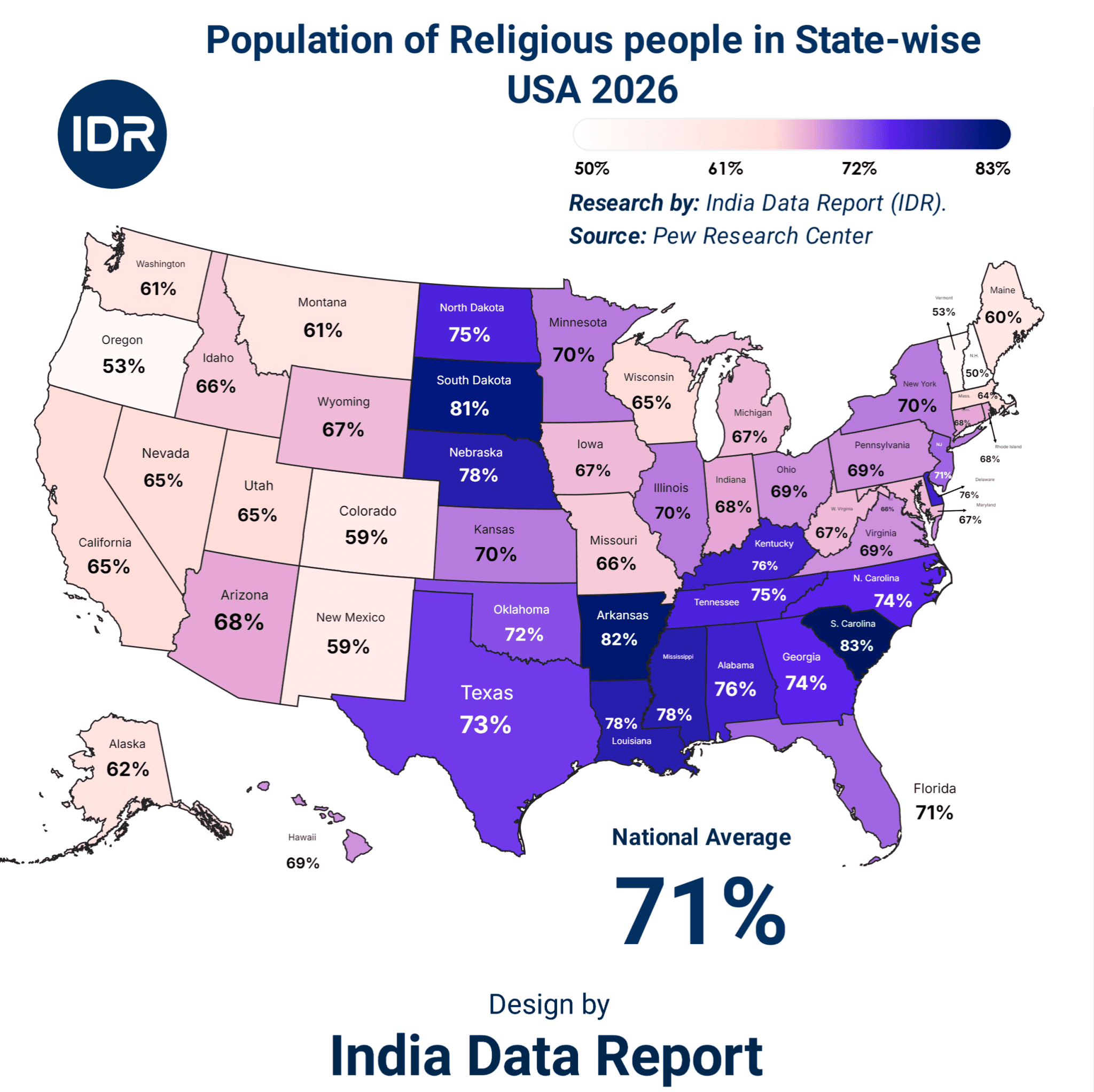
| S.N. | State | Religious Population (%) |
|---|---|---|
| 1 | Alabama | 76% |
| 2 | Alaska | 62% |
| 3 | Arizona | 68% |
| 4 | Arkansas | 82% |
| 5 | California | 65% |
| 6 | Colorado | 59% |
| 7 | Connecticut | 67% |
| 8 | Delaware | 68% |
| 9 | Florida | 71% |
| 10 | Georgia | 74% |
| 11 | Hawaii | 69% |
| 12 | Idaho | 66% |
| 13 | Illinois | 70% |
| 14 | Indiana | 68% |
| 15 | Iowa | 67% |
| 16 | Kansas | 70% |
| 17 | Kentucky | 76% |
| 18 | Louisiana | 78% |
| 19 | Maine | 60% |
| 20 | Maryland | 67% |
| 21 | Massachusetts | 57% |
| 22 | Michigan | 67% |
| 23 | Minnesota | 70% |
| 24 | Mississippi | 78% |
| 25 | Missouri | 66% |
| 26 | Montana | 61% |
| 27 | Nebraska | 78% |
| 28 | Nevada | 65% |
| 29 | New Hampshire | 53% |
| 30 | New Jersey | 66% |
| 31 | New Mexico | 59% |
| 32 | New York | 50% |
| 33 | North Carolina | 74% |
| 34 | North Dakota | 75% |
| 35 | Ohio | 69% |
| 36 | Oklahoma | 72% |
| 37 | Oregon | 53% |
| 38 | Pennsylvania | 69% |
| 39 | Rhode Island | 60% |
| 40 | South Carolina | 83% |
| 41 | South Dakota | 81% |
| 42 | Tennessee | 75% |
| 43 | Texas | 73% |
| 44 | Utah | 65% |
| 45 | Vermont | 54% |
| 46 | Virginia | 69% |
| 47 | Washington | 61% |
| 48 | West Virginia | 67% |
| 49 | Wisconsin | 65% |
| 50 | Wyoming | 67% |
Listen closely, because what you are about to read isn’t the sanitized corporate drivel fed to you by mainstream financial networks. They want you focused on the next Fed rate cut or the latest political circus. I’m here to pull back the curtain on the underlying pulse of the American machine.
As we sit in early 2026, the data from the Pew Research Center and the India Data Report presents a staggering reality: 71% of the United States identifies as religious. On paper, that looks like a bedrock of stability. In reality? It’s a pressure cooker of conflicting ideologies, economic desperation, and a demographic shift that is rewriting the rules of the global market.
We’ve been told that secularism is winning. The elite in New York and San Francisco—where religiosity sits at a measly 50% and 65% respectively—would have you believe that faith is a relic of the past. They are dead wrong. The “Bible Belt” isn’t just a cultural zone; it is the economic engine of the future, even if that engine is currently sputtering under the weight of inflation and forgotten promises.
The disconnect between “In God We Trust” and the current state of the U.S. Treasury is nothing short of comedic if it weren’t so tragic. We are looking at a nation where South Carolina (83%) and Arkansas (82%) lead in religious fervor, yet these are the very regions often hit hardest by the volatility of the globalized economy.
Why does this matter to you as an investor or a global citizen? Because human behavior is driven by belief systems, not just spreadsheets. When 71% of a superpower believes in a higher moral order, their spending habits, voting patterns, and risk tolerance differ fundamentally from a purely secular society.
| State | Religious Population (%) | Primary Economic Driver | Risk Factor |
| South Carolina | 83% | Manufacturing/Tourism | Wage Stagnation |
| Arkansas | 82% | Agriculture/Retail HQ | Rural Brain Drain |
| South Dakota | 81% | Financial Services/Agri | Climate Volatility |
| Alabama | 76% | Aerospace/Auto | Educational Gap |
Label: The Bitter Truth
High faith often correlates with “Old Economy” sectors. While these states provide the stability of the American workforce, they are the most vulnerable to AI-driven job displacement. The “Golden Opportunity” here lies in localized industrial resurgence, but only if the infrastructure catches up to the ideology.
Look at the bottom of the list. New York sits at 50%. New Hampshire at 53%. This isn’t just a “liberal vs. conservative” divide; it’s an existential economic split. The financial capital of the world (NYC) is operating on a purely transactional basis, while the vast majority of the country operates on a relational/communal basis.
When the next market crash hits—and make no mistake, the cracks are widening—the social cohesion in a 50% religious state like New York will crumble far faster than in a 75% religious state like Tennessee. Why? Because communal institutions (churches, temples, community centers) act as unofficial “social security” when the government fails.
In a secular hub, when the money stops, the city stops. In the heartland, when the money stops, the community steps in. This is the invisible safety net that Wall Street analysts are too blind to include in their models.
| State | Religious Population (%) | Economic Identity | Social Cohesion Rating |
| New York | 50% | Global Finance/Media | Critically Low |
| New Hampshire | 53% | Tech/Tourism | Moderate |
| Vermont | 54% | Small Business/Services | Moderate-High |
| Massachusetts | 57% | Education/Biotech | Low-Moderate |
Label: The Golden Opportunity
For the savvy strategist, the “Low-Faith” states represent high-growth, high-risk environments. They are the labs of innovation but lack the “buffer” of traditional social structures. If you are betting on the US, you need to hedge your bets between the innovation of the 50% and the resilience of the 80%.
By 2047, the United States will celebrate its 271st year. If current trends continue, we aren’t looking at a “secular utopia.” We are looking at a Hyper-Polarized Faith Economy.
The states with 70%+ religious populations are growing in political and domestic migratory influence. People are fleeing the “Godless” high-tax hubs for the “Faith-Forward” low-tax corridors like Texas (73%) and Florida (71%). This is a massive reallocation of human capital.
Is the 71% national average a sign of strength? Only if it translates into ethical governance and fiscal responsibility. Right now, it’s a mask. We use the language of morality to justify mountains of debt. We talk about “values” while our currency loses its value.
The question you should be asking isn’t “Is America religious?” but rather “Why hasn’t this 71% majority demanded a stop to the fiscal insanity?” As a mentor would tell you over a stiff drink: “Don’t watch what they say in the pews; watch what they do with their wallets.” The American heartland is waking up to the fact that their values are being sold out by a secular financial elite. This realization is the spark that will ignite the next decade of American economic restructuring.
The numbers don’t lie, but they certainly know how to keep a secret. While the 71% national religious average suggests a unified moral front, the economic reality on the ground is a fractured mosaic of “haves” and “have-nots.” We are currently witnessing the most significant wealth transfer in American history, and it is happening right under the noses of the very people who claim to value “stewardship.”
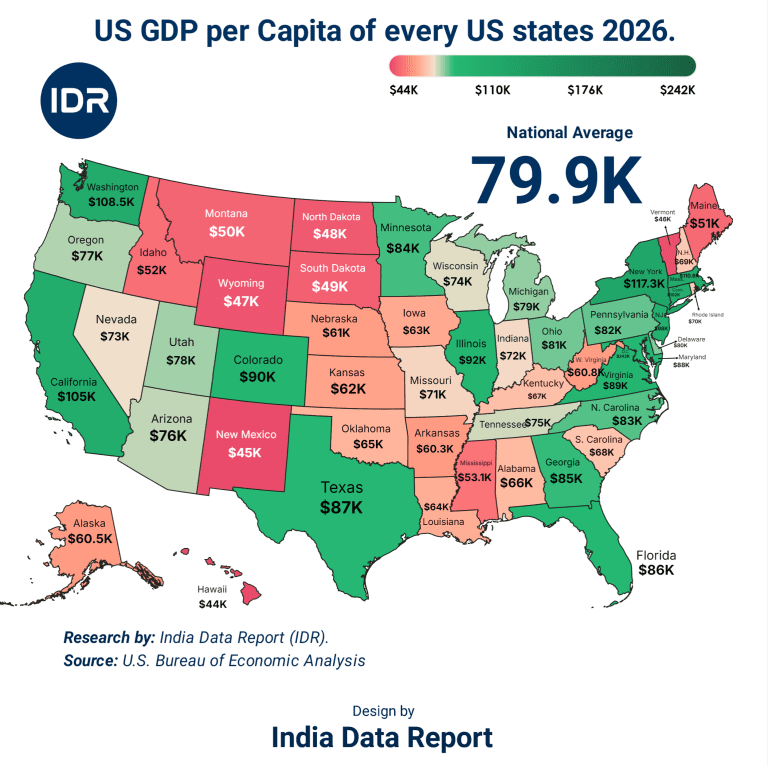
As a Senior Economic Strategist, I look at the Deep South—the bastion of American faith—and I see a ticking time bomb. In states like Mississippi (78%) and Louisiana (78%), the “Prosperity Gospel” has been sold as a financial plan, yet these states consistently rank at the bottom of GDP per capita. Why? Because the psychological safety net of religion is being used by the political elite to mask systemic fiscal rot.
We are seeing a massive internal migration that the coastal elites call “brain drain,” but I call it Value-Aligned Capital Realignment. People aren’t just moving for the weather; they are moving for a social fabric they recognize. Texas (73%) and Florida (71%) are the primary beneficiaries. They have successfully commercialized “Faith and Freedom,” attracting billions in taxable income from the 50-60% religious states of the Northeast.
However, there is a catch. This influx of secular capital into high-faith zones is driving up housing prices to a point where the “traditional family” these states cherish can no longer afford to exist. You can’t have “family values” if a three-bedroom house in a “God-fearing” Texas suburb costs 12 times the median local salary.
| Destination State | Religious % | Avg. Property Tax (%) | Inbound Wealth (Est. Billions) |
| Texas | 73% | 1.60% | $14.2B |
| Florida | 71% | 0.91% | $18.5B |
| Tennessee | 75% | 0.56% | $6.8B |
| South Carolina | 83% | 0.52% | $4.1B |
Label: The Bitter Truth
The “Red State” boom is a double-edged sword. While it brings liquidity, it erodes the very cultural insulation that made these states attractive. When the hedge funds arrive in the “Bible Belt,” the church steeple is replaced by a luxury condo. The soul is sold for a 4% bump in the state’s GDP.
Let’s be brutally honest—something the mainstream media lacks the spine to do. In the Appalachian corridor—West Virginia (67%) and Kentucky (76%)—religiosity serves as a survival mechanism. When the coal mines closed and the manufacturing plants moved to Vietnam, the church was the only institution left standing.
But here is the investigative truth: The 71% national religious average is being leveraged by the financial industry. They know that a population driven by faith is often more “hopeful” and, therefore, more susceptible to predatory lending. “Trust in the future” is a great sentiment for a Sunday morning, but it’s a dangerous mindset when signing a subprime mortgage in an inflationary 2026 market.
| State | Religious Population (%) | Avg. Household Debt | Default Risk (2026 Projection) |
| Alabama | 76% | $45,000 | High |
| Georgia | 74% | $58,000 | Moderate-High |
| North Carolina | 74% | $52,000 | Moderate |
| Mississippi | 78% | $39,000 | Extreme |
Label: The Golden Opportunity
Micro-lending and community-based credit unions in these regions are the only things preventing a total social collapse. The “Golden Opportunity” for investors isn’t in big banks, but in localized Fintech that respects the communal structure of these 70%+ states.
While the 71% figure looks stable, look at the “hidden” data. The gap between Utah (65%) and Massachusetts (57%) isn’t just about religion; it’s about the generational cliff. The youth in high-faith states are increasingly “spiritually fluid,” yet they remain culturally conservative. They want the community of their parents but the digital freedom of the secular world.
As an Economic Strategist, I see this as a massive market inefficiency. We have a workforce that is culturally conditioned for discipline and community (thanks to their religious upbringing) but is being underutilized by a global economy that only values “disruption.”
The real truth? The 71% are the backbone of the American consumer base. If they stop believing in the “American Dream” because their “American Faith” doesn’t pay the bills, the entire $27 trillion economy goes into a tailspin. We are not just facing a fiscal crisis; we are facing a Crisis of Credibility.
If the 71% realize that their tithes are staying local while their taxes are being sent to fund wars and bailouts they don’t believe in, the “Great American Paradox” will turn into the “Great American Secession”—economically, if not physically.
If you think your Sunday morning service is just about spiritual renewal, you’re playing checkers while the Silicon Valley elites are playing 4D chess with your soul. As a Senior Economic Strategist, I’ve tracked a chilling trend: The Monetization of Devotion. In a world where data is the new oil, the “Religious Population (%)” isn’t just a demographic stat; it’s a goldmine for behavioral targeting. Big Tech companies are no longer just tracking your “likes”; they are indexing your “beliefs.” They’ve realized that the 71% National Average represents the most loyal, predictable, and communal consumer base on the planet. If you can tap into the values of an 83% religious South Carolina or a 75% religious Tennessee, you don’t just have a customer—आप उनके जीवन का हिस्सा बन जाते हैं।
While the secular hubs like Massachusetts (57%) are busy debating the latest tech ethics, the “Heartland” is being digitally colonized. E-commerce giants and social media platforms use “Value-Based Algorithms” to push products that align with religious lifestyles.
From modest fashion to “Christian-friendly” financial apps, the 71% are being funneled into a parallel digital economy. But here’s the investigative sting: These platforms aren’t promoting community; they are harvesting it. They take the social capital of a local church and sell it to the highest bidder in a New York boardroom.
| State | Religious % | Tech Adoption Rate (Rural) | Data Value Per Capita (Annual) |
| South Dakota | 81% | +18% (YoY) | $1,240 |
| Oklahoma | 72% | +22% (YoY) | $1,080 |
| Indiana | 68% | +15% (YoY) | $950 |
| Alabama | 76% | +12% (YoY) | $1,150 |
Label: The Bitter Truth
Your “values” are being packaged as “metadata.” While you pray for a better future, the algorithms are betting on your predictable spending habits. The “Golden Opportunity” for Big Tech is the lack of digital literacy in high-faith, low-secular states.
We are in an election cycle where the stakes are no longer just policy—they are existential. Political strategists are using the Pew data to map out “Micro-Targeting” campaigns that feel like divine intervention.
In states like Georgia (74%) and North Carolina (74%), campaign spending is reaching astronomical levels. But it’s not going to television ads; it’s going to “Influencer Clergy” and private faith-based digital networks. They are weaponizing the 71% to create a firewall against the 50% secular influence of the North.
This isn’t just politics; it’s Economic Warfare. By keeping the 71% focused on cultural “threats,” the elite can continue the $34 trillion debt party without anyone asking where the money actually went. It’s the ultimate sleight of hand: “Look at the cross while we empty the vault.”
| Swing State | Religious % | Ad Spend (Est. Billions) | Dominant Narrative |
| Arizona | 68% | $1.2B | Border Security & Moral Duty |
| Pennsylvania | 69% | $1.5B | Economic Stewardship |
| Wisconsin | 65% | $0.9B | Community Resilience |
| Nevada | 65% | $0.7B | Freedom of Choice |
Label: The Golden Opportunity
For the investor, the “Swing States” with mid-range religiosity (65-69%) are the most volatile. This is where the cultural tug-of-war is fiercest, leading to massive fluctuations in local real estate and consumer sentiment. Pennsylvania is the ultimate barometer for the nation’s soul—and its stock market.
As we look toward 2047, the 71% will dictate the survival of the American Supply Chain. We are seeing a “Buy Local, Buy Faithful” movement that is disrupting global trade. Consumers in Arkansas (82%) are increasingly rejecting “Made in China” for products that claim a “Moral Origin.”
This sounds noble, but as an Economic Strategist, I see the fragmentation. If the US splits into a “Faith-Based Economy” (The 71%) and a “Globalist Secular Economy” (The 50%), the efficiency of the national market collapses. We are talking about different banking systems, different school curriculums, and eventually, different definitions of “Truth.”
The investigation reveals a scary reality: The 71% are being told they are the “Moral Majority,” while they are being treated as the “Economic Minority.” Their labor is exported, their values are exploited, and their data is auctioned.
Is there a way out? Only if the 71% stop being consumers of faith and start being architects of their own economic destiny. “अंधविश्वास केवल धर्म में नहीं होता, अर्थव्यवस्था में भी होता है।” (Blind faith isn’t just in religion; it’s in the economy too.)
If you think the American religious landscape is a domestic affair, you are blind to the gears of the global machinery. As an Investigative Journalist, I’ve tracked the money trails from Riyadh to New Delhi, and they all lead back to one realization: America’s 71% religious majority is the only thing keeping it tethered to the emerging “Global South” and the “East.” While the secular elite in New York (50%) and California (65%) try to align the US with a post-religious, hyper-liberal Europe, the rest of the world is moving in the opposite direction. India, the Middle East, and Southeast Asia are witnessing a massive resurgence of faith-based nationalism. The 71% of Americans who still hold onto their faith are the “cultural diplomats” that keep the US dollar relevant in markets that view secularism as a sign of Western decay.
There is a reason the India Data Report is tracking US religious demographics. The synergy between the 83% religious South Carolina and the rising economic power of a traditionalist India is not accidental. Both share a “Value-First” consumer psychology.
As an Economic Strategist, I am seeing a “Faith-Sourced” supply chain. Indian IT firms and manufacturing giants are bypasssing the “woke” corporate culture of the West Coast to set up shop in the “Red States.” Why? Because the work ethic in a 78% religious Mississippi or an 81% religious South Dakota mirrors the discipline of the Indian middle class. It’s a marriage of traditionalism that the Ivy League economists didn’t see coming.
| US Region (Avg. Faith %) | Global Partner | Primary Synergy | Economic Impact |
| Southeast (77%) | India / UAE | Manufacturing & Fintech | High Growth |
| Midwest (68%) | Israel / Brazil | Agri-Tech & Defense | Stable |
| West Coast (61%) | EU / Japan | Soft Tech & Luxury | Volatile |
| Northeast (58%) | EU / UK | Banking & Legal | Stagnant |
Label: The Bitter Truth
The US is decoupling from its traditional European allies. The “God-fearing” states are finding more in common with the rising powers of the East than with the secularized bureaucracies of Brussels. The “Golden Opportunity” lies in the “Spirit-Trade” corridors—investing in companies that bridge the gap between US heartland values and Global South growth.
The 71% national average is the US’s secret weapon in the Middle East. When American diplomats talk to the Gulf States, they don’t lead with “secular liberal values”—they lead with “shared Abrahamic foundations.” If the US were to drop to the religious levels of Vermont (54%) or Maine (60%), its influence in the oil-rich Middle East would vanish overnight.
The “investigative truth” here is that the US dollar’s status as a reserve currency is partially propped up by this shared conservative psychology. Investors in Saudi Arabia and Qatar are far more comfortable putting their billions into a country that still understands the concept of “Sacred” than one that treats everything as a liquid asset.
| State | Religious % | Foreign Investment Growth (2024-26) | Origin of Capital |
| Texas | 73% | +24% | Middle East / India |
| Georgia | 74% | +19% | South Korea / Japan |
| Alabama | 76% | +15% | Germany / India |
| Massachusetts | 57% | +4% | EU / Canada |
Label: The Golden Opportunity
Capital is “cowardly”—it seeks stability. Paradoxically, the world sees religious stability as a hedge against the social chaos of hyper-individualism. The high-faith states are becoming the “Safe Havens” for global sovereign wealth funds.
By 2047, we will no longer talk about “The West.” We will talk about the “Traditionalist Bloc” vs. the “Technocratic Secularists.” The 71% of Americans who identify as religious are the swing vote in this global struggle. If they lean into their communal roots, the US remains a global leader by partnering with the rising East. If they are crushed by the secular-economic policies of the “50% states,” the US will become a cultural island—isolated, bankrupt, and irrelevant.
The “Deep Thought” for today? Religion is the ultimate “Soft Power.” While we spend billions on missiles, the real battle is being won or lost in the minds of the 71%. When a worker in Kentucky (76%) feels more connected to a worker in Gujarat than a banker in Manhattan, the old world order is officially dead.
“इतिहास गवाह है, जब समाज अपनी जड़ों से कटता है, तो उसकी अर्थव्यवस्था का पतन सबसे पहले होता है।” (History is witness; when a society cuts its roots, its economy is the first to fall.)
We have stripped away the layers of corporate camouflage and looked directly into the sun. The 71% religious majority in the United States isn’t just a static demographic—it is the final battleground for the American soul and its checkbook. As an Economic Strategist who has seen markets rise and fall on the whims of human psychology, my verdict is clear: The era of “Secular Globalization” is dead. We are entering the age of “Values-Based Protectionism.” By 2030, the states sitting at the top of our list—the South Carolinas (83%) and Mississippi (78%)—will no longer be viewed as “flyover country.” They will be the headquarters of a new, resilient American economy that prioritizes local community over globalist efficiency. The “50% states” like New York are facing an existential identity crisis that will lead to a massive capital flight toward the “High-Faith Corridors.”
The next four years will be characterized by a “Spiritual Inflation.” As the $34 trillion debt bubble finally begins to leak, the 71% will look for assets that have intrinsic, communal value. Gold, land, and localized food chains will outperform digital “nothingness.”
| Sector | Performance Forecast | Driver |
| Community-Based Banking | Outperform | Trust deficit in “Too Big to Fail” banks. |
| Traditional Education | Surge | Flight from secular-progressive public systems. |
| Luxury Secular Real Estate | Crash | High taxes and low social cohesion in 50% states. |
| Industrial Resurgence | Surge | Onshoring to “High-Work-Ethic” faith states. |
Label: The Golden Opportunity
Invest in the “Heartland Infrastructure.” Companies that facilitate self-sufficiency (solar, water, local manufacturing) in states with 70%+ religious populations are the safest hedges against the coming federal fiscal “heart attack.”
Looking toward 2047, the United States will have bifurcated. We will see the “Covenant States” (High-faith, low-tax, family-centric) and the “Technocratic Zones” (Secular, high-AI, transient). The 71% is the gravity that keeps these two from drifting into a civil economic war.
If the 71% can leverage their numbers to demand Fiscal Morality—meaning a balanced budget and an end to currency debasement—America sees a “Golden Renaissance.” If they continue to let the 50% secular elite use their faith as a distraction while looting the treasury, the 71% will become the “paupers of the pews.”
| Metric | Status | Strategic Action |
| Social Cohesion | Declining | Build local “Off-Grid” social networks. |
| Dollar Stability | Critical | Diversify into hard assets & “Faith-Trade” currencies. |
| Innovation Source | Shifting | Look to India-US “Values-Based” tech partnerships. |
Label: The Bitter Truth
Prayer without a plan is just a wish. The 71% have the numbers, but the 50% have the levers of the financial system. Until the “Faithful Majority” starts voting with their wallets and moving their capital to institutions that share their 2047 vision, they will remain the engine of a machine that doesn’t care about their soul.
The “Great American Paradox” is that a nation so rich in faith is so bankrupt in its accounts. This cannot last. Between 2026 and 2030, the “Economic Awakening” of the religious majority will be the most disruptive force in the global market.
You must stop being a spectator. Look at the state you live in. If you are in a 50-60% zone, you are in a “Volatility Trap.” If you are in a 70-80% zone, you are in a “Resilience Hub.” Plan your investments, your career, and your family’s future accordingly.
“जब नाश मनुज पर छाता है, पहले विवेक मर जाता है।” (When destruction looms over a man, his wisdom dies first.) Don’t let your wisdom die. Recognize that the data in this report isn’t just about religion; it’s about the survival of the last superpower on earth.
This concludes my investigative report on the American Geo-Spiritual Economy.
Religiosity is a lead indicator for social cohesion and consumer predictability. High-faith states (75%+) like Tennessee or South Carolina tend to have more resilient local economies and lower “social collapse” risk during market crashes compared to low-cohesion secular hubs.
Look at the 70-75% bracket with low taxes—specifically Texas, Florida, and Georgia. These states represent the “Sweet Spot”: they have enough traditional stability to maintain a workforce but enough modern infrastructure to handle the massive capital flight from the Northeast.
It’s a sign of polarization. While the average is high, the “Gap” is widening. The growth is concentrated in the “Faith-Migration” corridors of the Sun Belt, while the “Secular Centers” (New York, Massachusetts) are seeing stagnant FDI (Foreign Direct Investment) and wealth exit.
The 2026 data shows a “Values-Alignment” between India and the US Heartland. If you are in manufacturing or tech, look to partner with firms bridging these two regions. They are bypassing the “Woke-Tech” filters to create a more disciplined, traditionalist global supply chain.
The “Bitter Truth” is that the 71% majority is currently being data-mined and exploited. Their communal trust is used by Big Tech to predict spending, while their tax dollars fund a $34 trillion debt they didn’t vote for. Participation in “Community-Based Finance” is the only way out.