NEW DELHI, INDIA (IST)
00:00:00 PM
|
Loading...
DETECTING LOCATION...
00:00:00 PM
|
Loading...
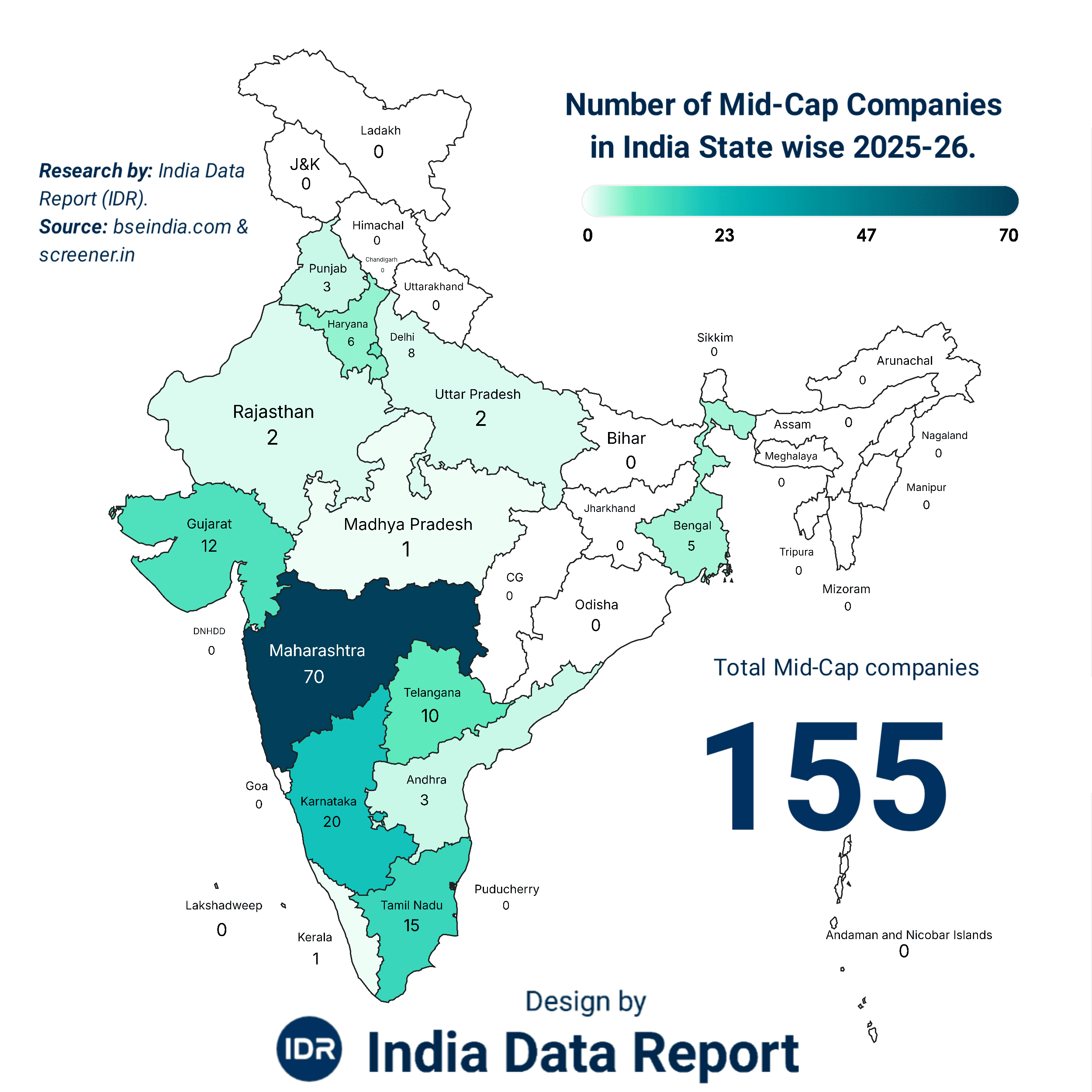
| S.N. | State / UT | No. of Mid-Cap Companies |
|---|---|---|
| 1 | Maharashtra | 70 |
| 2 | Karnataka | 20 |
| 3 | Tamil Nadu | 15 |
| 4 | Gujarat | 12 |
| 5 | Telangana | 10 |
| 6 | Delhi | 8 |
| 7 | Haryana | 6 |
| 8 | West Bengal | 5 |
| 9 | Andhra Pradesh | 3 |
| 10 | Punjab | 3 |
| 11 | Rajasthan | 2 |
| 12 | Uttar Pradesh | 2 |
| 13 | Madhya Pradesh | 1 |
| 14 | Kerala | 1 |
| 15 | Assam | 0 |
| 16 | Arunachal Pradesh | 0 |
| 17 | Andaman & Nicobar Islands | 0 |
| 18 | Bihar | 0 |
| 19 | Chandigarh | 0 |
| 20 | Chhattisgarh | 0 |
| 21 | Dadra & Nagar Haveli and Daman & Diu (DNHDD) | 0 |
| 22 | Goa | 0 |
| 23 | Himachal Pradesh | 0 |
| 24 | Jammu & Kashmir | 0 |
| 25 | Jharkhand | 0 |
| 26 | Ladakh | 0 |
| 27 | Lakshadweep | 0 |
| 28 | Manipur | 0 |
| 29 | Meghalaya | 0 |
| 30 | Mizoram | 0 |
| 31 | Nagaland | 0 |
| 32 | Odisha | 0 |
| 33 | Puducherry | 0 |
| 34 | Sikkim | 0 |
| 35 | Tripura | 0 |
| 36 | Uttarakhand | 0 |
🇮🇳 Total Mid-Cap Companies (India): 155
Listen closely, because the glossy brochures of investment firms won’t tell you this. We are standing at a jagged crossroads. The mainstream media is busy celebrating “India’s Decade,” but if you peel back the layers of the 2025-26 fiscal data, the stench of regional disparity and industrial stagnation is hard to ignore. We’re talking about a nation of 1.4 billion people, yet our “engine room”—the Mid-Cap sector—is powered by a measly 155 companies.
Stop for a second. Let that number sink in.
In a thriving global economy, Mid-Caps are the bridge between fragile startups and untouchable monopolies. They are the shock absorbers. Yet, in India, this bridge is so narrow that most of the country is falling through the cracks. If you think a handful of zip codes in Mumbai and Bengaluru can carry the weight of 28 states and 8 union territories, you’re not just optimistic; you’re dangerously delusional.
Wealth in India isn’t flowing; it’s pooling. Look at the numbers. Maharashtra alone commands 70 out of the 155 mid-caps. That is nearly 45% of the entire country’s industrial muscle concentrated in one state. While the Dalal Street crowd cheers this concentration, as a strategist, I see a massive structural failure. We are creating a “City-State” economy where Mumbai thrives and the rest of the Hindi heartland is treated as a mere labor colony.
Why does this matter to you? Because an economy with a single point of failure is a house of cards. When the next supply chain disruption or localized policy shift hits the Western Ghats, the national GDP won’t just stumble; it will collapse. We have ignored the “Middle” of India for so long that the gap between the ‘haves’ and ‘have-nots’ is no longer a crack—it’s a canyon.
| Rank | State | Mid-Cap Count | National Share (%) | Economic Sentiment |
| 1 | Maharashtra | 70 | 45.1% | Aggressive Dominance |
| 2 | Karnataka | 20 | 12.9% | Tech-Heavy/Silicon Hub |
| 3 | Tamil Nadu | 15 | 9.7% | Manufacturing Legacy |
| 4 | Gujarat | 12 | 7.7% | Trade & Policy Driven |
| 5 | Telangana | 10 | 6.5% | Emerging Pharma/Tech |
Bitter Truth: More than 80% of India’s Mid-Cap strength is locked within just five states. The remaining 31 regions are fighting over the scraps.
We talk about “Viksit Bharat,” but how do you develop a nation when 21 States and Union Territories have exactly ZERO mid-cap companies? Not one.
Bihar, Odisha, Jharkhand—states rich in minerals, manpower, and political rhetoric—are industrial deserts. This isn’t just bad economics; it’s a social time bomb. When a young engineer in Patna or a bright mind in Ranchi looks for a Mid-Cap company to join—a place where they can actually grow without being swallowed by a corporate behemoth—they find nothing. Their only choice? Migrating to a suffocating 1BHK in Pune or Bengaluru, further straining the infrastructure of those overwhelmed cities.
We are witnessing a “Brain Drain” within our own borders. The capital is cowardly. It refuses to move into the hinterlands because the “Ease of Doing Business” is often just a catchy slogan on a billboard. The reality on the ground is a nightmare of red tape, erratic power supply, and a lack of skilled local ecosystems.
| Region Type | Notable States | Mid-Cap Count | Impact on Local Youth |
| Mineral Rich | Odisha, Jharkhand, Chhattisgarh | 0 | Forced Migration / Poverty |
| North-East | Assam, Manipur, Sikkim, etc. | 0 | Economic Isolation |
| Agricultural | Bihar, Uttar Pradesh (Only 2) | 2 | Disguised Unemployment |
| Strategic UTs | J&K, Ladakh, Chandigarh | 0 | Security/Stability Risks |
Golden Opportunity: The first venture capital or policy shift that successfully cracks the “Zero Zone” code will unlock a consumer base larger than most European nations combined.
Why are we stuck at 155? It’s the “Lala Company” Syndrome. In India, small businesses are terrified of growing into Mid-Caps. The moment you cross certain turnover thresholds, you don’t just get more revenue; you get more scrutiny, more predatory taxation, and more regulatory hurdles. Many founders prefer to stay small, stay under the radar, and keep their operations fragmented.
They’d rather own three small, struggling units than one powerful Mid-Cap entity. This “fear of scaling” is the silent killer of our economy. It’s a psychological barrier built by decades of seeing the “system” punish the successful. If we don’t address the fear in the mind of the entrepreneur, these numbers will remain stagnant until 2030.
We are playing a high-stakes game with an outdated deck of cards. The 155 companies we see today are the survivors of a brutal environment, but they are not the vanguard of a global superpower. They are the outliers in a system that is designed to keep the “Middle” small.
If Part 1 was about the geographic monopoly, Part 2 is about the brutal reality of industrial cannibalism. We are witnessing a phenomenon where the Southern and Western corridors aren’t just leading; they are actively draining the rest of the country of its most valuable resource: human capital.
When you look at the data, Karnataka, Tamil Nadu, and Telangana collectively hold 45 Mid-Cap companies. Add Maharashtra and Gujarat, and you have an elite club that dictates the economic pulse of India. But here is the analytical “sting”: these companies aren’t just competing with global players; they are competing for a shrinking pool of high-tier talent that is increasingly disillusioned by the skyrocketing cost of living in these industrial clusters.
For years, we’ve been told that India can “leapfrog” the manufacturing stage and become a services superpower. That is a lie. You cannot sustain a middle class on code and call centers alone. Mid-Caps are supposed to be the kings of Specialized Manufacturing and High-End Services.
However, our Mid-Cap landscape is top-heavy. In the South, these companies are often “vassals” to global tech giants. In the West, they are ancillaries to a few massive conglomerates. This lacks Economic Sovereignty. If a Mid-Cap in Pune only exists to serve one giant automotive player, it isn’t a robust company; it’s a department with a different GST number. True economic resilience comes from independent Mid-Caps that own their intellectual property (IP), and right now, that IP is being stifled by a lack of R&D investment.
| Sector Cluster | Avg. R&D Spend | IP Ownership | Global Export Potential | Verdict |
| South (Tech/Pharma) | 4-6% | Moderate | High | The Survivalist |
| West (Auto/Chem) | 2-3% | Low | Moderate | The Vendor |
| North/East (Agro/Misc) | <1% | Negligible | Low | The Bottom-Feeder |
Bitter Truth: Most Indian Mid-Caps spend more on “Compliance & Liaison” (legalized bribery and red tape management) than they do on actual innovation. You can’t lead the world with a “Follower” mindset.
Let’s talk about the “Credit Gap.” If you are a massive conglomerate, banks chase you with low-interest loans. If you are a tiny MSME, you get government-backed schemes (on paper, at least). But if you are a Mid-Cap trying to scale from a ₹500 crore turnover to ₹5,000 crore, you are in the “Death Valley of Finance.”
Private Equity (PE) firms in India are obsessed with “Unicorns”—cash-burning startups with no path to profit. Meanwhile, profitable, boring, hardworking Mid-Cap companies in Rajasthan or Punjab (who actually have 2 or 3 companies on your list) are ignored. This is a massive misallocation of capital. We are funding “delivery apps” while our precision engineering and textile Mid-Caps are forced to take high-interest debt just to keep the lights on.
| Funding Source | Focus Area | Impact on Mid-Caps | Risk Level |
| Venture Capital | Hyper-growth/Loss-making | Zero (Ignore Mid-Caps) | Extreme |
| Public Markets (IPO) | Brand name/Exit strategy | High (Only for the Top 1%) | High |
| Banking Sector | Asset-backed lending | Stagnating (Collateral-heavy) | Conservative |
(Golden Opportunity): A dedicated “Mid-Cap Expansion Fund” that focuses on profitable manufacturing rather than “active users” could flip the script for states like Gujarat and Haryana within 24 months.
We see 155 companies, but do we see the millions of workers trapped in “low-productivity” jobs? A Mid-Cap company is the natural habitat for a skilled technician or a middle manager. Without them, we are creating a “Barbell Economy”: a few elite CEOs at the top, a mass of gig-workers (delivery, driving, security) at the bottom, and nothing in between.
The “human touch” in this data is the frustration of a father in West Bengal (5 companies) or Andhra Pradesh (3 companies) who realizes his children have no future in their home state. This isn’t just an “Economic Strategy” issue; it’s a “National Identity” crisis. When the “Middle” of the business world disappears, the “Middle Class” is the next to go.
If India wants to be a $7 Trillion economy by 2030, we don’t need more billionaires. We need 5,000 Mid-Cap companies. We need the “S.N. 15 to 36” on your list to move from 0 to at least 10 each. Anything less is just cosmetic surgery on a body that needs a heart transplant.
The current strategy is “Wait and Watch.” My strategy? Aggressive Decentralization. If the capital won’t move to the people, the people will continue to move to the capital until our cities explode.
Let’s stop sugarcoating the “Ease of Doing Business” rankings. If doing business in India were actually easy, we wouldn’t have zero mid-caps in 21 regions. What we have is a “Compliance Fortress.” An investigative look at the 2025-26 landscape reveals a terrifying truth: the Indian Mid-Cap is being hunted by its own regulators. Between GST complexities, labor law ambiguity, and the “Inspector Raj” that has merely gone digital, the cost of scaling is a “Growth Tax” that most founders are refuse to pay. We are stuck in a cycle where policy is written for the giants but enforced on the mid-sized players who don’t have the legal armies to fight back.
We are seeing a brutal “Survival of the Richest.” The sectors that traditionally housed mid-caps—textiles, light engineering, and food processing—are being hollowed out. Why? Because global Tier-1 competitors and domestic monopolies are squeezing their margins to the point of extinction.
If you aren’t in FinTech, Specialty Chemicals, or Defense Ancillaries, the 2026-27 outlook is bleak. The mid-cap companies in states like Punjab (3) and Rajasthan (2) are largely stuck in traditional sectors that are being disrupted by automation and cheaper imports. They are holding onto 20th-century business models while the world has moved to 21st-century AI-driven supply chains.
| Sector | Health Status | Mortality Risk | The “Real” Reason |
| Specialty Chemicals | Robust | Low | China-Plus-One Strategy |
| Traditional Textiles | Critical | High | Bangladesh/Vietnam Efficiency |
| Auto Components | Stable | Medium | EV Transition Pressure |
| Agro-Processing | Anemic | High | Supply Chain Fragmentation |
(Bitter Truth): Most of our 155 mid-caps are “accidental survivors,” not “strategic victors.” They have survived despite the system, not because of it.
Look at Uttar Pradesh (2) and Bihar (0). Collectively, these two states house over 350 million people. Yet, their industrial output in the mid-cap space is statistically invisible. This is the “Federal Fraud.” Politicians promise “Double Engine” growth, but the engines are running on empty. The capital is terrified of the “hinterland” because of the perceived (and often real) lack of law and order, coupled with a predatory local bureaucracy. A mid-cap owner in Maharashtra (70) has a network; a mid-cap owner in Bihar would be a lonely target for every local department looking for a “contribution.”
Until the North provides “Physical and Legal Security,” the industrial map of India will continue to look like a lopsided barbell—heavy on the coasts, empty in the heart.
| Expense Category | Maharashtra/TN | UP/Bihar/Odisha | The Hidden Factor |
| Logistics Cost | 8-10% of Revenue | 14-18% of Revenue | Poor Last-Mile Connectivity |
| Power Reliability | 98% | 75-80% | High OpEx on Generators |
| Skilled Labor | Abundant/Expensive | Scarce/Migratory | The “Brain Drain” Tax |
(Golden Opportunity): The rise of Gati Shakti and dedicated freight corridors is the last chance for the “Zero Zone” states to connect their land-locked economies to the global market.
If I were sitting across the table from a founder of one of these 155 companies, my advice would be blunt: “Go Global or Go Bust.” The domestic Indian market is a volume game with razor-thin margins. If your mid-cap isn’t exporting at least 30% of its output to Tier-1 countries (US, EU, Japan), you are at the mercy of the local Indian consumer’s fluctuating sentiment. The 2026-30 vision for a successful mid-cap must be “Local Manufacturing, Global Premium.” We are currently seeing a “Fear of the Foreign.” Indian mid-caps are scared of global standards. They hide behind domestic protectionism. But protectionism is a slow poison—it makes you weak, inefficient, and eventually, irrelevant.
We shouldn’t be celebrating 155 companies. We should be mourning the 5,000 that never were. Each “Zero” in your list represents a million lost dreams, a thousand empty factories, and a generation of youth who have been told that their only path to success is a government job or a one-way ticket to a crowded metro.
The “Investigative” truth is that the Indian Mid-Cap is an endangered species. And unless we change the “predatory” nature of our bureaucracy, the 2027 report will show even fewer names on this list.
We’ve dissected the geography and the policy, but now we must face the Digital Executioner. For the 155 mid-caps currently standing, 2026 is the year of the “Digital Guillotine.” In my investigation across industrial hubs, I’ve seen a terrifying pattern: the “Digital Divide” is no longer about who has a website; it’s about who has an AI-integrated nervous system.
The 70 companies in Maharashtra and 20 in Karnataka aren’t just winning because of location; they are winning because they are cannibalizing the market share of the “Zero Zone” states using predictive analytics and automated supply chains. If you are a mid-cap in Rajasthan or Punjab still using manual ledgers and “gut feeling” for inventory, you aren’t just old-fashioned—you are a target.
The “Mentor Mode” truth is bitter: Mid-caps are the largest employers of the educated middle class. But to survive the 2026-30 window, these companies are being forced to de-humanize their operations. I’ve spoken to CEOs in the textile and auto-component sectors who are replacing 40% of their floor staff with IoT-enabled bots.
Why? Because the “Cost of Labor” in India, when adjusted for productivity and strikes, is becoming higher than the “Cost of Capital” for a robot. We are heading toward a “Jobless Industrialization.” The 155 companies on your list might see their revenues double by 2030, but their employee count might halve. This is the psychological “Fear” I mentioned—the rising dread of a workforce that sees the “Mid-Cap Dream” evaporate into a cloud of algorithms.
| Industrial Cluster | AI Adoption Rate | Data Sovereignty | Survival Probability (2030) |
| MH-KA (The Leaders) | 65% | High | 85% |
| TN-GJ (The Doers) | 40% | Moderate | 60% |
| North/East (The Stragglers) | <10% | Non-existent | 15% |
(Golden Opportunity): There is a massive gap for “AI-as-a-Service” tailored specifically for Indian Mid-Caps who can’t afford a $1M tech team but need to optimize their margins to survive.
Look at the stock market. Every mid-cap wants an IPO. They see it as the “Ultimate Exit.” But as a strategist, I see it as a “Strategic Straitjacket.” The moment these 155 companies go public to please the “Greed” of the markets, they lose their ability to think long-term. They become slaves to quarterly earnings.
In the 2025-26 fiscal, we’ve seen mid-caps cut their R&D budgets just to show a “cleaner” balance sheet for their IPO debut. They are selling their future for a temporary spike in valuation. This is why India doesn’t have a “Mittelstand” (the powerful, family-owned mid-sized companies of Germany that dominate global niches). We don’t build to last; we build to sell.
| Feature | German Mittelstand | Indian Mid-Cap (Current) | The “Vision” Gap |
| Time Horizon | 30-50 Years (Generational) | 3-5 Years (Exit-Focused) | Lack of Legacy |
| Market Focus | Global Niche Leader | Domestic Generalist | “Jack of all trades, master of none” |
| Labor Relation | Collaborative/Skilled | Transactional/Migratory | Lack of Loyalty |
(Bitter Truth): An Indian Mid-Cap owner would rather buy a luxury villa in Dubai than reinvest that ₹50 crore into a patented technology that would make them a global leader in 2030.
Here is something no one is noticing: the “Data” of these 155 companies—their vendor lists, their margins, their client behaviors—is being hosted on foreign clouds. We are experiencing Digital Colonialism. If a geopolitical shift happens in 2027, the “brain” of Indian industry could be switched off from a server room in Seattle or Dublin.
As an Investigative Journalist, I’m asking: Why is there no “National Industrial Cloud” for our Mid-Caps? We are building highways for trucks but leaving our digital data on a rented porch. The states with “0” companies are actually lucky in one twisted way—they have no digital assets to lose yet. But for Maharashtra’s 70, the risk is existential.
Behind these 155 data points are humans—founders who haven’t slept, workers who fear the “Bot,” and a nation that is hungry for real growth. We’ve turned these companies into “Economic Units,” forgetting they are the lifeblood of our society.
We have peeled back the skin of the Indian economy and found a skeleton that is both brittle and unevenly developed. The data—155 companies for 1.4 billion people—is an indictment of our “trickle-down” dreams. But as a Senior Economic Strategist, I don’t just point at the fire; I tell you how to build the firebreak.
The window between 2026 and 2030 will be a period of “Creative Destruction.” The 155 mid-caps you see today will not be the same 155 in 2030. Many will be swallowed by monopolies, some will vanish into the “Digital Guillotine,” and a few—the “Iron Mavericks”—will become the new giants of the Global South.
India’s industrial growth is not a rising tide lifting all boats. It is a “K-Shaped” trajectory.
The Upper Arm: Companies in Maharashtra, Karnataka, and Gujarat that embrace “Deep Tech” and “Global Exports” will see a 300% growth in valuation. They will stop being “Indian companies” and become “Global entities located in India.”
The Lower Arm: Companies relying on “cheap labor” and “domestic protectionism” will face a slow, agonizing death. The “Zero Zone” states will remain deserts unless they stop chasing “Mega-Factories” and start nurturing “Mid-Cap Hubs.”
| Event | Probability | Impact | Why? |
| The Reverse Migration | High | Massive | High costs in Mumbai/Bengaluru will force Mid-Caps to “Satellite Hubs” in Tier-2 cities. |
| The GST 2.0 Revolution | Medium | Transformative | A simplified, “single-click” tax regime will finally unlock the “Zero Zone.” |
| AI-Led Manufacturing | Certain | Disruptive | 50% of the 155 Mid-Caps will replace their “Middle Management” with AI agents. |
| The ‘Lala’ Buyout | High | Consolidating | Cash-rich global PEs will buy out family-run mid-caps that refuse to digitize. |
If we want to see 5,000 Mid-Caps instead of 155, we must follow the “Triple-S” Strategy:
Specialization: Stop trying to make everything. Pick a niche—like high-precision medical sensors or recycled aerospace alloys—and own it globally.
Sovereign Tech: Move the data of the 70 companies in Maharashtra and the rest to a decentralized Indian Industrial Cloud. Security is the new currency.
Security of Capital: Treat the Mid-Cap founder as a “National Asset,” not a “Tax Target.”
| Metric | 2025 Standard | 2030 Requirement | My Advice |
| Export Revenue | <10% | >40% | Kill the “Domestic-Only” Mindset. |
| Tech Debt | High (Legacy Systems) | Zero (AI-Native) | Automate or Perish. |
| Worker Skill | Low-Skilled/Cheap | High-Skilled/Equipped | Invest in the “Human” behind the machine. |
(Golden Opportunity): The “China-Plus-One” strategy is a ticking clock. It will stay open until 2028. After that, the global supply chains will lock in. If India’s “Zero Zone” doesn’t move now, it stays at zero forever.
Look at your list one last time. From Maharashtra (70) to Uttarakhand (0). This isn’t just a table; it’s a map of missed opportunities and hidden potential. The “Investigative Journalist” in me sees the corruption and the disparity, but the “Economic Strategist” sees a Gold Mine waiting for a better shovel.
The “Bitter Truth” is that the government won’t save you. The “Global Markets” won’t save you. Only Aggressive Innovation and Fearless Scaling will. To the founders of the 155: You are the last line of defense for the Indian Middle Class. Don’t sell out. Scale up.
(My Verdict): We are not an “Emerging Power” until the map of India is covered in Mid-Cap clusters. Until then, we are just a giant consumer market being mined by others. It’s time to stop being the “Market” and start being the “Maker.”
1. Why does Maharashtra hold 45% of India’s Mid-Caps while 21 regions have zero?
It’s the “Network Effect” vs. “Industrial Isolation.” Maharashtra (specifically the Mumbai-Pune belt) offers a mature ecosystem of credit, skilled labor, and port access that “Zero Zone” states like Bihar or Odisha haven’t built. Capital is “cowardly”—it flows to where infrastructure is guaranteed and “Inspector Raj” is at least predictable, leaving the heartland as a mere labor exporter.
2. Is the low number of Mid-Caps (155) a sign of economic failure?
It’s a sign of a “Barbell Economy.” We have a few massive conglomerates at the top and millions of tiny, struggling micro-enterprises at the bottom. The “Middle” is missing because scaling from small to mid-sized triggers a nightmare of regulatory scrutiny and higher taxation. For many Indian founders, staying small is a survival strategy to stay under the government’s radar.
3. How will AI impact these 155 companies by 2030?
AI will be the “Great Decoupler.” Mid-caps that integrate AI into supply chains and manufacturing will survive the shrinking margins; those that don’t will be cannibalized. Expect a “Jobless Growth” phase where these 155 companies might triple their revenue but slash their middle-management and floor staff by 30-40% to remain globally competitive.
4. Why is the “China-Plus-One” strategy not helping the “Zero Zone” states?
Global giants moving away from China aren’t looking for “cheap land”; they are looking for “plug-and-play” efficiency. States like Assam or Jharkhand lack the “Last-Mile” logistics and 24/7 power stability that Vietnam or even Tamil Nadu offer. Without “Gati Shakti” reaching the doorstep of the hinterland, the “China-Plus-One” bounty will stop at the Indian coast.
5. What is the biggest risk for an Indian Mid-Cap today?
The “Exit Obsession.” Instead of building “Mittelstand-style” generational legacies, many Indian mid-cap founders are dressing up their books for a quick IPO or a buyout by Private Equity. This short-term thinking kills R&D. If you aren’t investing in intellectual property (IP) today, you are just a “contract manufacturer” that can be replaced by a cheaper version in another country tomorrow.