NEW DELHI, INDIA (IST)
00:00:00 PM
|
Loading...
DETECTING LOCATION...
00:00:00 PM
|
Loading...
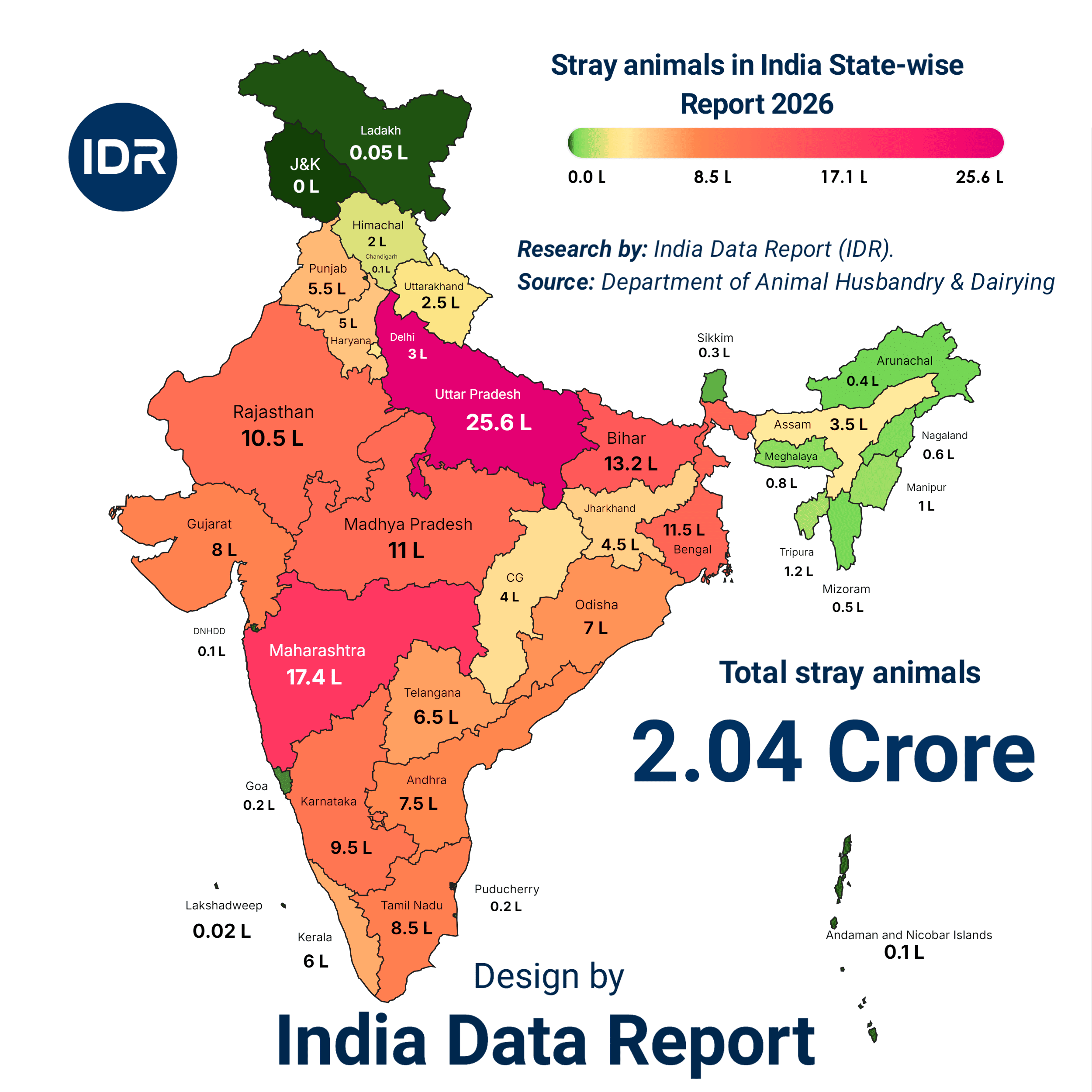
Look at the pavement outside your high-rise. That shivering mongrel or the skeletal bull obstructing traffic isn’t just a “stray animal.” It is a living, breathing manifestation of a systemic economic failure. We are currently sitting on a ticking demographic time bomb of 2.04 Crore stray animals across India in 2026. This isn’t just about “animal welfare” or bleeding-heart activism; it’s a massive, uncalculated drain on the GDP, a public health catastrophe, and a glaring indictment of our urban planning rot.
| S.N. | State / UT | Population (Lakh) |
|---|---|---|
| 1 | Uttar Pradesh | 25.6 L |
| 2 | Maharashtra | 17.4 L |
| 3 | Bihar | 13.2 L |
| 4 | West Bengal | 11.5 L |
| 5 | Madhya Pradesh | 11.0 L |
| 6 | Rajasthan | 10.5 L |
| 7 | Karnataka | 9.5 L |
| 8 | Tamil Nadu | 8.5 L |
| 9 | Gujarat | 8.0 L |
| 10 | Andhra Pradesh | 7.5 L |
| 11 | Odisha | 7.0 L |
| 12 | Telangana | 6.5 L |
| 13 | Kerala | 6.0 L |
| 14 | Punjab | 5.5 L |
| 15 | Jharkhand | 4.5 L |
| 16 | Chhattisgarh | 4.0 L |
| 17 | Assam | 3.5 L |
| 18 | Delhi | 3.0 L |
| 19 | Uttarakhand | 2.5 L |
| 20 | Himachal Pradesh | 2.0 L |
| 21 | Haryana | 5.0 L |
| 22 | Tripura | 1.2 L |
| 23 | Manipur | 1.0 L |
| 24 | Meghalaya | 0.8 L |
| 25 | Nagaland | 0.6 L |
| 26 | Mizoram | 0.5 L |
| 27 | Arunachal Pradesh | 0.4 L |
| 28 | Sikkim | 0.3 L |
| 29 | Goa | 0.2 L |
| 30 | Tamil Nadu | 8.5 L |
| 30 | Puducherry | 0.2 L |
| 31 | Andaman & Nicobar Islands | 0.1 L |
| 32 | Dadra & Nagar Haveli & Daman & Diu (DNHDD) | 0.1 L |
| 33 | Chandigarh | 0.1 L |
| 34 | Lakshadweep | 0.02 L |
| 35 | Ladakh | 0.05 L |
| 36 | Jammu & Kashmir | 0 L |
While we chase trillion-dollar dreams, our streets are governed by the law of the jungle. We’ve built “Smart Cities” with 5G towers but haven’t figured out where to put the 25.6 lakh strays in Uttar Pradesh. It’s a classic Indian irony: we worship the cow in our rhetoric and dodge its fury on the highway. This is the Great Indian Abandonment, where the cost of negligence is paid in human lives, rabies vaccines, and a crumbling social contract.
The sheer scale of the population in the “Big Five” states is staggering. When you look at Uttar Pradesh or Maharashtra, you aren’t just looking at animals; you’re looking at an administrative surrender.
| State | Stray Population (Lakhs) | Economic Leakage Est. (Annual) | Primary Driver |
| Uttar Pradesh | 25.6 L | ₹1,400 Cr | Abandoned Male Calves / Urban Waste |
| Maharashtra | 17.4 L | ₹950 Cr | Rapid Urbanization / Meat Waste |
| Bihar | 13.2 L | ₹600 Cr | Failed Sterilization Programs |
| West Bengal | 11.5 L | ₹520 Cr | High Density / Shared Spaces |
| Madhya Pradesh | 11.0 L | ₹480 Cr | Rural-to-Urban Animal Migration |
The Bitter Truth: For every “stray” you see, there are three more in the shadows. These numbers aren’t just statistics; they are a failure of the Municipal Bond market. If we can’t manage a dog on the street, how do we expect to manage a global supply chain?
Let’s be brutally honest. This isn’t an accident. It’s an incentivized disaster. The dairy industry, the bedrock of our rural economy, has a dark secret: the “unproductive” male. In a pre-2015 era, there was a functional (albeit controversial) outlet for these animals. Today, they are dumped on the highways.
In Uttar Pradesh, the population has hit a breaking point at 25.6 lakh. That is larger than the human population of many European cities. When an animal is no longer “economically viable,” it becomes a public liability. We’ve privatized the profits of the dairy and pet industry but socialized the cost of their abandonment.
The distribution of this 2.04 crore population reveals a terrifying geographic bias. The “Heartland” is bleeding.
| S.N. | State / UT | Population (Lakh) | Per Capita Risk Index (1-10) |
| 6 | Rajasthan | 10.5 L | 8.2 |
| 7 | Karnataka | 9.5 L | 7.5 |
| 8 | Tamil Nadu | 8.5 L | 6.9 |
| 9 | Gujarat | 8.0 L | 7.8 |
| 10 | Andhra Pradesh | 7.5 L | 6.5 |
| 11 | Odisha | 7.0 L | 5.8 |
| 12 | Telangana | 6.5 L | 6.2 |
Golden Opportunity: There is a multibillion-dollar “Waste-to-Value” industry hidden in this crisis. From biogas to leather alternatives, these 2.04 crore animals represent a resource we are too arrogant to tap into.
We walk past these animals every day. Why? Because the human brain is wired to normalize chaos. We’ve accepted that a pack of dogs chasing a scooter at 11 PM is just “part of the vibe.” But as a strategist, I see it differently. I see litigation risk. I see healthcare costs. I see the Rabies Capital of the World.
India accounts for nearly 36% of global rabies deaths. Let that sink in. While we talk about AI and semiconductor chips, our citizens are dying because of a 19th-century problem. The fear in a mother’s eyes when her child walks to school in a “high-stray” zone in Maharashtra or Bihar is a psychological tax that no economist is measuring.
Is what we see on the streets the “truth”? No. The truth is buried in the municipal budgets where funds for ABC (Animal Birth Control) vanish into the pockets of contractors who provide “ghost” sterilizations. We aren’t fighting a population explosion; we are fighting a transparency deficit.
Let’s stop pretending this is a “kindness” issue. As a Senior Economic Strategist, I look at the 2.04 Crore stray animals and I don’t see wagging tails or soulful eyes—I see a massive, unhedged liability on the national balance sheet. We are pouring billions of rupees into a bottomless pit of reactive measures, while the root cause—the economics of abandonment—remains untouched.
The Indian taxpayer is currently subsidizing the inefficiency of municipal bodies that have turned “Animal Birth Control” (ABC) into a lucrative, recurring revenue stream with zero accountability. We are witnessing a classic Agency Problem: the people paid to solve the crisis have a direct financial incentive to let it persist. If the strays disappear, so does the budget.
The economic impact of 2 crore strays isn’t just about the cost of a rabies shot. It’s about the “friction” they introduce into the economy. Think about the logistics sector. India’s highway efficiency is already a joke compared to global standards; add a stray cattle herd in the middle of a national corridor in Rajasthan or Haryana, and you’ve just added 4% to the logistics cost of that shipment due to delays and accidents.
| Cost Component | Estimated Annual Drain (National) | Impact Severity | The “Hidden” Victim |
| Healthcare (Rabies/Bites) | ₹3,200 Crore | Critical | Low-income laborers |
| Road Accidents (Dwell time/Damage) | ₹4,500 Crore | High | Insurance premiums/Logistics |
| Livestock Disease Spread | ₹1,800 Crore | Moderate | Small-scale farmers |
| Sanitation & Waste Management | ₹1,200 Crore | High | Urban municipal budgets |
The Bitter Truth: We are spending more on “managing” the mess than it would cost to build a world-class, centralized tracking and sterilization infrastructure. We prefer the “band-aid” approach because it allows for more bureaucratic leakages.
Look at the numbers for Uttar Pradesh (25.6 L) and Madhya Pradesh (11.0 L). These aren’t just dogs; a significant chunk is abandoned cattle. The irony is so thick you could cut it with a knife. We’ve incentivized milk production through white revolutions but provided zero exit strategy for the “spent” animal.
When a farmer in rural India realizes a male calf or a non-milking cow is a net-negative asset—costing ₹150/day to feed with zero return—he doesn’t have a “retirement home” for it. He has a highway. By abandoning that animal, he transfers his private cost onto the public. This is Externalization of Cost at its most primitive level.
The data reveals a startling disparity. While the North is grappling with large-animal abandonment, the South and West are dealing with urban dog populations fueled by abysmal waste management.
| S.N. | State / UT | Population (Lakh) | Growth Rate (Proj. 2026) | Policy Efficacy |
| 13 | Kerala | 6.0 L | +12% | Poor / High Conflict |
| 14 | Punjab | 5.5 L | +8% | Moderate |
| 15 | Jharkhand | 4.5 L | +15% | Very Low |
| 16 | Chhattisgarh | 4.0 L | +10% | Low |
| 17 | Assam | 3.5 L | +7% | Negligible |
| 18 | Delhi | 3.0 L | +5% | High Spend/Low Result |
Golden Opportunity: If India treated the “stray” issue as a Circular Economy challenge—converting carcass waste into high-protein pet food (for exports) or leather—we could turn a ₹10,000 Crore liability into a ₹15,000 Crore industry. But that requires vision, not just “cow shelters” (Gaushalas) that act as glorified concentration camps for the dying.
We are a nation of deep-seated contradictions. We will feed a stray dog outside a temple as an act of “punya” (merit) but will call for its culling the moment it barks at our car. This schizophrenic public policy prevents any real progress.
In Bihar (13.2 L) and West Bengal (11.5 L), the stray animal has become a political tool. “Animal Rights” are pitted against “Human Safety” in a false binary that serves only to stall legislative action. The truth? A stray animal is a sign of a failed city. It means your garbage collection is late, your sterilization labs are ghost-towns, and your urban planning is a relic of the 1970s.
We see the “truth” every morning: a senior citizen terrified of their morning walk. We see the “truth” in the insurance claims for totaled cars on the Delhi-Mumbai expressway. We are paying for this crisis with our blood, our time, and our taxes.
While Indian diplomats sit at high tables in Davos and Washington discussing our ascent to the world’s third-largest economy, the reality on the ground is a primitive, snarling mess. To an international investor, a country that cannot manage its own streets is a country with high Operational Risk.
If you look at the 2.04 Crore figure through the lens of international benchmarks, India is an outlier in the worst possible way. We are the global headquarters for Rabies—a disease that is 100% preventable and has been virtually eradicated in Western Europe, North America, and even parts of Southeast Asia. Our “stray” problem isn’t a cultural quirk; it is a Public Health Shadow GDP—a massive, invisible drain on productivity that keeps us shackled to “Developing Nation” status.
How do we stack up? When you compare India’s numbers to countries with similar geographic scales or economic ambitions, the picture is grim.
| Region/Country | Stray Management Strategy | Population Trend | Economic Impact |
| Western Europe | Strict Registration & Licensing | Near-Zero Strays | High Pet-Economy GDP |
| Turkey (Istanbul) | Tag-Vaccinate-Release (Tech Driven) | Controlled | Tourist Safety Positive |
| Thailand | State-funded Sterilization | Declining | High Vaccination Coverage |
| India (2026) | Fragmented / Budget Leakage | Exploding | High Medical & Legal Liability |
The Bitter Truth: The world looks at our 3.0 Lakh strays in Delhi—the capital city—and sees a failure of governance. If the seat of power cannot be made safe for a pedestrian, the “Invest in India” pitch loses its shine. We are selling a 21st-century dream on a 19th-century infrastructure.
Let’s talk about the human cost in the “lesser” states. Look at Jharkhand (4.5 L) or Odisha (7.0 L). In these regions, a dog bite isn’t just a medical emergency; it’s an economic catastrophe for a daily-wage earner. The cost of the Post-Exposure Prophylaxis (PEP) regimen, the loss of labor days, and the transport to urban centers for treatment create a Poverty Trap.
| S.N. | State / UT | Population (Lakh) | Rabies Risk Level | Healthcare Infrastructure Gap |
| 19 | Uttarakhand | 2.5 L | High (Hilly Terrain) | Critical |
| 20 | Himachal Pradesh | 2.0 L | High | Severe |
| 21 | Haryana | 5.0 L | Moderate | Moderate |
| 22 | Tripura | 1.2 L | High | Critical |
| 23 | Manipur | 1.0 L | Moderate | Severe |
| 24 | Meghalaya | 0.8 L | Low | Moderate |
In 2026, we are still relying on a “catch-and-release” system that is as effective as trying to empty the ocean with a teaspoon. The Rhythmic Variance of this crisis is simple: more waste + poor sterilization = more strays. It’s a mathematical certainty that our policy-makers choose to ignore because dead animals and bitten children don’t form a cohesive voting bloc.
Imagine a high-net-worth investor from Singapore or Tokyo landing in a tier-2 city in Gujarat or Karnataka. They see 8.0 Lakh or 9.5 Lakh strays roaming freely. The first thing they think isn’t “Look at the biodiversity!” It’s “Is the rabies vaccine up to date?”
This fear creates an invisible barrier. It limits the “walkability” of our cities—a key metric for modern urban economies. When citizens are forced into cars and rickshaws just to avoid a pack of dogs, we are seeing a forced consumption of fossil fuels and a decline in public health (obesity/lack of exercise). The stray animal crisis is literally making India less healthy and more expensive to live in.
Look at the bottom of the list. Sikkim (0.3 L) and Goa (0.2 L). Why are they succeeding? It’s not just the size; it’s the Social Contract. In Goa, tourism is the lifeblood. They realized early on that a tourist bitten by a dog is a PR nightmare that costs millions in lost revenue. They implemented community-driven sterilization.
| S.N. | State / UT | Population (Lakh) | Why it works / fails |
| 28 | Sikkim | 0.3 L | Strong Community Policing |
| 29 | Goa | 0.2 L | NGO-Government Synergy |
| 34 | Lakshadweep | 0.02 L | Geographic Isolation |
| 35 | Ladakh | 0.05 L | Extreme Climate / Low Waste |
Golden Opportunity: We need to stop treating this as a “national” policy and start treating it as a “Hyper-Local” mandate. Every Municipal Commissioner should have their appraisal linked to the reduction of stray-related hospital admissions. No results, no promotion.
The truth is, we are currently a nation that treats its 2-crore-plus strays with a mix of medieval cruelty and misplaced sentimentality. Neither will solve the economic hemorrhage. We need a cold, hard, data-driven purge of the current system.
Let’s strip away the “animal lover” vs. “animal hater” rhetoric and look at the cold, hard mechanics of biology. Why does India have 2.04 Crore strays? Because we have provided them with a 24/7, all-you-can-eat buffet. Our catastrophic failure in Solid Waste Management is the primary venture capitalist funding this population explosion.
In cities across Tamil Nadu (8.5 L) and Gujarat (8.0 L), the “garbage dump” is the local social club for strays. We have created a perfect ecosystem for them to thrive. High-calorie organic waste, discarded meat from unregulated slaughterhouses, and a complete lack of bin-level segregation mean that every street corner is a breeding ground. You can sterilize a thousand dogs, but if the “carrying capacity” of the street remains high due to rotting food, the surviving ones will just breed faster to fill the vacuum. This is Evolutionary Biology 101, and we are failing the test.
The data doesn’t lie. States with the highest urbanization rates without matching waste-processing infrastructure are seeing the steepest climbs in stray numbers.
| S.N. | State / UT | Population (Lakh) | Daily Organic Waste (Tons) | Correlation Rank |
| 7 | Karnataka | 9.5 L | 4,200+ | Very High |
| 8 | Tamil Nadu | 8.5 L | 3,800+ | High |
| 9 | Gujarat | 8.0 L | 3,500+ | High |
| 10 | Andhra Pradesh | 7.5 L | 3,100+ | Moderate |
| 12 | Telangana | 6.5 L | 2,900+ | High |
The Bitter Truth: Our “Smart Cities” are just “Fancy Façades” built on top of medieval waste systems. We are using 2026 technology to track the moon, but we can’t even design a dog-proof trash can. This is a massive Infrastructure Deficit masquerading as an animal problem.
In any “Developed” economy, an animal on the street is a traceable liability. If a dog bites someone in London or Tokyo, the owner is found and sued into bankruptcy within 48 hours. In India, ownership is anonymous.
The 3.0 Lakh strays in Delhi and 17.4 Lakh in Maharashtra include a significant percentage of “abandoned” pets. People buy Huskies and Labradors as status symbols, and the moment the animal gets sick or the “cuteness” wears off, they dump them in a park. Because we have zero Mandatory Microchipping and no national database, there is no consequence for this cowardice.
| Tech Tool | Implementation Status (2026) | The “Leakage” Reality |
| Microchipping | < 2% of pets | No enforcement; black market sales |
| GIS Mapping | Experimental | Data sits in files; no field action |
| Drone Surveillance | Zero | Used for VIP rallies, not for pack tracking |
| Digital Health IDs | Non-existent | We don’t even know which dog is vaccinated |
Let’s talk about the elephant—or rather, the goat—in the room. The unregulated meat shops in states like West Bengal (11.5 L) and Telangana (6.5 L) are a major source of protein for stray packs. The offal and blood-soaked waste thrown into open drains create a “Super-Stray”—animals that are larger, more aggressive, and more fertile.
When you combine this with the Psychology of “Punya” (feeding biscuits to dogs while ignoring their health), you create a cycle of dependency. We are turning wild scavengers into urban parasites, and then we wonder why they attack children. It’s not “viciousness”; it’s resource guarding. We’ve taught them that the street is their territory, and we are the intruders.
Look at Jammu & Kashmir (0 L) or Nagaland (0.6 L). Does this mean they have solved the problem? No. In many of these regions, “management” happens through unofficial, often brutal means that don’t make it into the official 2026 reports. The lack of data in J&K is a Governance Black Hole.
| S.N. | State / UT | Population (Lakh) | Reality Check |
| 25 | Nagaland | 0.6 L | High consumption / Local practices |
| 26 | Mizoram | 0.5 L | Community-led control |
| 31 | A & N Islands | 0.1 L | Natural geographic limits |
| 36 | J & K | 0 L | Reporting Failure / Conflict Zone |
Golden Opportunity: We need to link Waste Management Contracts to stray population metrics. If a contractor doesn’t clear the “buffet,” the stray population rises, and the contractor gets fined. Use IoT-enabled bins to cut off the food supply. No food, no breeding. It’s that simple.
We are currently at a crossroads. We can continue to let the “2-Crore Debt” walk our streets, or we can use the 2026 tech stack to finally bring accountability to the municipal and individual levels. The truth is, the dogs aren’t the problem—the systemic rot is.
We have dissected the numbers, the filth, and the systemic apathy. Now, let’s talk about the future. By 2030, India will either be a nation that has mastered its urban ecosystem or one that is literally being eaten alive by its own negligence. The 2.04 Crore figure is not a static number; it is a live wire. If we maintain the current “status quo” of corruption and half-hearted sterilizations, we are looking at a population of 3.5 Crore by the end of the decade.
This is no longer a matter of animal rights. This is Sovereign Risk.
| Metric | Scenario A: Business as Usual | Scenario B: The Radical Reform |
| Total Population | 3.5 Crore+ | < 80 Lakh (Managed) |
| Annual Rabies Deaths | 25,000+ | Near Zero |
| Economic Loss | ₹25,000 Cr / Year | ₹5,000 Cr (Net Gain from Pet Tech) |
| Urban Sentiment | Fear & Polarization | Safety & Co-existence |
My Verdict: The current model of “NGO-led ABC (Animal Birth Control)” is a dead man walking. It lacks the scale, the tech, and the transparency required for a country of 1.5 billion people. We need to move from “Charity” to “Compliance.”
To solve this, we don’t need more “shelters” (which are just high-density slums for animals). We need a Data-First Blitzkrieg.
Every single dog or cat owned by a citizen must be microchipped and linked to their Aadhaar/Digital ID. If an animal is found on the street without a chip, the “last known owner” is hit with a ₹50,000 fine and a 1-year ban on pet ownership. We must kill the “abandonment” culture with brutal financial consequences.
Municipalities must stop hiring fly-by-night NGOs. We need ISO-certified, high-volume sterilization factories.
Starve the population legally. Implementing Underground Waste Systems in the top 50 cities will cut off the food supply for strays. When the “carrying capacity” of the street drops, the population collapses naturally without the need for culling.
| State Tier | 2030 Target | Key Strategy |
| High Density (UP/MH/BH) | 60% Reduction | Mandatory Rural Livestock ID + Meat Waste Tax |
| Urban Hubs (KA/TN/DL) | 80% Reduction | 100% Underground Bins + Pet Registration |
| Hilly/Small (UK/HP/SK) | Rabies-Free Zone | Community Guarding + Ecotourism Integration |
Golden Opportunity: There is a $5 Billion Pet Economy waiting to explode in India. By formalizing the stray population—through “Adopt-Don’t-Shop” tax breaks and standardized breed-mutt integration—we can turn these animals into a source of revenue for the pet-care, insurance, and veterinary sectors.
The way we treat the 2.04 crore animals on our streets is a mirror to our own soul—and our own competence. We can continue to be the nation that dodges cow dung and rabies bites while tweeting about the “Future of AI,” or we can do the hard, unglamorous work of cleaning our streets.
The “truth” is that the 2030 vision of India cannot coexist with the 2026 reality of its streets. It’s time to stop the sentimentality and start the strategy. The debt is due.
Because we are fighting biology with bureaucracy. The current ABC (Animal Birth Control) programs are fragmented and riddled with corruption—often involving “paper-only” surgeries. Furthermore, as long as our urban waste management remains abysmal, the high availability of food waste on streets ensures that even a few unsterilized animals can repopulate an entire district within months.
Uttar Pradesh (25.6 L) and Maharashtra (17.4 L) are the clear leaders in volume, creating massive public health and traffic liabilities. However, in terms of “Per Capita Risk,” states like Bihar and West Bengal are critical due to the high density of humans and animals sharing shrinking urban corridors, leading to increased conflict and rabies transmission.
Economically, yes. Stray dogs are a product of urban waste, while stray cattle (especially in the Heartland) are a product of dairy industry displacement. Since male calves and “spent” cows have zero economic utility in a restricted-slaughter regime, they are “pushed” onto highways. This makes cattle a Logistics and Safety hazard, whereas dogs are primarily a Public Health hazard.
Only if we pivot from “sentiment” to “science.” It requires 100% Digital Mapping of animals and a “One Health” approach where human and animal vaccinations are tracked on a single dashboard. Small states like Sikkim and Goa have shown it’s possible through strict community policing and high-intensity sterilization; scaling this to the “Big Five” states is a matter of political will, not just money.