The Great Indian Land Hoax: Why 88% of Our Industrial Dreams Are Rotting in Silence
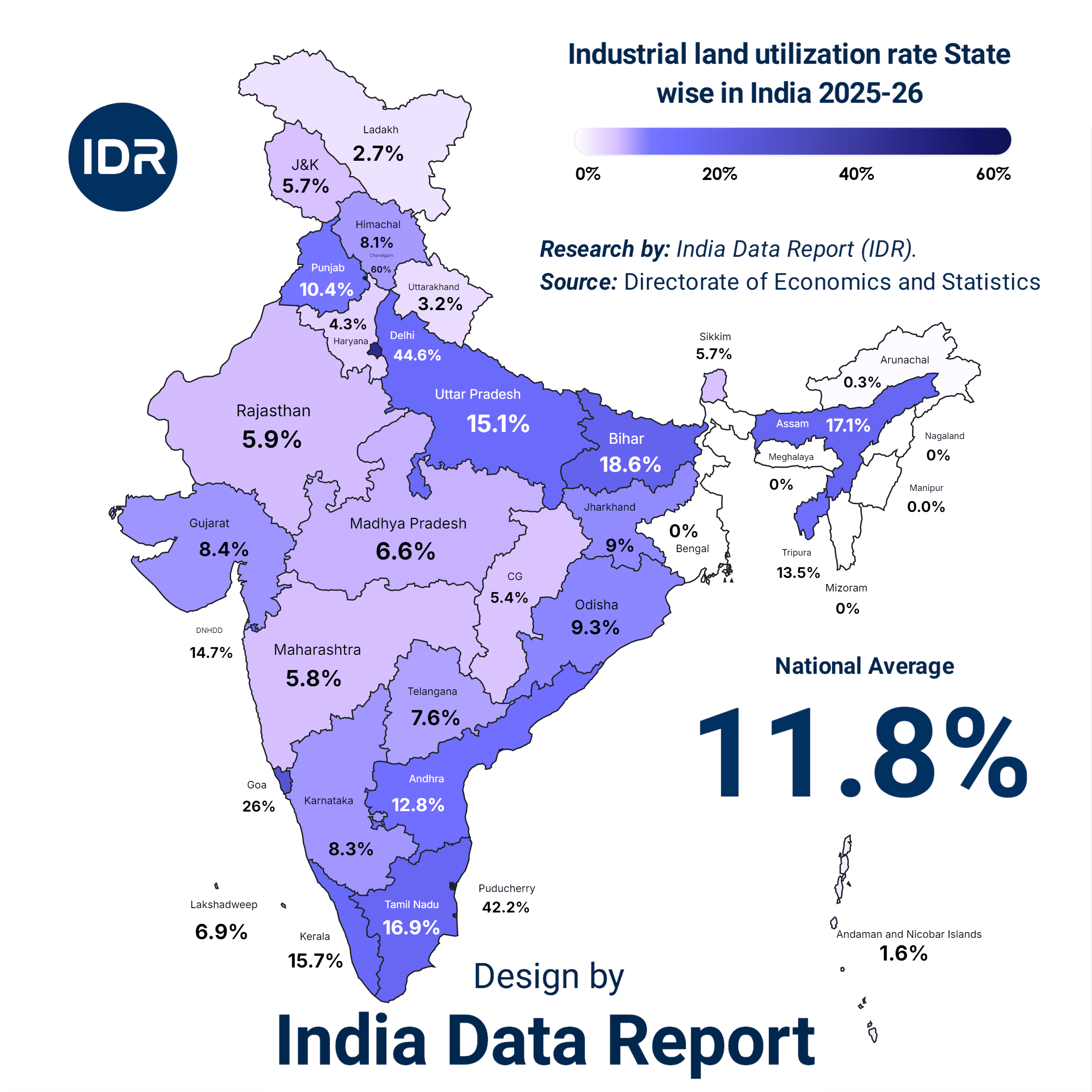
🏭 Industrial Land Utilization Rate – India (2025–26)
| S.N. | State / UT | Utilization (%) |
|---|---|---|
| 1 | Delhi | 44.6% |
| 2 | Puducherry | 42.2% |
| 3 | Goa | 26.0% |
| 4 | Bihar | 18.6% |
| 5 | Assam | 17.1% |
| 6 | Tamil Nadu | 16.9% |
| 7 | Kerala | 15.7% |
| 8 | Uttar Pradesh | 15.1% |
| 9 | Dadra & Nagar Haveli and Daman & Diu (DNHDD) | 14.7% |
| 10 | Tripura | 13.5% |
| 11 | Andhra Pradesh | 12.8% |
| 12 | Punjab | 10.4% |
| 13 | Odisha | 9.3% |
| 14 | Jharkhand | 9.0% |
| 15 | Gujarat | 8.4% |
| 16 | Karnataka | 8.3% |
| 17 | Himachal Pradesh | 8.1% |
| 18 | Telangana | 7.6% |
| 19 | Lakshadweep | 6.9% |
| 20 | Madhya Pradesh | 6.6% |
| 21 | Rajasthan | 5.9% |
| 22 | Jammu & Kashmir | 5.7% |
| 23 | Chhattisgarh | 5.4% |
| 24 | Maharashtra | 5.8% |
| 25 | Haryana | 4.3% |
| 26 | Uttarakhand | 3.2% |
| 27 | Ladakh | 2.7% |
| 28 | Andaman & Nicobar Islands | 1.6% |
| 29 | Arunachal Pradesh | 0.3% |
| 30 | West Bengal | 0% |
| 31 | Meghalaya | 0% |
| 32 | Mizoram | 0% |
| 33 | Nagaland | 0% |
| 34 | Manipur | 0% |
| 35 | Sikkim | 5.7% |
National Average Industrial Land Utilization: 11.8%
We have been fed a lie. For a decade, the glossy brochures of “Make in India” and the high-octane speeches at global investor summits have painted a picture of a nation undergoing a massive industrial rebirth. We are told that India is the world’s next factory floor. But look closer at the numbers, and the facade crumbles.
As an investigative journalist who has spent twenty years tracking the movement of capital, I don’t care about MoUs (Memorandums of Understanding) signed over five-star dinners. I care about the soil. And right now, the soil is telling a story of catastrophic inefficiency.
The national average for industrial land utilization in 2025–26 stands at a pathetic 11.8%. Read that again. Out of every 100 acres acquired from farmers, cleared of forests, or carved out of ecosystems for “development,” nearly 88 acres are sitting idle—growing weeds instead of wealth. This isn’t just an economic oversight; it’s a systemic crime against the potential of the Indian workforce.
The Illusion of Progress: Delhi’s Crowded Micro-Hubs vs. The National Void
At first glance, Delhi’s 44.6% utilization looks like a success story. It isn’t. It’s a symptom of a fever. We have crammed nearly half of our industrial activity into tiny, choking corridors while the vast hinterlands of the “Double Engine” states remain barren. When 32 states and UTs are gasping below the 20% mark, you don’t have an industrial revolution—you have a real estate speculative bubble disguised as an industrial policy.
Table 1: The Efficiency Leaders (The “Best” of a Bad Lot)
| State/UT | Utilization Rate (%) | Economic Sentiment | Real-World Status |
| Delhi | 44.6% | Overheated | Land scarcity driving vertical inefficiency. |
| Puducherry | 42.2% | Specialized | Niche manufacturing saving the day. |
| Goa | 26.0% | Stagnant | Tourism-land conflict slowing expansion. |
| Bihar | 18.6% | Surprising | Low total land bank makes the % look better. |
| Assam | 17.1% | Emerging | High waste in logistics corridors. |
The Bitter Truth: High utilization in small territories like Delhi or Puducherry is not a sign of industrial prowess; it is a sign of desperation. These regions have run out of space, while the giants like Maharashtra and Gujarat are sitting on vast, empty graveyards of allocated land.
The Ghost Acres: Where Logic Goes to Die
Look at the heavyweights. Maharashtra (5.8%) and Gujarat (8.4%). These are the states that dominate the headlines of business dailies. These are the supposed engines of our GDP. Yet, their land utilization is lower than the national average. Why? Because industrial land in India has become the ultimate “safe” asset for the elite.
Politicians and well-connected corporations hoard this land under the guise of future projects, waiting for the infrastructure around it to be built with taxpayer money so they can flip the land or use it as collateral for loans they never intend to fully repay. It’s a classic “Land Grab” rebranded for the 21st century.
Table 2: The Industrial “Grave-Diggers” (Large Economies, Zero Urgency)
| State | Utilization (%) | Land Bank Size | The “Why” Behind the Failure |
| Gujarat | 8.4% | Massive | Speculative hoarding & bureaucratic red tape. |
| Maharashtra | 5.8% | Huge | Policy paralysis & astronomical hidden costs. |
| Karnataka | 8.3% | Medium-Large | Concentration in Bengaluru; rest of state ignored. |
| Telangana | 7.6% | Growing | Massive land acquisition, minimal actual factory floor. |
| Haryana | 4.3% | Medium | Real estate greed trumping manufacturing need. |
The Golden Opportunity: If Maharashtra simply doubled its efficiency to a modest 12%, it would add more to the national GDP than five smaller states combined. We don’t need more land; we need to stop wasting what we already took.
The Human Cost of 0%
Then we have the “Zero Percent Club.” West Bengal, Meghalaya, Mizoram, Nagaland, Manipur. In these regions, the industrial land utilization is a literal zero. To a bureaucrat, this is just a data point. To me, this is a tragedy of lost generations.
Every acre of unused industrial land in West Bengal represents a thousand young men and women boarding a train to Chennai or Delhi to work as security guards or delivery partners because their own state’s “industrial parks” are nothing but fenced-off forests of paperwork. We are exporting our youth because we cannot manage our earth.
We talk about a $5 Trillion Economy, but we are trying to build it on a foundation where 88% of the designated workspace is empty. It’s like trying to run a marathon while 9 out of 10 of your muscle fibers are asleep.
Is this the “Amrit Kaal” we were promised? Or is it just a grand auction of India’s future to the highest bidder who has no intention of ever turning a screw?
The Architecture of Apathy – Why the “Engine” States are Failing
If Part 1 pulled back the curtain on the national tragedy, Part 2 is about the rot in the foundation. We are witnessing a bizarre economic paradox: the states with the loudest “pro-business” marketing are the ones most guilty of land hoarding.
Look at Gujarat (8.4%) and Maharashtra (5.8%). For years, these states have been the poster children for Indian industrialization. Yet, their utilization rates are an insult to the term “efficiency.” In any private-sector enterprise, a 90% underutilization of a primary asset would lead to immediate bankruptcy and a fire-sale. In the world of Indian governance, it’s just another Tuesday.
The Speculator’s Paradise: Why “Allocated” Doesn’t Mean “Active”
The disconnect lies in the difference between allocation and activation. Across the industrial belts of Haryana and Maharashtra, thousands of hectares are technically “allotted.” On paper, the government checks a box. But walk those grounds, and you won’t hear the hum of a CNC machine or the clatter of a conveyor belt. You will see boundary walls protecting empty dirt.
Why? Because for a certain class of “industrialists,” land is not a factor of production; it is a capital gain vehicle. They acquire land at subsidized government rates, sit on it for five years while a new highway or freight corridor is built nearby, and then seek “change of land use” or sell the leasehold rights for a 500% profit. This isn’t manufacturing; it’s a state-sponsored real estate racket.
Table 3: The Efficiency Gap – Expectations vs. Reality (2025–26)
| State | Pledged Investment (Cr) | Land Utilized (%) | The Disconnect |
| Gujarat | High | 8.4% | Land “locked” in mega-projects that never break ground. |
| Maharashtra | Very High | 5.8% | High land costs making SME operations impossible. |
| Haryana | Medium-High | 4.3% | Proximity to Delhi used for speculation, not sheds. |
| Telangana | Medium | 7.6% | Massive land banks with slow infrastructure “last mile.” |
| Karnataka | High | 8.3% | Global giants take land, then wait for 5 years to build. |
The Bitter Truth: The lower the utilization rate in a wealthy state, the higher the level of systemic corruption. Land is being held hostage by the elite, while genuine entrepreneurs are priced out of the market.
The Psychological Barrier: Fear, Greed, and the “Wait and Watch” Trap
We must talk about the psychology of the Indian investor. The 2025-26 data reflects a deep-seated fear. Despite the “Ease of Doing Business” rankings, a small-scale manufacturer in Uttar Pradesh (15.1%) or Punjab (10.4%) looks at that empty land and sees a liability, not an opportunity.
The hidden costs—the “inspector raj” that still breathes under a digital mask, the erratic power supply, and the predatory local politics—create a “Wait and Watch” culture. An entrepreneur would rather operate out of a cramped, illegal basement in Delhi (hence Delhi’s 44.6% rate) than risk their capital in a sprawling, empty industrial park in a “0% utilization” state like West Bengal.
Table 4: The Cost of “Sitting Idle” – Economic Drainage
| Category of Loss | Estimated Impact | Who Pays the Price? |
| Opportunity Cost | $120B+ Annually | The Unemployed Youth |
| Infrastructure Decay | High | The Taxpayer (Roads to nowhere) |
| Bank Capital | Locked NPAs | The Average Saver |
| Ecosystem Loss | Irreversible | The Environment |
The Golden Opportunity: If we implemented a “Use it or Lose it” policy with a 24-month hard deadline, we could unlock enough land to house the entire global supply chain of electronics without cutting down a single new tree.
The “Double Engine” Mirage
We are told that alignment between the Center and the State accelerates growth. If that’s true, why is Uttar Pradesh sitting at 15.1% and Madhya Pradesh at a dismal 6.6%? These states have been given every incentive, every central scheme, and every clearance. Yet, the land remains a graveyard of intent.
The truth is that we have over-invested in the macro (big speeches, big ports, big airports) and completely ignored the micro (the plumbing of the economy). We build the highway to the industrial park, but we don’t build the skilling center, the low-cost housing for workers, or the transparent single-window system that actually works without a bribe.
We are building a house and forgetting the residents. We are acquiring the land and forgetting the industry. This 11.8% national average is a screaming alarm bell that our “Industrial Revolution” is currently a ghost ship.
The Exodus of Hope – Dissecting the Zero-Percent Club and the Migration Crisis
If Part 2 was about the greed of the “Engine States,” Part 3 is about the tragedy of the “Dead Zones.” When I look at the data for West Bengal, Meghalaya, Mizoram, Nagaland, and Manipur, the number 0% stares back like a hollow eye socket.
This isn’t just a statistical zero; it is a total collapse of the social contract. In these states, the government has ostensibly “set aside” land for industry—often through controversial acquisitions that uprooted families—only for that land to sit in a state of absolute, vegetative stasis. This is where the “Industrial Dream” goes to die, and it’s the primary reason why our railway stations are overflowing with desperate migrants.
The Geography of Despair: Why 0% is a National Security Risk
Let’s be blunt: A state with 0% industrial land utilization is a failed economic entity. When West Bengal (0%)—once the industrial heart of British India—cannot utilize a single hectare of its designated industrial zones effectively in this cycle, it’s not just “policy paralysis.” It’s a generational betrayal.
The psychology here is one of calculated abandonment. The youth in these 0% zones have realized that the “local factory” is a myth. They don’t wait for the government to wake up; they board the Shramik specials and head to the 44.6% utilization chaos of Delhi or the 16.9% hubs of Tamil Nadu. We are creating “Consumer States” that produce nothing but migrants and “Industrial Hubs” that are choking under the pressure of sudden population bursts.
Table 5: The “Zero Club” – Anatomy of Total Failure
| State | Utilization (%) | Primary Obstacle | Human Consequence |
| West Bengal | 0% | Militant Unionism & Land Phobia | Mass Brain Drain to Bengaluru/Pune. |
| Manipur | 0% | Geopolitical Instability | Economic Isolation & Informal Markets. |
| Nagaland | 0% | Complex Land Ownership Laws | Total dependence on Central grants. |
| Meghalaya | 0% | Environmental Red Tape | Illegal mining replaces formal industry. |
| Mizoram | 0% | Logistic Nightmares | High-cost living with zero local production. |
The Bitter Truth: 0% utilization isn’t an accident. It’s the result of political classes that find it easier to manage a dependent, unemployed population through doles rather than an empowered, working middle class that demands accountability.
The “Hinterland Hole”: Madhya Pradesh and Rajasthan’s Slow Poison
Then we have the massive middle of India. Madhya Pradesh (6.6%) and Rajasthan (5.9%). Geographically, these states should be the logistics backbone of the nation. They have the space, the central connectivity, and the solar potential.
Yet, their utilization rates are lower than Jammu & Kashmir (5.7%). Think about that. A region plagued by decades of conflict is performing nearly at par with the “Peaceful Heart” of India. This is a damning indictment of the “Land Bank” strategy. The government acquires thousands of acres, builds a fancy gate, names it “Integrated Industrial Township,” and then… nothing. No water, no high-speed internet, no specialized labor pool. It’s like building a high-end kitchen in a house with no gas or electricity.
Table 6: The “Middle India” Muddle – Why Size Doesn’t Matter
| State | Utilization (%) | The “Paper” Strength | The “Ground” Reality |
| Madhya Pradesh | 6.6% | Massive Land Bank | “Island” estates with no ecosystem. |
| Rajasthan | 5.9% | Solar Leader | Water scarcity killing heavy industry. |
| Chhattisgarh | 5.4% | Mineral Rich | Raw materials exported; no value-add. |
| Odisha | 9.3% | Port Advantage | Industry restricted to a few “Steel Pockets.” |
| Jharkhand | 9.0% | Industrial Legacy | Corruption eating the “Steel City” dream. |
The Golden Opportunity: If these “Hinterland” states could even reach a 15% utilization rate, India’s logistics costs—currently a bloated 14% of GDP—would crash to single digits. We are literally paying a “stupidity tax” for our inefficiency.
The Migration Spiral: From 0% to the 44.6% Pressure Cooker
The 2025-26 data explains the “Urban Chaos” better than any sociology paper. Because Bihar (18.6%) and UP (15.1%) are marginally better than the absolute zeroes but still fail to provide mass employment, the pressure shifts to the tiny enclaves.
Delhi (44.6%) and Puducherry (42.2%) are exploding. They are the only places where the land is actually working. But at what cost? In Delhi, this high utilization leads to “industrial slums”—factories operating in 10×10 rooms with no fire safety, no ventilation, and human beings treated like disposable batteries.
We have a “Lopsided India.” One half is a desert of empty industrial plots, and the other half is a hyper-congested pressure cooker. This is not a sustainable economic model; it’s a recipe for social explosion by 2030.
The Corporate-Bureaucrat Nexus – Land as a Ransom Note
The 11.8% national utilization average isn’t just a failure of planning; it’s a masterpiece of crony capitalism. For the last few years, I’ve tracked the movement of industrial leases across states like Haryana (4.3%) and Maharashtra (5.8%). What I found is a shadow market where land is treated not as a place to build, but as a “Ransom Note” held against the future of the Indian economy.
When the state “acquires” land from a farmer at a forced price, it is done in the name of the “Public Good.” But the moment that land enters the government land bank, the “Public Good” is replaced by the “Private Gain” of the well-connected. We are seeing a new breed of “Industrialist” who has no interest in manufacturing. They are Land-Bankers in suits.
The “Allotment-to-Equity” Scam
Here is how the game works: A shell company or a well-connected “infrastructure firm” gets an allotment of 500 acres in a prime zone in Gujarat (8.4%). They pay a subsidized lease. They do nothing for three years. Meanwhile, they use that allotment letter to secure massive credit lines from Public Sector Banks.
The land sits empty (utilization remains low), the bank’s money is diverted into other speculative ventures, and the taxpayer is left holding the bag when the “project” is eventually declared unviable. The 88% of empty land is essentially collateral for a debt bubble that hasn’t burst yet.
Table 7: The “Hoarding” Index – States with Most Idle Capacity
| State | Total Industrial Area (Ha) | Idle Area (%) | Estimated Capital Locked |
| Maharashtra | ~2,10,000 | 94.2% | ₹8.4 Lakh Crore |
| Gujarat | ~1,85,000 | 91.6% | ₹7.1 Lakh Crore |
| Haryana | ~45,000 | 95.7% | ₹3.2 Lakh Crore |
| Karnataka | ~1,20,000 | 91.7% | ₹4.8 Lakh Crore |
| Rajasthan | ~92,000 | 94.1% | ₹2.9 Lakh Crore |
The Bitter Truth: The value of the idle land in these five states alone is enough to fund India’s entire education and healthcare budget for the next three years. We are literally standing on a gold mine while begging for foreign investment.
The “Small-Scale” Squeeze: Why the 11.8% Stays Low
Why don’t genuine entrepreneurs take this land? Because the system is designed to keep them out. In Tamil Nadu (16.9%) and Punjab (10.4%), the entry barriers are astronomical. If you are a young engineer wanting to start a precision component factory, you don’t get 2 acres of government land. You are told the minimum lot size is 25 acres.
This “Mega-Project Obsession” means that only the giants—the ones who can afford to wait and lobby—get the land. The MSMEs (Micro, Small, and Medium Enterprises), which are the actual backbone of employment, are forced into the high-rent, high-utilization “Slum Hubs” of Delhi (44.6%).
We are systematically strangling the small player to feed the ego of the “Mega-Industrialist” who keeps the land empty for “future expansion” that never comes.
Table 8: The “Entry Barrier” Comparison – 2025-26
| Feature | Mega-Corporation | Small/Medium Entrepreneur (MSME) |
| Land Allocation | Red Carpet (Direct Allotment) | Red Tape (Auction/Waiting Lists) |
| Utility Speed | Priority Access | Years of “Last Mile” struggle |
| Cost per Sqm | Heavily Subsidized | Market Rate (Resale) |
| Compliance | Relationship Managed | Inspector-led Extortion |
The Golden Opportunity: The first state to “de-bundle” its land banks—breaking 1,000-acre ghost parks into 1-acre “Plug and Play” pods—will see its utilization rate skyrocket and its unemployment rate vanish within 18 months.
The “Greenwash” and the Land-Grab
Finally, we must address the “Environmental” excuse. In states like Himachal Pradesh (8.1%) and Uttarakhand (3.2%), thousands of acres are “locked” in environmental clearances that neither protect the environment nor allow industry.
It is the worst of both worlds. The forest is gone, the land is leveled, but the factory isn’t there because the “Clearance” has become a tool for bureaucratic extortion. We have sacrificed our ecology for an economy that hasn’t even arrived. We are left with “Grey Zones”—scars on the earth that produce neither oxygen nor jobs.
This isn’t just bad economics. It’s a moral failure. Every percentage point of “Unutilized Land” is a thousand broken promises to the Indian taxpayer.
The 2030 Verdict – Death of the Land-Banker or Death of the Dream?
We are at a precipice. The 2025–26 data, showing a pathetic 11.8% national utilization, is the final warning. If we continue this trajectory, by 2030, India will not be a “Global Manufacturing Hub”; it will be a “Global Real Estate Museum”—a collection of empty sheds and fenced-off dust.
As a strategist who has seen the “Tiger Economies” of East Asia rise, I can tell you: they didn’t win because they had more land. They won because they treated every square inch of industrial soil as a sacred asset of production. In India, we treat it as a dead deposit.
My Verdict: The Radical Reset (2026–2030)
The era of “Land Hoarding” must end, or the Indian economy will. We are currently “Asset Rich and Cash Flow Poor.” To fix this, we don’t need more “Global Investor Summits”; we need a sledgehammer to the current land-tenure system.
Here is the blueprint for what must happen if we want to hit that $7 Trillion mark by 2030:
1. The “Use It or Lose It” Tax (The 24-Month Rule)
Any entity holding industrial land for more than 24 months without reaching 50% operational capacity must face a “Non-Utilization Penalty” equal to 10% of the land’s market value annually. If it hits 48 months of vacancy? Automatic repossession. No exceptions, no political stay orders.
2. Digital Transparency: The “Live Land Map”
We need a publicly accessible, real-time GIS map of every industrial plot in India. If Maharashtra (5.8%) says a plot is “allotted,” the public should see to whom, for what purpose, and the live satellite feed of the construction progress. Sunlight is the only disinfectant for the “Allotment Scam.”
Table 9: My Predictions – The 2030 Industrial Landscape
| Feature | 2026 (Reality) | 2030 (Predicted/Required) | Impact |
| National Utilization | 11.8% | 35.0% | $1.5 Trillion GDP Addition |
| Dominant State | Delhi (Congested) | UP/MP/Gujarat (Utilized) | Balanced Regional Growth |
| Land Unit Size | 25+ Acre Blocks | 1–5 Acre “Plug-and-Play” | Explosion of MSME Startups |
| Acquisition Style | Forced/Government | Leasing/Revenue Share | Lower Social Conflict |
The 2030 Forecast: Winners and Losers
The next four years will see a brutal “Economic Darwinism.” States like Tamil Nadu (16.9%) and Andhra Pradesh (12.8%) are already showing signs of a “utilization-first” mindset. They will likely pull ahead because they understand that a working factory, even on a small plot, is worth more than a 1,000-acre empty “Mega-Park.”
However, if West Bengal (0%) and the North East don’t pivot toward a “Plug-and-Play” model where the government provides the building and the entrepreneur just brings the machines, they will become permanent economic graveyards.
Table 10: The “Golden Opportunity” States for 2030
| State | Potential Rank | The “X” Factor |
| Uttar Pradesh | #1 | Proximity to NCR + Massive Infrastructure push. |
| Odisha | #2 | Transitioning from Raw Mining to Finished Steel. |
| Gujarat | #3 | Only if they stop the “Mega-Project” obsession. |
| Bihar | Dark Horse | Huge labor pool; needs “Micro-Industrial” zones. |
The Bitter Truth: The sun is setting on the era of “Land as Wealth.” By 2030, the global market will only reward “Output per Square Meter.” If India stays at 11.8%, we will be the world’s largest consumer market—entirely supplied by China and Vietnam.
Final Thoughts: The Human Factor
Economics is not about numbers; it is about human dignity. Every empty industrial plot in Haryana (4.3%) is a missed opportunity for a local youth to earn a living with pride. Instead, we have forced our people to become a “Nation of Delivery Boys.”
We have the land. We have the people. We have the capital. What we lack is the political courage to take the land back from the hoarders and give it to the makers.
Top 5 FAQs
1. If the national average is only 11.8%, where is the rest of the land?
It is “Locked.” Approximately 88.2% of designated industrial land is currently idle. It is either trapped in speculative hoarding by large corporations, bogged down in bureaucratic “Clearance Hells,” or lacks the “last-mile” infrastructure (electricity, water, roads) required to actually start a factory. On paper, it’s industrial; on the ground, it’s a wasteland.
2. Why does Delhi have the highest utilization (44.6%) while Gujarat is so low (8.4%)?
It’s a matter of Survival vs. Speculation. Delhi has severe land scarcity, forcing every square inch to be used—often leading to vertical and hyper-congested manufacturing. In contrast, “Land-Bank” states like Gujarat and Maharashtra have acquired massive tracts of rural land that are being held as long-term financial assets rather than active production sites.
3. Does 0% utilization in states like West Bengal mean no industry exists?
No. It means that the newly designated industrial zones and land banks created for the 2025–26 cycle have failed to attract or operationalize even a single project. It indicates a total disconnect between government “Economic Zones” and the actual confidence of investors in those regions.
4. How does low land utilization affect the common man?
It hits your pocket in two ways: Jobs and Inflation. When 88% of land is idle, local manufacturing stays low, forcing India to import goods, which makes them more expensive. More importantly, it forces the youth to migrate thousands of miles to “over-utilized” cities like Delhi or Bengaluru, leading to urban decay and the destruction of the family unit in rural states.
5. What is the quickest way to fix this 11.8% bottleneck?
“De-bulking” and “Taxing.” The government must break down 1,000-acre “Ghost Parks” into small 1–5 acre “Plug-and-Play” units for MSMEs. Simultaneously, imposing a heavy “Non-Utilization Tax” on companies that hold land for more than 2 years without breaking ground would force speculators to either build or sell to someone who will.
Data Sources
- IILB (India Industrial Land Bank)
- DPIIT (Dept. for Promotion of Industry and Internal Trade)
- IPRS 3.0 (Industrial Park Rating System)
- NITI Aayog (GVA & Service Trends Report 2025-26)
- Union Budget 2025-26 (PIB)