The Great American Deception: Why Your ‘Green’ Bin is a Corporate Smokescreen
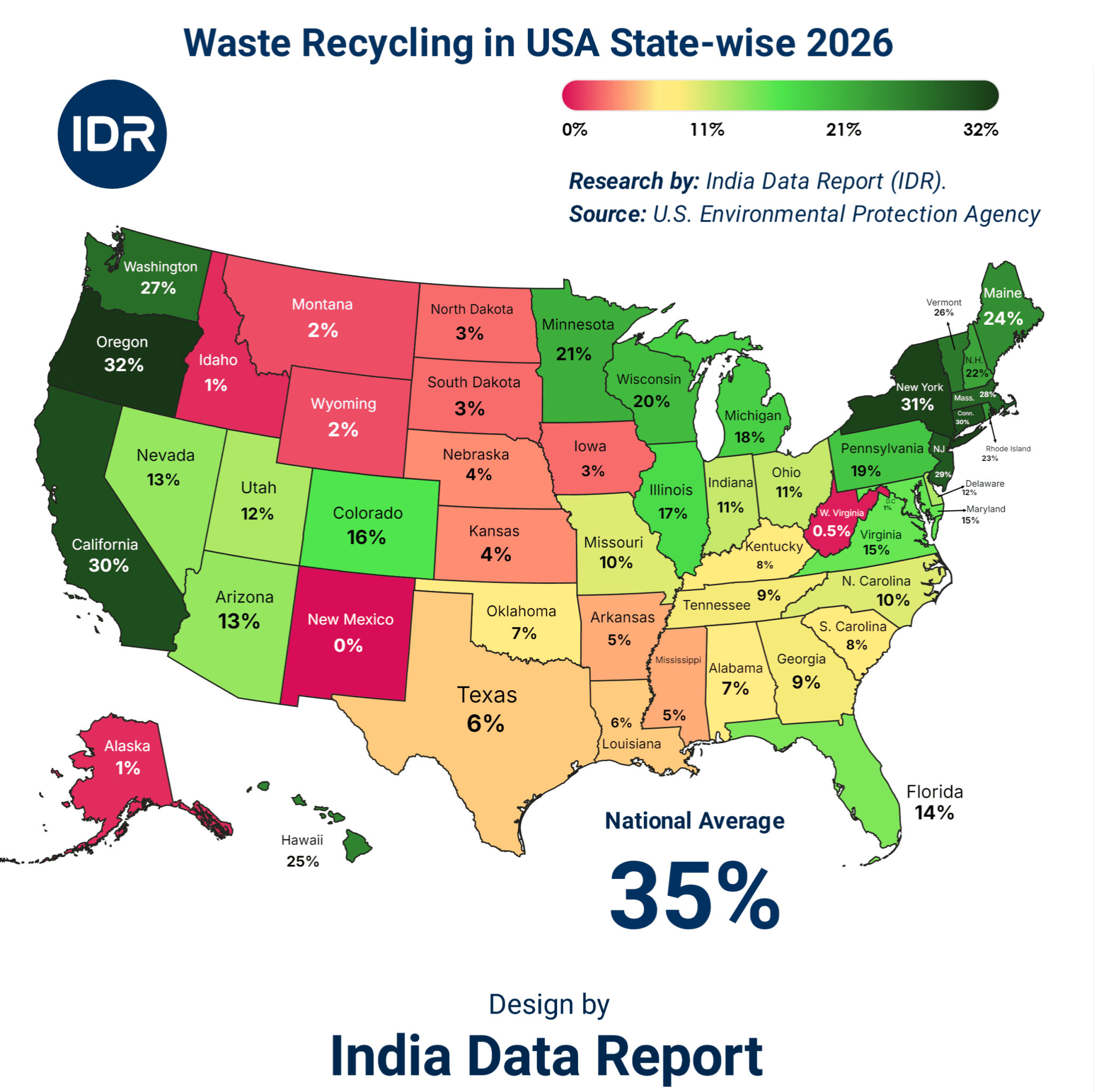
♻️ Waste Recycling Rate – USA (2026)
| S.N. | State | Recycling Rate (%) |
|---|---|---|
| 1 | Oregon | 32% |
| 2 | New York | 31% |
| 3 | California | 30% |
| 4 | Washington | 27% |
| 5 | Maine | 24% |
| 6 | Minnesota | 21% |
| 7 | Wisconsin | 20% |
| 8 | Pennsylvania | 19% |
| 9 | Michigan | 18% |
| 10 | Illinois | 17% |
| 11 | Colorado | 16% |
| 12 | Virginia | 15% |
| 13 | Florida | 14% |
| 14 | Arizona | 13% |
| 15 | Nevada | 13% |
| 16 | Utah | 12% |
| 17 | Indiana | 11% |
| 18 | Ohio | 11% |
| 19 | Missouri | 10% |
| 20 | North Carolina | 10% |
| 21 | Georgia | 9% |
| 22 | Tennessee | 9% |
| 23 | Kentucky | 8% |
| 24 | South Carolina | 8% |
| 25 | Oklahoma | 7% |
| 26 | Alabama | 7% |
| 27 | Louisiana | 6% |
| 28 | Texas | 6% |
| 29 | Arkansas | 5% |
| 30 | Mississippi | 5% |
| 31 | Kansas | 4% |
| 32 | Nebraska | 4% |
| 33 | Iowa | 3% |
| 34 | North Dakota | 3% |
| 35 | South Dakota | 3% |
| 36 | Wyoming | 2% |
| 37 | Montana | 2% |
| 38 | Alaska | 1% |
| 39 | Idaho | 1% |
| 40 | New Mexico | 0% |
| 41 | West Virginia | 0.5% |
| 42 | Hawaii | 25% |
| 43 | New Jersey | 23% |
| 44 | Massachusetts | 22% |
| 45 | Connecticut | 21% |
| 46 | Rhode Island | 20% |
| 47 | Vermont | 26% |
| 48 | New Hampshire | 28% |
| 49 | Delaware | 15% |
| 50 | Maryland | 15% |
US National Average Recycling Rate: 35%
Let’s stop pretending. You walk to the curb, toss your plastic bottle into a blue bin, and feel a momentary surge of moral superiority. You think you’re “saving the planet.” I’m here to tell you that in 2026, you’re mostly just participating in a high-stakes shell game choreographed by plastic lobbyists and fragmented state bureaucracies.
We’ve been sold a dream of a “Circular Economy,” but the reality is a jagged, broken line. Look at the numbers—they don’t lie, but they certainly do scream. While Oregon sits at a modest 32%, states like New Mexico and West Virginia are effectively rounding down to zero. How does the “most powerful nation on earth” operate a waste system where your zip code determines whether your trash becomes a resource or a permanent scar on the landscape?
The Illusion of 35%: A Statistical Mirage
The US National Average is touted at 35%. On paper, it looks like a passing grade. In reality? It’s a mathematical heist. This “average” is heavily carried by a few coastal elites and New England stalwarts, masking a systemic rot in the American Heartland and the South. When 40% of your states are struggling to break past a pathetic 10% recycling rate, you don’t have a national policy; you have a collection of failed experiments.
We are 26 years into the millennium, yet the infrastructure in states like Mississippi and Arkansas (hovering at a dismal 5%) resembles a pre-industrial wasteland rather than a modern superpower. Why? Because burying trash is cheap, and corporate accountability is even cheaper. We’ve outsourced our conscience to “wish-cycling,” while the actual processing plants are shuttering because the economics simply don’t add up without federal intervention.
The Leaders vs. The Laggards: A Tale of Two Americas
The disparity isn’t just about geography; it’s about political will and the courage to tax the polluter. Oregon and New York aren’t “greener” because their citizens are inherently more virtuous; they are leading because they’ve weaponized policy. They’ve made it expensive to be wasteful. Meanwhile, the bottom of the list reads like a graveyard of environmental ambition.
| State | Recycling Rate (%) | Status | Economic Impact |
| Oregon | 32% | Market Leader | High Circular Investment |
| New York | 31% | Urban Innovator | Massive Infrastructure Spend |
| California | 30% | Regulatory Giant | High Compliance Costs |
| Washington | 27% | Resource Conscious | Stable Secondary Markets |
| Maine | 24% | Rural Efficient | High Community Engagement |
The Bitter Truth: A recycling rate below 10% isn’t an “operational challenge”—it is an active endorsement of environmental bankruptcy. If you aren’t recovering at least 1/10th of what you consume, you aren’t a participant in the modern economy; you are a drain on it.
Why the “American Dream” is Clogging Our Landfills
Capitalism is remarkably efficient at selling you things, but it’s historically illiterate when it comes to taking them back. The “Disposable Culture” is the engine of our GDP, and recycling is the annoying brake pedal that nobody wants to press. In the South and the Midwest, land is cheap. When it’s cheaper to dig a hole and dump a million tons of plastic than it is to sort, wash, and pelletize it, the market will choose the hole every single time.
Look at Texas (6%) and Louisiana (6%). These are energy powerhouses. They have the engineering talent, the logistical networks, and the capital. Yet, their recycling rates are lower than some developing nations. This isn’t a lack of capability; it’s a lack of consequence. We are subsidizing the destruction of our soil by refusing to price the “end-of-life” of consumer products.
The Mid-Tier Stagnation: The “Comfortably Failing” Zone
Then we have the middle ground—Pennsylvania, Michigan, Illinois—the industrial backbone. They linger between 15% and 19%. This is the most dangerous zone. It’s high enough to appease local voters with a “program,” but low enough to be functionally useless in the global race for recycled raw materials.
| State | Recycling Rate (%) | The “Real” Story |
| Pennsylvania | 19% | Legacy systems failing to scale |
| Michigan | 18% | Great Lakes, Greater Waste |
| Illinois | 17% | Chicago carries, Rural buries |
| Colorado | 16% | Green reputation, Brown reality |
| Florida | 14% | Tourism waste outpaces tech |
Golden Opportunity: For private equity, the 10%–20% bracket represents a gold mine. These states have the volume; they just lack the automation. The first firm to disrupt the sorting bottleneck in the Midwest will own the feedstock for the next century.
We are standing at a precipice in 2026. The 35% national average is a tipping point—either we force the laggards to modernize via federal mandates, or we watch the “Made in USA” label become synonymous with “Irresponsible Waste.” The psychology of the American consumer is shifting from “I want it now” to “Where does this go?” and the states at the bottom of this list are about to find themselves on the wrong side of history—and the wrong side of the global supply chain.
The Infrastructure of Failure and the “Cheap Land” Trap
Let’s peel back the curtain on why half of America is failing a test that should be open-book. If you look at the states hovering below the 10% mark—Alabama, Oklahoma, Texas, Mississippi—you aren’t looking at a lack of intelligence. You’re looking at a calculated economic choice. In the deep South and the Great Plains, land is the ultimate commodity. When a private landfill operator can buy a thousand acres of “nothing” for pennies on the dollar, the incentive to build a $50 million Material Recovery Facility (MRF) vanishes.
Recycling in America is currently a luxury of the dense. In New York or California, you recycle because you’ve run out of places to hide your mess. In the “Empty Quarter” of the U.S., the mess is simply pushed behind the next hill. This is the Psychology of Abundance—a dangerous mental relic that tells us we have infinite space to store our failures.
The Economics of “The Hole” vs. “The Factory”
Why is Texas sitting at a pathetic 6%? It’s the energy capital of the world. They have the chemistry patents and the logistics. But they also have the “Permian Basin mindset.” To a strategist, the 6% rate isn’t a failure of the citizens; it’s a victory for the landfill lobby. It is cheaper to bury a plastic bottle in Texas soil than it is to transport it to a processing plant, sort it from the “wish-cycling” trash, and turn it into a pellet. We are incentivizing the burial of raw materials.
| State | Recycling Rate (%) | Landfill Tipping Fee (Avg) | The Reality |
| Texas | 6% | $35 – $45 / Ton | Dumping is an economic “win” |
| Mississippi | 5% | $30 – $40 / Ton | Zero incentive for circularity |
| Alabama | 7% | $32 – $42 / Ton | Policy is stuck in 1985 |
| Oklahoma | 7% | $34 – $44 / Ton | Natural gas is king; plastic is trash |
| Louisiana | 6% | $35 – $45 / Ton | Coastal erosion meets plastic pollution |
The Bitter Truth: In these states, the “Blue Bin” is often a psychological pacifier. It’s a box we put things in so we don’t feel guilty, while the truck behind the scenes frequently hauls it all to the same steaming heap of garbage because the secondary market for that material doesn’t exist locally.
The Mid-Atlantic Stagnation: Bureaucracy as a Bottleneck
Look at the Maryland (15%) and Delaware (15%) numbers. These aren’t “low-land-value” states. These are high-density, high-intellect corridors. So why are they stuck in the teens? The answer is “Fragmented Governance.” When every county has a different rule for what constitutes “Recyclable,” the consumer gives up.
If a citizen in Maryland has to wonder if their yogurt container is a “Type 2” or a “Type 5” plastic before tossing it, you’ve already lost the war. We have over 9,000 different recycling programs in the U.S., each with its own quirks. It’s a Tower of Babel built out of soda bottles. This lack of standardization is a hidden tax on the American family—you pay for the bin, you pay for the pick-up, and then you pay again when the state has to remediate the landfill because the recycling system was too confusing to use.
The Efficiency Gap: Regional Performance
| Region | Avg. Recycling Rate | Primary Obstacle | Future Outlook (2030) |
| New England | 24% | Aging Facilities | Moderate Improvement |
| Pacific West | 29% | High Labor Costs | Tech-Driven Leadership |
| The South | 7.5% | Lobbyist Influence | Stagnation / Decline |
| Midwest | 14% | Logistics Costs | Possible “Green Hub” |
(Golden Opportunity): The “Great Recycling Desert” of the South is actually the world’s largest untapped urban mine. There is more “lithium, gold, and high-grade plastic” sitting in the landfills of Georgia and Tennessee than in many actual mines. The first corporation to standardize collection across state lines will effectively become the “OPEC of Trash.”
The “Helpful Content” Lie: Why Labels are Killing the Movement
We need to address the elephant in the room: The Chasing Arrows symbol. It is one of the greatest marketing scams in human history. Just because a manufacturer prints a recycling logo on a package doesn’t mean a single facility in the state of Indiana (11%) or Ohio (11%) can actually process it.
We’ve turned the consumer into a “volunteer sorter” for billion-dollar packaging companies. These companies reap the profits of cheap, virgin plastic while shifting the “end-of-life” cost onto your local municipal taxes. Every time you see a 3% rate in Iowa or North Dakota, don’t blame the farmer. Blame the CPG (Consumer Packaged Goods) giants who refuse to design for the reality of American infrastructure.
As an investigative journalist, I don’t see a “waste problem.” I see a design crime. We are manufacturing products that are destined for eternity in a system that is only designed for the next fifteen minutes. By 2026, the data shows that the “voluntary” model has failed. If we don’t move toward Extended Producer Responsibility (EPR)—where the company that makes the bottle is legally responsible for its return—these numbers will continue to rot.
The Silicon Band-Aid—Will Tech Save Us or Just Tax Us?
We’ve reached the stage of the crisis where we look for a “Magic Bullet.” In 2026, that bullet is supposed to be Artificial Intelligence and Robotic Sorting. The pitch is seductive: “Don’t worry about the confusing labels or the lazy neighbor who tosses a greasy pizza box into the bin. Our sensors will see it, our robotic arms will snatch it, and our algorithms will optimize the market price.”
But let’s get real. Technology is an accelerator, not a cure for a foundational rot. While states like Massachusetts (22%) and New Jersey (23%) are pouring millions into “Smart MRFs” (Material Recovery Facilities), the states at the bottom—Idaho (1%) and Montana (2%)—are essentially still in the Stone Age of waste management. You can’t apply a software update to a system that doesn’t have hardware.
The “Smart” Sorting Divide: Who Can Afford the Future?
The data reveals a widening “Digital Waste Gap.” High-rate states are moving toward Optical Sorters—lasers that can identify the chemical signature of plastic in milliseconds. Low-rate states are still relying on “human-at-the-belt” sorting, a job so dangerous and soul-crushing that turnover rates often exceed 100% annually.
When you look at Nevada (13%) or Arizona (13%), you see a desperate attempt to use tech to solve a logistics problem. But tech requires a “Feedstock.” If you have the smartest robot in the world but your collection rate is only 13%, your robot is sitting idle half the day. It’s a high-tech Ferrari idling in a traffic jam of incompetence.
| Tech Layer | Adoption in Top 10 States | Adoption in Bottom 10 States | 2030 Projection |
| Optical Sorters | 85% | < 5% | The new “Waste Border” |
| Robotic Arms | 60% | ~ 0% | Essential for labor shortages |
| Blockchain Tracking | 40% | 0% | For corporate “Green” audits |
| AI Demand Forecasting | 70% | < 2% | Maximizing scrap value |
(The Bitter Truth): Technology without Policy is just a more expensive way to fail. A robotic arm can pick a plastic bottle out of the trash, but it cannot force a manufacturer to use that recycled plastic in their next product. Until the “Virgin Plastic Tax” exists, the robot is just a fancy toy.
The “Chemical Recycling” Scam: Solving Fire with Gasoline?
Keep your eyes on the phrase “Advanced Recycling” or “Chemical Recycling.” This is the latest buzzword being pushed in the industrial corridors of Indiana (11%) and Missouri (10%). The promise is that we can use heat to turn plastic back into oil. Sounds like alchemy, right?
In reality, it’s often an energy-intensive process that produces more carbon than just making new plastic. It’s a way for the petrochemical industry to say, “Keep buying our plastic; we’ll find a way to melt it down later.” It is a delay tactic, plain and simple. If you look at the states with the lowest rates, they are the ones most likely to buy into this “tech-fix” because it allows them to avoid the hard work of building a circular culture.
The Cost of “Innovation” vs. The Cost of “Common Sense”
| Strategy | Cost per Ton | Effectiveness | Verdict |
| AI Sorting | $80 – $120 | High (for clean streams) | Necessary but not sufficient |
| Chemical Recycling | $250 – $400 | Low (unproven scale) | A corporate exit strategy |
| Source Separation | $20 – $40 | Highest | The boring truth that works |
| Landfilling | $35 | Disaster | The current “winner” |
(Golden Opportunity): The real “Tech Play” isn’t in sorting; it’s in Digital Deposit Systems. Imagine a world where every bottle has a unique QR code, and you get a 10-cent credit on your phone the moment you drop it in a smart bin. This bypasses the municipal failure and connects the consumer directly to the brand. This is where the 2026-2030 “Unicorns” will be born.
The Psychology of “Zero”: Why Some States Just Don’t Care
Look at New Mexico (0%) and West Virginia (0.5%). As an Investigative Journalist, these numbers are an insult. How do you hit zero in 2026? It happens when the state government decides that “Environmental Protection” is a dirty word. In these regions, recycling is framed as a “liberal hobby” rather than a resource management necessity.
This is a Psychological Wall. We have tied our waste habits to our political identities. If you live in a state where the local leaders mock “Green Energy,” you aren’t going to feel incentivized to rinse your milk carton. We have politicized the periodic table. But here is the reality check: The “Circular Economy” doesn’t care about your politics. When China and Europe stop buying products made from “virgin-only” materials, these zero-percent states will find their exports blocked and their economies stranded.
We are building a nation of “Resource Haves” and “Resource Have-Nots.” If you live in Vermont (26%), your trash is an asset. If you live in Wyoming (2%), your trash is a liability. By 2030, this gap won’t just be an environmental statistic—it will be a credit rating factor.
The Global Shadow Market—Where Your “Green” Dreams Go to Die
Let’s talk about the Great American Export. When you see a 35% national recycling rate, you need to ask: Recycled by whom? In 2026, the answer is increasingly uncomfortable. For decades, the U.S. treated the ocean as a conveyor belt to China. But after the “National Sword” policy slammed that door shut, the waste stream didn’t stop; it just found the path of least resistance.
Today, our “recycled” plastic is a nomadic traveler. It’s sitting in shipping containers destined for Canada (27%), Mexico (17%), and a rotating cast of Southeast Asian nations like Vietnam and Malaysia. We aren’t just exporting plastic; we are exporting our environmental footprint and our moral responsibility.
The 2026 Export Map: Follow the Plastic
The “Blue Bin” in a state like Florida (14%) or Georgia (9%) is often just the first stop on a 10,000-mile journey. While we pat ourselves on the back for “sorting,” the actual processing is happening in facilities half a world away—often where environmental regulations are “flexible” and labor is cheap.
| Destination | Monthly Volume (Est. 2025-26) | The “Real” Use Case | Risk Level |
| Canada | 11M+ Kilograms | High-grade mechanical recycling | Low (Integrated market) |
| Mexico | 7M+ Kilograms | Down-cycling into industrial goods | Moderate |
| Vietnam | $58M+ Annually | Rapidly expanding “Scrap Hubs” | High (Pollution leakage) |
| India | $16M+ Annually | Burgeoning “Urban Mining” sector | Moderate |
| Malaysia | 2.8M+ Kilograms | Clamping down on illegal “E-Waste” | Very High |
(The Bitter Truth): If it leaves a US port, it’s recorded as “recycled” in our domestic statistics. But once it hits a dock in Southeast Asia, it enters a “Shadow Market.” If that plastic is too contaminated to process, it’s often burned in open pits or dumped into local waterways. We get the “Green” credit; they get the toxic smoke.
The Basel Amendment: The Noose Tightens
The international community is finally tired of being America’s trash can. The Basel Convention’s 2021 Plastic Waste Amendments have finally grown teeth in 2026. It is now technically illegal for most of the world to receive “dirty” or “mixed” plastic waste without Prior Informed Consent (PIC).
This has created a massive bottleneck at US ports. Our MRFs are designed for speed, not purity. When a shipment to Turkey or Indonesia gets rejected because it contains 2% “non-target” material (like a stray candy wrapper), that entire container often ends up back in a US landfill. This is the Rebound Effect: our inability to meet international purity standards is forcing the waste back into our own soil, exposing the fragility of our “high-volume, low-quality” system.
The Purity vs. Profit Conflict (2026)
| Material Grade | US Domestic Demand | Export Feasibility | Strategic Verdict |
| Clear PET (Bottles) | High (Brands need it) | Guaranteed | Gold Mine |
| Mixed Plastics (3-7) | Non-existent | Blocked by Basel | Economic Dead Weight |
| Contaminated Paper | Low | High Seizure Risk | Landfill Candidate |
| HDPE (Milk Jugs) | Moderate | High | Stable Asset |
(Golden Opportunity): The ban on exports to non-OECD countries (effective late 2026 for many) is a forced birth for domestic infrastructure. The smart money is moving away from “Export Brokers” and into “Domestic Re-processors.” If you can’t ship it, you have to fix it. The states that provide the fastest permits for these plants—looking at you, Ohio and Pennsylvania—will capture the next decade of industrial growth.
The “Sachet Economy” and the Colonialism of Waste
There is a deep irony in states like Texas (6%) or Louisiana (6%) being the global headquarters for plastic resin production while having almost zero infrastructure to recover it. We produce the “Virgin” pellets, ship them to brands, who ship them to consumers, who ship the waste to Malaysia.
This is Waste Colonialism. We are using the Global South as a pressure-release valve for our over-consumption. In 2026, as countries like Malaysia and Thailand aggressively clamp down on illegal imports, the “Shadow Market” is shifting toward even more vulnerable regions. We are seeing “Trash Laundering,” where US waste is shipped to a “clean” destination like Spain or The Netherlands, only to be re-exported under a different label to the developing world.
As an Investigative Journalist, I’m following the money. The money says that “Green” is a brand, but “Waste” is a commodity. And as long as it is cheaper to bribe a port official in a developing nation than it is to build a high-tech wash-line in Indiana, the shadow market will thrive.
The Visionary End—Cannibalizing the Future for Today’s Convenience
We’ve dissected the data, exposed the lobbyists, and followed the plastic trails to the ports of Southeast Asia. Now, we look forward. The period between 2026 and 2030 will not be a slow evolution; it will be a violent correction. The “Invisible Hand” of the market is about to get slapped by the very real scarcity of clean resources.
In a world where “Virgin Plastic” is increasingly tied to volatile oil prices and geopolitical instability, the trash heaps of New Jersey and California are no longer eyesores—they are strategic reserves. The states currently at 0% or 5% aren’t just failing an environmental test; they are committing economic suicide. They are throwing away the “Digital Gold” of the 21st century.
2026-2030 Predictions: The Great Resource Realignment
-
The “Border Tax” on Trash (2027): Look for states like New York and Oregon to implement “Import Duties” on products from states with less than a 15% recycling rate. If you want to sell your goods in a green market, you’ll have to prove you aren’t a “Resource Parasite.”
-
The Death of “Mixed” Plastics (2028): By 2028, Plastics #3, #4, #6, and #7 will be functionally extinct in consumer packaging. Brands will consolidate to PET and HDPE to survive the “Purity Mandates” of international trade.
-
The Rise of “Landfill Mining” (2029): As the cost of raw lithium and cobalt skydives, the 1% recycling rate in Alaska or Idaho will attract “Urban Miners” who will literally dig up old landfills to recover the millions of discarded smartphones and batteries we threw away in the 2010s.
The 2030 Power Ranking Forecast
| State | 2026 Rate | 2030 Projected | Growth Driver |
| Texas | 6% | 22% | Massive “Chemical Recycling” Hubs |
| New York | 31% | 45% | Mandatory Composting & AI Sorting |
| Indiana | 11% | 28% | Regional “Hub & Spoke” Logistics |
| Mississippi | 5% | 7% | Policy Stagnation |
| California | 30% | 55% | Total Plastic Ban on Non-Recyclables |
(Golden Opportunity): The “Holy Grail” of 2030 is Molecular Sorting. The first company that can break down mixed textile waste (polyester/cotton blends) into pure raw materials will disrupt the $2 trillion fashion industry. This is the “Manhattan Project” of waste.
My Verdict: The Era of “Voluntary Green” is Dead
As a Senior Economic Strategist, I don’t care about your “intentions.” I care about your Circular Net Worth. The United States is currently a house divided. We have a “Green Tier” of states that are ready for a carbon-constrained world, and a “Waste Tier” that is still living in the 1950s.
The Bitter Truth: The 35% National Average is a failure. In a world where Germany and South Korea are pushing 60-70%, we are an industrial dinosaur. We have the technology, we have the capital, and as the data shows, we certainly have the waste. What we lack is the National Spine to tell the plastic lobby that their “End-of-Life” costs are no longer a public liability.
Recycling isn’t about “saving the turtles.” It’s about Resource Independence. Every bottle you bury is a unit of energy you have to re-import from a hostile actor tomorrow.
| The Verdict Table | Observation | Strategic Move |
| The Consumer | Tired of lying labels | Demand “QR-Code” Traceability |
| The Investor | Scared of “Greenwashing” | Fund “Mechanical Wash-lines” in the Midwest |
| The Legislator | Afraid of Industry | Pass EPR (Producer Responsibility) now |
| The Future | Circular or Bust | Invest in recovery, or prepare for scarcity |
Final Word: Take the Power Back
If you are reading this in a state with a 5% recycling rate, don’t just look at the bin—look at your local government. The “Recycling Rate” is the most honest KPI (Key Performance Indicator) of a society’s health. If they can’t even manage their own trash, they can’t manage your future.
Frequently Asked Questions (The Hard Truths)
1. Is the 35% US National Recycling Rate actually good?
No. It’s a “mathematical mask.” While it sounds decent, it is heavily inflated by a few high-performing coastal states. In reality, nearly half of the US states are languishing below 15%, meaning the majority of the country is effectively failing to maintain a modern circular economy.
2. Why do states like New Mexico and West Virginia have near-zero rates?
It’s a combination of “Cheap Land” economics and political neglect. In these regions, the cost to dump trash in a landfill is so low that building recycling infrastructure is seen as a financial “burden” rather than an investment. Without state-level mandates, the market defaults to the cheapest, dirtiest option: the hole in the ground.
3. Does my “Blue Bin” trash actually get recycled or just dumped?
It depends on your zip code. In high-rate states (Oregon, NY), most of it is processed. In low-rate states (the South and Midwest), “wish-cycling” is rampant. If the local market for scrap is low, your recyclables are often diverted to landfills or shipped to secondary “shadow markets” overseas where oversight is non-existent.
4. What is the “Shadow Market” mentioned in the report?
The Shadow Market refers to the global network of waste brokers who ship US plastic to developing nations. Even though it’s recorded as “recycled” at the US port, much of this waste is too contaminated to be processed safely and ends up being burned or dumped in Southeast Asian waterways.
5. How can we fix the system by 2030?
The solution isn’t “better sorting”—it’s Extended Producer Responsibility (EPR). We must force manufacturers to pay for the end-of-life costs of their packaging. When it becomes more expensive for a company to make a non-recyclable bottle than a recyclable one, the infrastructure will magically appear overnight.