NEW DELHI, INDIA (IST)
00:00:00 PM
|
Loading...
DETECTING LOCATION...
00:00:00 PM
|
Loading...
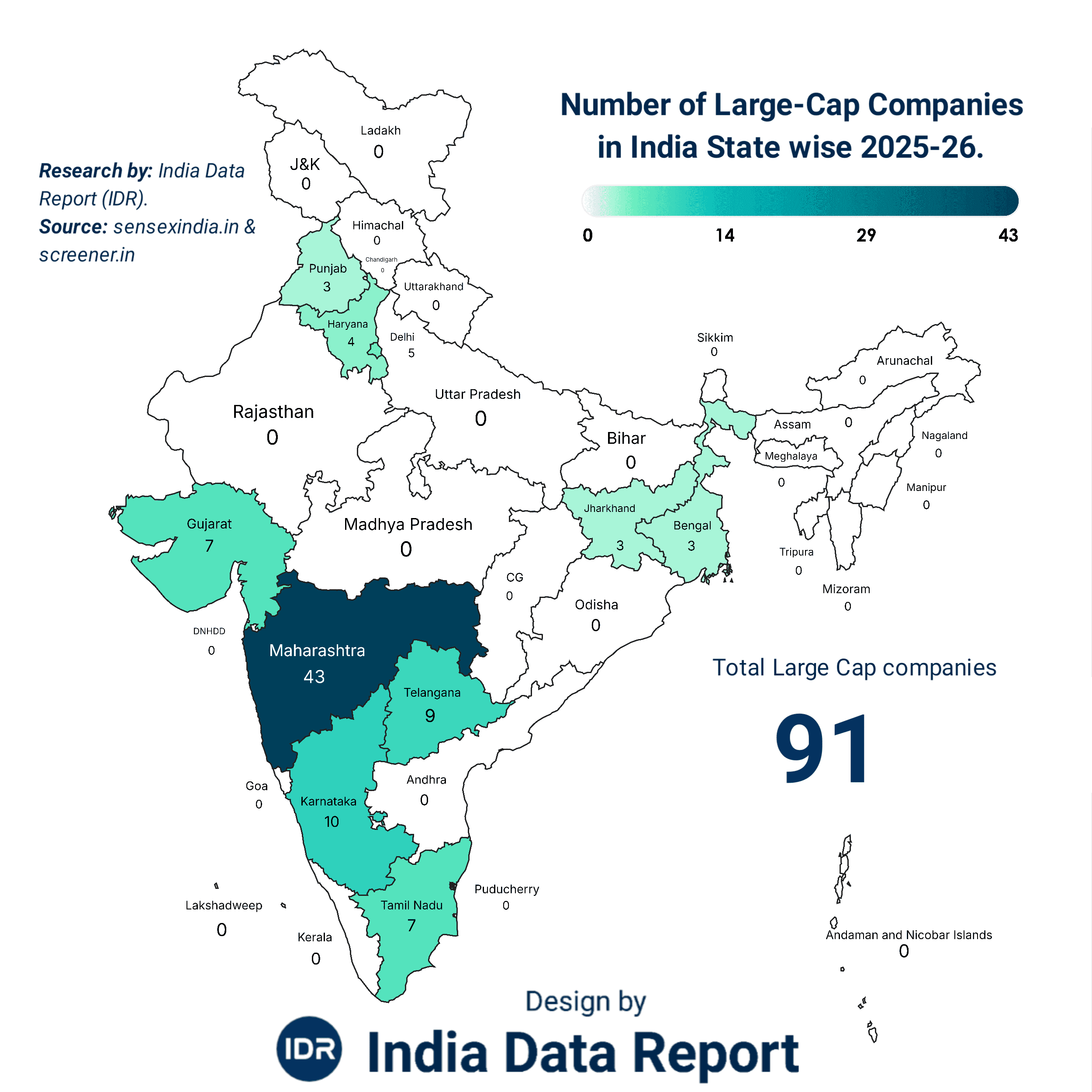
| S.N. | State / UT | No. of Large-Cap Companies |
|---|---|---|
| 1 | Maharashtra | 43 |
| 2 | Karnataka | 10 |
| 3 | Telangana | 9 |
| 4 | Gujarat | 7 |
| 5 | Tamil Nadu | 7 |
| 6 | Haryana | 4 |
| 7 | West Bengal | 3 |
| 8 | Punjab | 3 |
| 9 | Jharkhand | 3 |
| 10 | Delhi | 5 |
| 11 | Andhra Pradesh | 0 |
| 12 | Arunachal Pradesh | 0 |
| 13 | Assam | 0 |
| 14 | Bihar | 0 |
| 15 | Chandigarh | 0 |
| 16 | Chhattisgarh | 0 |
| 17 | Dadra & Nagar Haveli & Daman & Diu (DNHDD) | 0 |
| 18 | Goa | 0 |
| 19 | Himachal Pradesh | 0 |
| 20 | Jammu & Kashmir | 0 |
| 21 | Kerala | 0 |
| 22 | Ladakh | 0 |
| 23 | Lakshadweep | 0 |
| 24 | Madhya Pradesh | 0 |
| 25 | Manipur | 0 |
| 26 | Meghalaya | 0 |
| 27 | Mizoram | 0 |
| 28 | Nagaland | 0 |
| 29 | Odisha | 0 |
| 30 | Puducherry | 0 |
| 31 | Rajasthan | 0 |
| 32 | Sikkim | 0 |
| 33 | Tripura | 0 |
| 34 | Uttar Pradesh | 0 |
| 35 | Uttarakhand | 0 |
| 36 | Andaman & Nicobar Islands | 0 |
Listen closely, because the glossy brochures of investment firms won’t tell you this. We are currently witnessing a geographic and economic apartheid that is being rebranded as “India’s Decade.” As a Senior Economic Strategist who has spent decades peeling back the skin of global markets, I don’t care about the celebratory headlines. I care about the rot underneath the floorboards.
We are told India is the world’s next superpower. But look at the data on my desk for 2025-26. Out of a sprawling subcontinent of 28 states and 8 union territories, a staggering 91 Large-Cap companies dominate the landscape. But here is the kicker that should keep you awake at night: nearly 50% of them are suffocated into a single state. Maharashtra isn’t just leading; it’s cannibalizing the rest of the country. While Mumbai’s skyscrapers pierce the clouds, 25 states and UTs are effectively industrial graveyards with zero large-cap presence. This isn’t “balanced growth.” It’s an economic heart attack waiting to happen.
When 43 out of 91 giants reside in one pin code, we aren’t looking at a national economy; we are looking at a city-state masquerading as a global giant. The greed of capital is predictable—it flows where the pipes are already laid. But the psychological cost on the “Other India” is immeasurable. A youth in Bihar or Odisha sees the same 5G ads as a kid in South Bombay, but for one, the “Large-Cap” dream is a reality, and for the other, it’s a fairy tale told in a language they can’t afford to speak.
The market is currently drunk on liquidity, ignoring the fact that our industrial backbone is as thin as a wire. We are building a pyramid on its tip, and we’re calling it stability.
| Region | Number of Large-Cap Entities | Percentage of National Total | Economic Sentiment |
| Maharashtra | 43 | 47.25% | Hyper-Concentrated / Volatile |
| Southern Hubs (KA, TS, TN) | 26 | 28.57% | Specialized / Tech-Dependent |
| The Rest of India (28+ Units) | 22 | 24.18% | Starved / Migration-Dependent |
Label: The Bitter Truth
While the Nifty 50 hits record highs, the “Geography of Opportunity” is shrinking. If you aren’t in the Golden Triangle, you are essentially an economic spectator.
Look at the list again. Uttar Pradesh? Zero. Rajasthan? Zero. Odisha? Zero. These aren’t just names on a map; these are territories with populations larger than most European countries. To have zero Large-Cap companies in Uttar Pradesh—a state that dictates the political destiny of India—is a strategic failure of epic proportions.
Investors are blinded by “Consumption Data,” but they forget that consumption without local production is just a slow-motion wealth drain. We are creating a nation of delivery boys for companies headquartered in Mumbai and Bengaluru. The “Fear of Missing Out” (FOMO) is driving the markets, but the “Fear of Being Left Behind” is what will eventually drive the streets.
The current valuation of these 91 companies is priced for perfection. But perfection assumes a stable social fabric. When the hinterland realizes it’s being used as a mere marketplace rather than a production hub, that fabric tears.
| Category | Representative States | Population Impact (Approx.) | Economic Reality |
| The Political Giants | UP, Bihar, Madhya Pradesh | ~400 Million | Labor Exporting Engines |
| The Borderlands | J&K, North-East Seven Sisters | ~50 Million | Subsidy Dependent |
| The Resource Rich | Odisha, Chhattisgarh | ~75 Million | Extraction without Retention |
Label: The Golden Opportunity (For Critics)
Capital is cowardly. It avoids the “hard” states, preferring the comfort of established ecosystems. This cowardice is creating a structural imbalance that no “Digital India” campaign can fix.
We are standing at a crossroads in 2026. One path leads to a genuine distributed economy; the other leads to a hyper-stratified society where wealth is guarded by gated communities and private security. The data doesn’t lie, even if the politicians do.
The concentration of 75% of India’s corporate might in just five states isn’t a success story. It’s a warning. We are betting the entire future of a billion people on the stability of a few coastal enclaves. If the tide turns—and in economics, the tide always turns—the fall will be felt hardest by those who never even got to join the party.
The numbers I just showed you aren’t just statistics; they are a map of systemic exclusion. To the “Suits” in Mumbai or the “Tech-Bro” elite in Bengaluru, the fact that Maharashtra, Karnataka, Telangana, Gujarat, and Tamil Nadu hold 76 out of 91 Large-Cap companies is seen as “efficiency.” To me, it’s a terrifying lack of redundancy. We have built an economic engine that runs on five cylinders while the other twenty-five are filled with sand.
Why does capital flee from the North and East? It’s not just “infrastructure.” It’s a psychological barrier. Investors suffer from a herd mentality that would make sheep look like pioneers. They want the safety of a pre-existing ecosystem. This creates a vicious cycle: wealth goes where wealth is, leaving the “Zero-States” to survive on remittances and government doles.
| Metric | The Top 5 States (MH, KA, TS, GJ, TN) | The Remaining 31 States/UTs | The “Real World” Implication |
| Large-Cap Count | 76 | 15 | Massive concentration of risk. |
| Capital Density | Ultra-High | Ghost Town Levels | Job seekers must migrate or starve. |
| Policy Influence | High (Corporate Lobbying) | Low (Agrarian Focus) | Economic policy is written for the 5%. |
Label: Kadhwa Sach (The Bitter Truth)
We are not one economy; we are an elite club of five states surrounded by a massive labor camp that provides the muscles but enjoys none of the equity.
Let’s talk about the “Headquarter Effect.” A company might mine minerals in Odisha, refine them in Chhattisgarh, and sell the finished product in Uttar Pradesh—but its registered office is in a plush tower in Bandra-Kurla Complex (BKC). Consequently, the taxes, the high-paying white-collar jobs, and the “Large-Cap” status are credited to Maharashtra.
This is the colonization of the hinterland by the coastal cities. We are extracting the soul out of states like Jharkhand and Bihar and calling it “National GDP.” This isn’t just an economic imbalance; it’s an intellectual drain. The brightest minds from the “Zero-States” are forced to move to the “Elite Five” to find work at these 91 companies. They build the cities of the South and West while their hometowns become retirement communities for the left-behind.
| Source State (Zero Large-Cap) | Destination Hub | Primary Sector | Result for Source State |
| Bihar / UP | Maharashtra / Haryana | Manufacturing/Service | Human Capital Depletion |
| Odisha / WB | Karnataka / Telangana | IT / Deep Tech | “Brain” Export |
| Rajasthan / MP | Gujarat | Industrial / Trade | Local Entrepreneurial Death |
Label: Sunhera Avsar (The Golden Opportunity)
The first Large-Cap company that genuinely anchors itself in a “Zero-State” like UP or MP will find a desperate, loyal, and untapped workforce. But who has the guts to be the first?
Don’t let the “fintech” revolution fool you. You can have a billion UPI transactions in Bihar, but if the company processing those transactions, the bank holding the money, and the servers hosting the data are all in Bengaluru or Mumbai, Bihar remains poor. Digital connectivity has made it easier to spend money in the hinterland, but it hasn’t made it easier to accumulate it there.
We are seeing a “Consumerist Invasion.” The 91 Large-Cap companies see the “Zero-States” as a giant mouth to be fed, not a pair of hands to be utilized. When consumption is centralized but production is localized only in five hubs, the wealth gap doesn’t just grow—it explodes.
Let’s strip away the “Billion-Dollar Valuation” talk and look at the man standing at a tea stall in Lucknow or Bhopal. He is told India is “shining,” yet every product he touches—from his smartphone to the SIM card inside it, from his bank app to the packet of biscuits he buys—is owned by one of the 91 titans headquartered thousands of miles away.
This is the Psychological Siege. When a state has zero Large-Cap companies, it loses its “Economic Sovereignty.” It becomes a vassal state to the corporate kingdoms of the coast. The greed of the current market structure has dictated that it is cheaper to ship a product 2,000 kilometers than to build a factory in the heartland. This is a short-term profit strategy that is creating a long-term social disaster.
| Factor | The Elite 5 (MH, KA, TS, GJ, TN) | The Zero-Cap Hinterland | The “Common Man” Reality |
| Local Job Quality | High-end R&D, Strategy | Delivery, Retail, Security | The “Heartland” is a gig-economy trap. |
| Direct Investment | Foreign VC/PE Flow | Government Subsidies only | No “Wealth Creation,” only “Wealth Survival.” |
| Social Status | “The Economic Engine” | “The Labor Pool” | A deep-seated sense of regional inferiority. |
Label: Kadhwa Sach (The Bitter Truth)
We are training our youth in the North and East for a race they are not allowed to run in their own backyard. We are exporting our best people to build someone else’s dream.
Why aren’t there more Large-Caps in Delhi (only 5) or West Bengal (only 3)? It’s the Fear of Chaos vs. the Greed for Stability. Investors are terrified of the complex socio-political layers of the “Zero-States.” They prefer the sterile, predictable, “business-friendly” environments of Gujarat or Maharashtra.
But here is the truth the “Investigative Journalist” in me sees: By ignoring the hinterland, these 91 companies are creating their own graveyard. If the 400 million people in the “Zero-Cap” states don’t get high-paying jobs, they eventually won’t have the money to buy the products these companies sell. You cannot have a Tier-1 corporate structure supported by a Tier-3 consumer base forever. The math simply doesn’t add up.
| Sector | Large-Cap Dominance (%) | Presence in Zero-States | The “Saty (Truth)” |
| Banking/Finance | 95% | Branches only (No HQ) | The Hinterland’s savings fund the Coast’s loans. |
| Consumer Goods | 80% | Distribution Hubs only | Selling dreams to people with shrinking pockets. |
| Technology | 99% | Zero | No digital “Creation” happens outside the bubble. |
Label: Sunhera Avsar (The Golden Opportunity)
The first CEO who decides to move their HQ to a city like Patna or Indore—not just as a “back office” but as a “Brain Center”—will trigger an economic revolution that could rival 1991.
Every time a talented worker leaves Jharkhand for Bengaluru, Jharkhand pays a “Migration Tax.” It loses the local spending, the local tax revenue, and the future innovation that person would have provided. Multiply this by millions, and you see why the “Zero-States” stay at zero.
The 91 Large-Cap companies are currently enjoying the benefits of this “Human Capital Loot.” They get the cheapest labor and the brightest minds without having to invest a single rupee in the infrastructure of the states those people come from. It is a brilliant business model—and a moral catastrophe.
We are currently standing at the edge of a precipice. The Year 2030 is often touted as the moment India cements its place as the world’s third-largest economy. But as a Strategist, I have to ask: Whose economy? If the current trajectory continues, by 2030, we won’t have a “National Economy.” We will have a “Fortress of Five”—five states that operate like a developed European nation, surrounded by a vast, stagnating landscape that feels more like 19th-century colonial outposts.
The “Greed” of the present is blinding us to the “Risk” of the future. When wealth is this concentrated, the system becomes brittle. One tectonic shift in the global supply chain, or a localized social upheaval in a “Zero-State,” and the entire 91-company house of cards starts to wobble.
| Indicator | Current Status (2025-26) | Projected Status (2030) | The “Saty” (Truth) |
| Wealth Concentration | Top 5 States hold 83% Cap | Top 5 States hold 90%+ Cap | Corporate Feudalism becomes the norm. |
| Urban Migration | High (Internal Refugees) | Explosive (City Collapse) | Mumbai/Bengaluru will reach a breaking point. |
| Regional Inequality | Strained | Critical / Decisive | The “Two Indias” will no longer speak the same language. |
Label: Kadhwa Sach (The Bitter Truth)
We are building the world’s most expensive penthouses on a foundation that is being eaten away by neglect. 2030 will either be India’s “Greatest Show” or its “Greatest Fracture.”
Here is the irony that most analysts are too scared to mention. The political power in India resides in the North (the “Zero-States”), but the economic power resides in the South and West (the “Elite Five”). This is a fundamental misalignment.
By 2030, this tension will reach a boiling point. We will see “Zero-States” demanding a larger share of the “Elite Five’s” tax revenue to survive. This isn’t just theory—it’s already happening in the debates over fiscal federalism. The 91 companies are caught in the middle. They want the market of the North but the stability of the South. You cannot have both without paying the price of local investment.
| The Fear | The Hope | The Strategist’s Advice |
| Job Displacement | AI-driven localized hubs | Skill up for “Remote Creation,” not “Physical Migration.” |
| Resource Wars | Green Energy in the Hinterland | Solar/Wind could turn “Zero-States” into Power Hubs. |
| Social Erasure | Digital Renaissance | Use the tools of the “Elite Five” to build local wealth. |
Label: Sunhera Avsar (The Golden Opportunity)
The states currently at “Zero” (like UP, Rajasthan, and Odisha) have the most to gain from the Green Energy revolution. If they can own the “Power,” they can finally own the “Cap.”
We need to redefine what a “Large-Cap” company is. Is it just about Market Capitalization? Or should it be about “Social Capital”? If a company has a 1-Trillion valuation but doesn’t create a single high-value job in the states where it gets its raw materials, is it truly a national asset? Or is it an economic parasite?
As we move toward 2030, the “Search for Truth” will force us to confront these uncomfortable questions. The common man is tired of being told he is part of a “Trillion Dollar Dream” when he can’t even find a decent job within 500 kilometers of his home.
We have dissected the anatomy of an imbalanced giant. The data from 2025-26 isn’t just a spreadsheet; it’s a heartbeat monitor of a nation that is running a fever. If we continue to concentrate 83% of our corporate oxygen in just five states, the body politic will eventually suffer a stroke.
As an Investigative Journalist, I don’t look at the “Nifty 50” charts; I look at the migration patterns at railway stations. As a Strategist, I don’t listen to CEO speeches; I listen to the silence of the industrial zones in the “Zero-States.” My verdict is clear: The era of “Centralized Greed” is hitting a wall.
The “Hinterland Tax” (2026-27): Expect a massive political push for a “Local Employment Tax” or mandatory regional investment quotas. The “Zero-States” (UP, Bihar, WB) will realize their voting power is their only leverage against the economic power of the “Elite Five.”
The Reverse Migration Wave (2027-28): As Mumbai and Bengaluru become unlivable due to infrastructure collapse and astronomical costs, we will see “Satellite Large-Caps.” Companies will be forced to move their “Brain Centers” to Tier-2 cities like Indore, Jaipur, and Lucknow just to keep their talent from burning out.
The Rise of “State-Specific” Giants (2029): We will see the birth of the first “Regional Large-Caps”—companies born and bred in the North or East that refuse to move their HQ to Mumbai. These will be the true “People’s Titans.”
The 2030 Fracture: India will either be a “Federation of Five” (Economic Collapse of the rest) or a “Subcontinent of 30” (Distributed Growth). There is no middle ground.
| The Sector | The 2030 Winner | The 2030 Loser | My Verdict |
| Real Estate | Tier-2 Regional Hubs | Overpriced Coastal Ghettoes | Sell the Penthouse; buy the Land. |
| Manufacturing | Eastern Industrial Corridors | Land-Locked Western Hubs | The East is the new West. |
| Human Capital | Multi-Lingual Regional Experts | English-Only Elite Bubbles | Authenticity will beat “Corporate Speak.” |
Label: Kadhwa Sach (The Bitter Truth)
If you are an investor betting only on the current 91 giants, you are betting on the past. The future belongs to the “Zero-States” that are hungry enough to eat the coast’s lunch.
To the Common Man: Stop waiting for a Large-Cap company to save your town. Use the digital tools of 2026 to create local value. The “Elite Five” want your consumption; give them your competition instead.
To the Policymakers: If you don’t incentivize the 91 giants to move into the “Zero-States” today, you will be managing a social explosion by 2030. Infrastructure isn’t just roads; it’s the dignity of a job close to home.
To the Investors: Look beyond the BKC and HSR Layout. The real “Unicorns” of 2030 are currently being born in the “Industrial Deserts” of India. That is where the 1000% returns are hiding.
The report is complete. The truth is out. The question is: do you have the courage to act on it, or will you remain a spectator in someone else’s Trillion Dollar Dream?
Because concentration equals fragility. When nearly 50% of India’s corporate might is anchored in Maharashtra, any localized crisis—be it infrastructure failure, climate events, or political shifts—threatens the entire national economy. For the citizen, it means if you don’t live in the “Elite Five,” you are subsidizing a growth model that offers you zero high-value local jobs.
Not necessarily, but it means the state is an economic colony. States like Uttar Pradesh or Odisha may have high GSDP, but without Large-Cap HQs, the “brain trust” and high-tax revenues flow out. They become places where people work and consume, but not where wealth is retained or compounded.
It won’t fail on paper, but it will fail on the streets. We might hit the $7 Trillion mark, but it will be a “Hollow GDP” if 400 million people in the heartland are still migrating 2,000 km for basic dignity. An economy that doesn’t breathe in the North and East is an economy with one lung—it can’t run a marathon.
No. In fact, it’s currently accelerating the drain. Digital tools make it easier for a giant in Bengaluru to sell products in a village in Bihar. The money leaves the village instantly via UPI and lands in a corporate vault in a Tier-1 city. Technology is currently a one-way straw sucking wealth out of the “Zero-States.”