NEW DELHI, INDIA (IST)
00:00:00 PM
|
Loading...
DETECTING LOCATION...
00:00:00 PM
|
Loading...
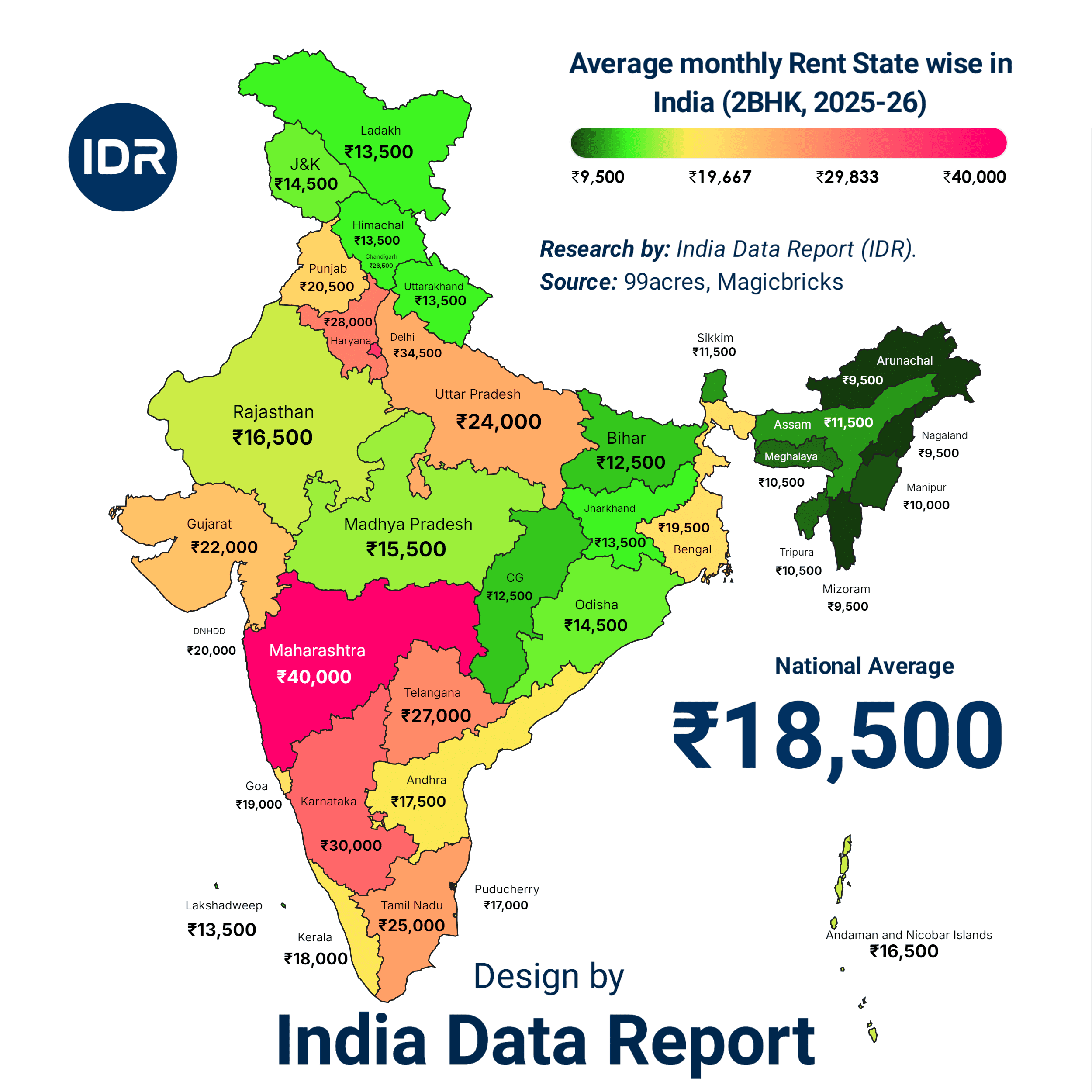
| S.N. | State / UT | Rent (₹) |
|---|---|---|
| 1 | Maharashtra | 40,000 |
| 2 | Delhi | 34,500 |
| 3 | Karnataka | 30,000 |
| 4 | Telangana | 27,000 |
| 5 | Tamil Nadu | 25,000 |
| 6 | Uttar Pradesh | 24,000 |
| 7 | Gujarat | 22,000 |
| 8 | Punjab | 20,500 |
| 9 | West Bengal | 19,500 |
| 10 | Kerala | 18,000 |
| 11 | Andhra Pradesh | 17,500 |
| 12 | Rajasthan | 16,500 |
| 13 | Madhya Pradesh | 15,500 |
| 14 | Uttarakhand | 13,500 |
| 15 | Himachal Pradesh | 13,500 |
| 16 | Jammu & Kashmir | 14,500 |
| 17 | Odisha | 14,500 |
| 18 | Bihar | 12,500 |
| 19 | Chhattisgarh | 12,500 |
| 20 | Jharkhand | 13,500 |
| 21 | Sikkim | 11,500 |
| 22 | Assam | 11,500 |
| 23 | Meghalaya | 10,500 |
| 24 | Manipur | 10,000 |
| 25 | Tripura | 10,500 |
| 26 | Nagaland | 9,500 |
| 27 | Arunachal Pradesh | 9,500 |
| 28 | Mizoram | 9,500 |
| 29 | Goa | 19,000 |
| 30 | Puducherry | 17,000 |
| 31 | Andaman & Nicobar Islands | 16,500 |
| 32 | Lakshadweep | 13,500 |
| 33 | Dadra & Nagar Haveli and Daman & Diu (DNHDD) | 20,000 |
The middle-class dream of “Roti, Kapda, aur Makaan” has been hijacked by a ruthless landlord economy that doesn’t care about your increments or your inflation-adjusted savings. If you think you’re working to build a future, look at your bank statement on the 1st of every month. You aren’t working for yourself; you are working to pay off someone else’s mortgage.
We are standing at a dangerous intersection in 2026. While the GDP figures look shiny on a government dashboard, the ground reality in cities like Mumbai and Bengaluru tells a story of systematic wealth drain. We’ve entered an era where rent is the new income tax, but without the benefit of public infrastructure. It is a silent, aggressive predator eating into the disposable income of the most productive segment of our population.
Let’s be brutally honest: the National Average of ₹18,500 for a 2BHK is a mathematical lie that hides the suffering of the urban professional. When you factor in the high-demand economic zones of Maharashtra and Delhi, you aren’t just paying for four walls; you are paying a “survival premium.”
In Maharashtra, a 2BHK now commands a staggering ₹40,000. Think about that. For a young family or a professional earning ₹1 Lakh a month—which is considered “rich” by Indian standards—40% of their post-tax income vanishes before they even buy a liter of milk. This isn’t just an expense; it’s a lifestyle tax that forces people to live on the fringes, sacrificing health, leisure, and retirement corpus just to be near their workplace.
| State / UT | Avg. Rent (2BHK) | % of National Avg | The “Pain” Factor |
| Maharashtra | ₹40,000 | 216% | Extreme |
| Delhi | ₹34,500 | 186% | High |
| Karnataka | ₹30,000 | 162% | High |
| Telangana | ₹27,000 | 146% | Moderate-High |
| Tamil Nadu | ₹25,000 | 135% | Moderate |
Bitter Truth: The “Silicon Valley of India” and the “Financial Capital” have become playgrounds for real estate cartels. When rent consumes more than 30% of your paycheck, you aren’t living; you’re just maintaining the property for a landlord who likely bought it decades ago for a pittance.
Why are we paying these prices? Is it because the houses are better? No. It’s because of the “Proximity Trap.” Corporations demand “Return to Office,” and landlords smell blood in the water. They know you’d rather pay an extra ₹5,000 in rent than spend three hours in a soul-crushing traffic jam.
This isn’t just economics; it’s a psychological siege. The fear of being evicted or having to move your kids to a new school every two years gives landlords the leverage to hike rents by 10-15% annually, far outstripping the average 7% salary hike. We are seeing a massive transfer of wealth from the young, educated workforce to the older, asset-owning class. It is an intergenerational robbery happening in broad daylight.
| State | Avg. Rent (2BHK) | YoY Growth (Est.) | Sentiment |
| Uttar Pradesh | ₹24,000 | +12% | Alarming |
| Gujarat | ₹22,000 | +9% | Growing |
| Punjab | ₹20,500 | +8% | Stable |
| West Bengal | ₹19,500 | +7% | Under Pressure |
Golden Opportunity: For those who can work remotely, the data suggests a massive arbitrage opportunity in states like Odisha (₹14,500) or Kerala (₹18,000). But the question remains: will the infrastructure follow the talent, or are we destined to stay trapped in the ₹40k-a-month concrete boxes of Mumbai?
The market is currently a “Seller’s Market” on steroids. If you’re a tenant, you’re not a customer; you’re a line item in someone else’s investment portfolio. We see a clear pattern: the more “developed” a state claims to be, the more it punishes its residents for wanting a roof over their heads. Is this the growth we were promised? Or is this just a bubble waiting for a pin?
The numbers don’t just represent currency; they represent the blood, sweat, and tears of a workforce that is increasingly being pushed to the brink. When we look at Karnataka (₹30,000) or Telangana (₹27,000), we aren’t looking at “luxury living.” We are looking at the price of participation in the modern Indian economy. If you want a seat at the table in India’s tech or corporate sectors, you must pay a “gatekeeper’s fee” to the local real estate market.
This is the Migration Paradox. We tell our youth to move to the cities for better opportunities, yet the city itself acts as a massive vacuum, sucking out the very financial gains they came for. A software engineer in Hyderabad might earn 30% more than his peer in Jaipur, but after paying the ₹27,000 rent for a standard 2BHK, his net savings are often lower. We are trading our time and peace of mind for a higher “Gross Income” that never actually reaches our savings accounts.
Look at the surge in Uttar Pradesh (₹24,000) and Gujarat (₹22,000). These were once the “affordable” alternatives. Not anymore. The industrial expansion in Noida, Lucknow, and Ahmedabad has triggered a rental gold rush. Landlords in these regions are no longer looking at local benchmarks; they are benchmarking their expectations against Mumbai and Bengaluru.
This “Rental Contagion” is spreading. It’s a classic case of greed-flation. There is no fundamental change in the quality of construction or the amenities provided, yet the prices are behaving like they are luxury suites in Manhattan. We are witnessing the death of the “budget” 2BHK in any city that has a functional airport and a decent internet connection.
| State | Rent (2BHK) | Purchasing Power Impact | The “Truth” Behind the Hike |
| Uttar Pradesh | ₹24,000 | Severe | Proximity to NCR & Infra Hype |
| Gujarat | ₹22,000 | Moderate | Industrial clusters & GIFT City |
| Punjab | ₹20,500 | Low-Moderate | NRI investment & Luxury demand |
| Goa | ₹19,000 | High | The “Digital Nomad” invasion |
Bitter Truth: In many of these “emerging” states, the infrastructure (roads, water, electricity) hasn’t improved by 20%, but the rent has jumped by 50%. You are paying for the promise of a better city, while living in a construction site.
We cannot talk about monthly rent without addressing the elephant in the room: the upfront capital. In Karnataka, the “10-month deposit” rule is essentially an interest-free loan you give to a stranger. For a ₹30,000 apartment, you are expected to cough up ₹3 Lakhs.
Where does an average 28-year-old get ₹3 Lakhs? They break their FDs, they take personal loans, or they borrow from parents. This is dead capital. That money could have been in an Index Fund or a SIP, compounding for their future. Instead, it sits in a landlord’s bank account, likely being used to down-pay for another property, further inflating the market. It is a vicious cycle where the tenant funds the very system that keeps them a tenant.
| State | Avg. Deposit Months | Upfront Cost (2BHK) | Opportunity Cost (at 12% p.a.) |
| Karnataka | 10 Months | ₹3,00,000 | ₹36,000 / year |
| Maharashtra | 6 Months | ₹2,40,000 | ₹28,800 / year |
| Delhi/NCR | 2 Months | ₹69,000 | ₹8,280 / year |
| Tamil Nadu | 10 Months | ₹2,50,000 | ₹30,000 / year |
(Golden Opportunity): There is a massive market opening for “Zero Deposit” rental startups. However, beware—the convenience of monthly subscriptions often hides a much higher long-term cost. The only real winner here is the one who owns the land.
The psychological toll of this is immeasurable. When a massive chunk of your income is fixed and non-negotiable, you become risk-averse. You don’t quit the job you hate, you don’t start that business you dreamed of, and you don’t take risks. Why? Because you are three months of “rent-default” away from homelessness. This rental trap is effectively killing the entrepreneurial spirit of India’s youth.
As we peel back the layers of this economic onion, a pungent reality hits: the dream of escaping to “affordable” Tier-2 cities is becoming a mirage. People looked at the ₹40,000 rent in Maharashtra and thought, “I’ll move to Rajasthan or Madhya Pradesh.” But look at the data—Rajasthan is at ₹16,500 and Madhya Pradesh at ₹15,500. On the surface, it looks like a bargain. But when you factor in the local wage depression in these regions, the Rent-to-Income ratio is actually worse than in the metros.
This is the Tier-2 Delusion. You move to a smaller city for “peace,” but you realize the job market there is a desert. You might save ₹15,000 on rent, but you lose ₹40,000 in career growth potential. Landlords in Bhopal, Jaipur, and Indore have caught the “Metro Fever.” They see the swanky new malls and the four-lane highways and decide their 15-year-old property is suddenly worth a premium. They are charging “India 1” prices in an “India 2” economy.
We are seeing the birth of a new social class: the Rental Aristocracy. These are individuals or families who own 5–10 apartments across cities like Bengaluru, Pune, and Gurgaon. They don’t contribute to the GDP through innovation or service; they are “Rent-Seekers” in the purest economic sense.
In states like Kerala (₹18,000) and Punjab (₹20,500), this is fueled by NRI money. Large, empty houses sit like tombstones of migration, while the local population struggles to find affordable housing. This creates an artificial scarcity. When supply is throttled by owners who don’t need the rental income to survive, they can afford to keep a flat vacant for six months rather than lower the rent by ₹2,000. It is a standoff where the common man always blinks first.
| State | Avg. 2BHK Rent | Local Entry-Level Salary (Avg) | % of Salary on Rent |
| West Bengal | ₹19,500 | ₹35,000 | 55% |
| Rajasthan | ₹16,500 | ₹28,000 | 59% |
| Madhya Pradesh | ₹15,500 | ₹25,000 | 62% |
| Bihar | ₹12,500 | ₹18,000 | 69% |
(Bitter Truth): In states like Bihar and Jharkhand, rent is consuming a terrifying 60-70% of local entry-level professional wages. This forces a “Compulsory Migration” to the very metros that are already overpriced. It’s a dead-end loop.
The most offensive part of this data is the “Quality Gap.” In Uttarakhand (₹13,500) or Himachal (₹13,500), you are often paying for scenic views but dealing with primitive waste management and erratic power. In the metros, you pay ₹30,000+ and still deal with water tankers and flooded basements every monsoon.
We are paying Premium Rents for Substandard Infrastructure. In any sane global market, rent is tied to the quality of life. In India, rent is tied to the desperation of the tenant. If you work in Gachibowli or Whitefield, the landlord knows you are a “captive customer.” You aren’t paying for the flat; you are paying a ransom to avoid a 4-hour commute.
| Location Type | Rent (2BHK) | Monthly Commute Cost | Hidden “Time Tax” (Hrs/Mo) |
| CBD / Tech Hubs | ₹35,000+ | ₹3,000 | 20 Hrs |
| Suburban (15km out) | ₹20,000 | ₹8,000 | 60 Hrs |
| Satellite Towns | ₹14,000 | ₹12,000 | 90+ Hrs |
(Golden Opportunity): The real winners in 2026 are those living in states like Odisha (₹14,500) or Andhra Pradesh (₹17,500) with remote-first jobs. They are the only ones successfully “arbitraging” the system.
Because 2BHKs are becoming unaffordable, we are seeing the “Bunker-ization” of Indian housing. Young married couples are delaying having children because they can’t afford the extra room. Professionals in their 30s are living with “flatmates” like college students.
The 2BHK, once the symbol of a stable middle-class life, is becoming a luxury. When a basic human need—shelter—becomes a speculative asset, the social fabric starts to tear. We are trading our privacy and our dignity to keep the real estate bubble inflated.
Is this a sustainable economic model? Or are we building a skyscraper on a foundation of sand?
We are accelerating toward a structural collapse. By 2030, if the current trajectory holds, the 2BHK rent in Mumbai will breach the ₹60,000 mark, while Bengaluru will comfortably sit at ₹45,000. We are not just talking about inflation; we are talking about the total financial disenfranchisement of the salaried class. When the cost of shelter grows at 12% and wages grow at 6%, the math eventually stops working. The “Middle Class” is being squeezed out of existence, forced to choose between becoming “Rent Slaves” or “Urban Nomads.”
This isn’t just an economic shift; it’s a systemic failure of urban planning. The government’s obsession with “Smart Cities” has focused on glass buildings and metro pillars, completely ignoring the “Human Cost” of living within those cities. We’ve built concrete jungles where the predators are the property owners and the prey is anyone with a monthly paycheck.
The scariest trend on the horizon is the entry of big corporate capital into the residential rental market. Currently, your landlord is likely an individual (an uncle or an NRI). But by 2030, you will be renting from multi-billion dollar Real Estate Investment Trusts (REITs). These entities have no “Human Touch.” They use AI algorithms to maximize “Yield,” meaning they will hike your rent by the maximum legal (or illegal) limit every single year without fail.
In states like Goa (₹19,000) and Uttarakhand (₹13,500), we are already seeing “AitBnB-fication.” Properties that should be available for long-term residents are being converted into short-term rentals for tourists. This artificial supply crunch is driving local families into the outskirts. We are destroying the soul of our towns to serve the greed of the “yield-hungry” investor.
| State | 2026 Rent (Base) | 2030 Projected Rent | The “Survival” Salary Required |
| Maharashtra | ₹40,000 | ₹62,000 | ₹2.2 Lakhs / Mo |
| Karnataka | ₹30,000 | ₹48,000 | ₹1.8 Lakhs / Mo |
| Telangana | ₹27,000 | ₹42,000 | ₹1.5 Lakhs / Mo |
| Delhi | ₹34,500 | ₹52,000 | ₹1.9 Lakhs / Mo |
(Bitter Truth): In four years, a “decent” life in a Tier-1 city will require a household income of ₹25 Lakhs per annum just to stay afloat. If you aren’t in the top 1% of earners, the city is effectively telling you: “You are not welcome here.”
Surprisingly, the data from the North East and our Islands tells a different story. Sikkim (₹11,500), Assam (₹11,500), and Nagaland (₹9,500) represent the only remaining “Sanity Zones” in India. Even the Andaman & Nicobar Islands (₹16,500) are cheaper than the smog-filled suburbs of Punjab.
But for how long? As high-speed internet reaches every corner of the country, the “Rental Virus” will travel with it. The moment a location becomes “livable” for a remote worker, the local real estate sharks circle the waters. We are seeing a “Gentrifaction Wave” that threatens to displace the local culture of the North East in favor of high-yield rental units for outsiders.
| State / UT | Rent (2BHK) | Why it’s Low | The “Risk” Factor |
| Nagaland | ₹9,500 | Limited Commercialization | Low |
| Mizoram | ₹9,500 | Community-driven markets | Low |
| Sikkim | ₹11,500 | Regulated Land Laws | Moderate |
| Lakshadweep | ₹13,500 | Geographic isolation | High (Tourism Hype) |
(Golden Opportunity): The North East isn’t just a travel destination; for the smart professional, it’s a “Wealth Preservation” destination. If you can take your Mumbai salary to Kohima, you aren’t just saving money; you are buying back your life.
Financial planners used to say, “Never spend more than 30% of your income on rent.” In 2026, that advice is as useful as a floppy disk. In the reality we inhabit, people are spending 45%, 50%, even 60% of their take-home pay on rent.
This leads to a “Debt-Fueled Lifestyle.” To maintain the appearance of a middle-class life, people are using credit cards to buy groceries because their rent swallowed the liquid cash. We are building an economy on a foundation of “Negative Savings.” When the next economic downturn hits, these people won’t have a safety net. They will have a pile of rent receipts and an empty bank account.
The question isn’t whether the bubble will burst. The question is: who will be left standing when the music stops?
We have dissected the data, exposed the greed, and mapped the geographic inequality of the Indian rental landscape. Now, let’s look into the crystal ball. We aren’t just looking at “higher prices”; we are looking at a total recalibration of the Indian Dream.
By 2030, the traditional concept of “owning a home” will be a relic for the average professional. We are moving toward a “Subscription Society” where you own nothing and rent everything. But unlike a Netflix subscription, you can’t just “cancel” your roof. The power dynamic is shifting so heavily in favor of asset owners that we might see the emergence of “Rental Unions”—tenants striking against predatory hikes, much like labor unions of the 20th century.
| Action Plan | Strategy | Expected Outcome |
| The Arbitrage | Move to Tier-3 (Sikkim/Assam) | 70% increase in Savings |
| The Co-Invest | 2 Families sharing a 3BHK | 40% reduction in individual rent |
| The Exit | Remote work + Satellite towns | Debt-free life by 45 |
| The Trap | Staying in Mumbai/Bengaluru | Permanent “Rent-Slave” status |
(Golden Opportunity): The real “Gold Mine” for investors is no longer the luxury segment, but “Affordable Professional Housing” in Tier-2 cities like Ahmedabad and Lucknow. The demand-supply gap there is a literal printing press for money.
If you are a tenant in 2026, you must understand one thing: You are being harvested. Every hour you spend in a meeting, every weekend you sacrifice for a project, a significant portion of that energy is being converted into “Rental Yield” for someone else.
The data is clear. In Maharashtra and Delhi, you are paying a “Success Tax.” In the North East, you are enjoying a “Sanity Subsidy.” My advice? Stop chasing the prestige of a pin code. The 2030 economy will not reward those who lived in the “best” areas; it will reward those who had the foresight to keep their overheads low and their liquid capital high.
| Category | States | My Advice |
| The Money Pits | MH, DL, KA, TS | EXIT or Negotiate hard. |
| The Rising Threats | UP, GJ, PB, WB | BUY NOW if you plan to stay. |
| The Sanity Havens | OR, AP, KL, RJ | RENT HERE and work remotely. |
| The Final Frontiers | NE States, Islands | THE FUTURE for slow-living. |
(Bitter Truth): A house is a basic human right, but in India, it has become a luxury stock. If you don’t change your strategy now, you will spend your most productive years funding your landlord’s retirement while sacrificing your own.
The Great Indian Rental Trap is real, it’s hungry, and it’s growing. Don’t be the fuel for someone else’s fire. Analyze your rent-to-income ratio tonight. If it’s over 30%, you aren’t an employee; you’re a volunteer for your landlord’s wealth fund.
Move, Pivot, or Invest—but do not stand still.
It’s a “Demand-Supply Stranglehold.” These states house the financial and tech arteries of India. Landlords leverage the Proximity Trap—they know you’ll pay a premium to avoid the 3-hour daily commute. In 2026, you aren’t paying for square footage; you are paying for the “minutes” saved from traffic.
No. The national average is a statistical ghost. It is heavily diluted by rural and semi-urban data from states like Nagaland and Mizoram. In any city with a “Job Ecosystem,” the floor price for a livable 2BHK has effectively crossed ₹22,000–₹25,000. If you find something at the average, expect compromises on safety or water.
In cities like Mumbai (₹40,000 rent), the Rental Yield is still around 3-4%, while home loan interest is 8.5-9.5%. Purely mathematically, renting is cheaper. However, with rents projected to rise 12% annually, the “Rental Trap” will eventually exceed an EMI. My Verdict: Rent in the metros, but buy your “exit home” in a Tier-2 city like Ahmedabad or Jaipur now.
The only defense is Geographic Arbitrage. If your job allows even a “Hybrid” model, move 40km away from the city center to a satellite town. You can slash your rent by 40% (e.g., moving from Central Bengaluru to the outskirts), which, if invested in a Nifty Index fund, could build a house down-payment in 5 years.
Only for the next 24–36 months. As “Work from Anywhere” becomes the corporate standard, we are seeing the Gentrification Wave moving East. Once high-speed 6G and better road connectivity hit these zones, the local “Rental Aristocracy” will emerge there too. If you want to move, the window is closing fast.