NEW DELHI, INDIA (IST)
00:00:00 PM
|
Loading...
DETECTING LOCATION...
00:00:00 PM
|
Loading...
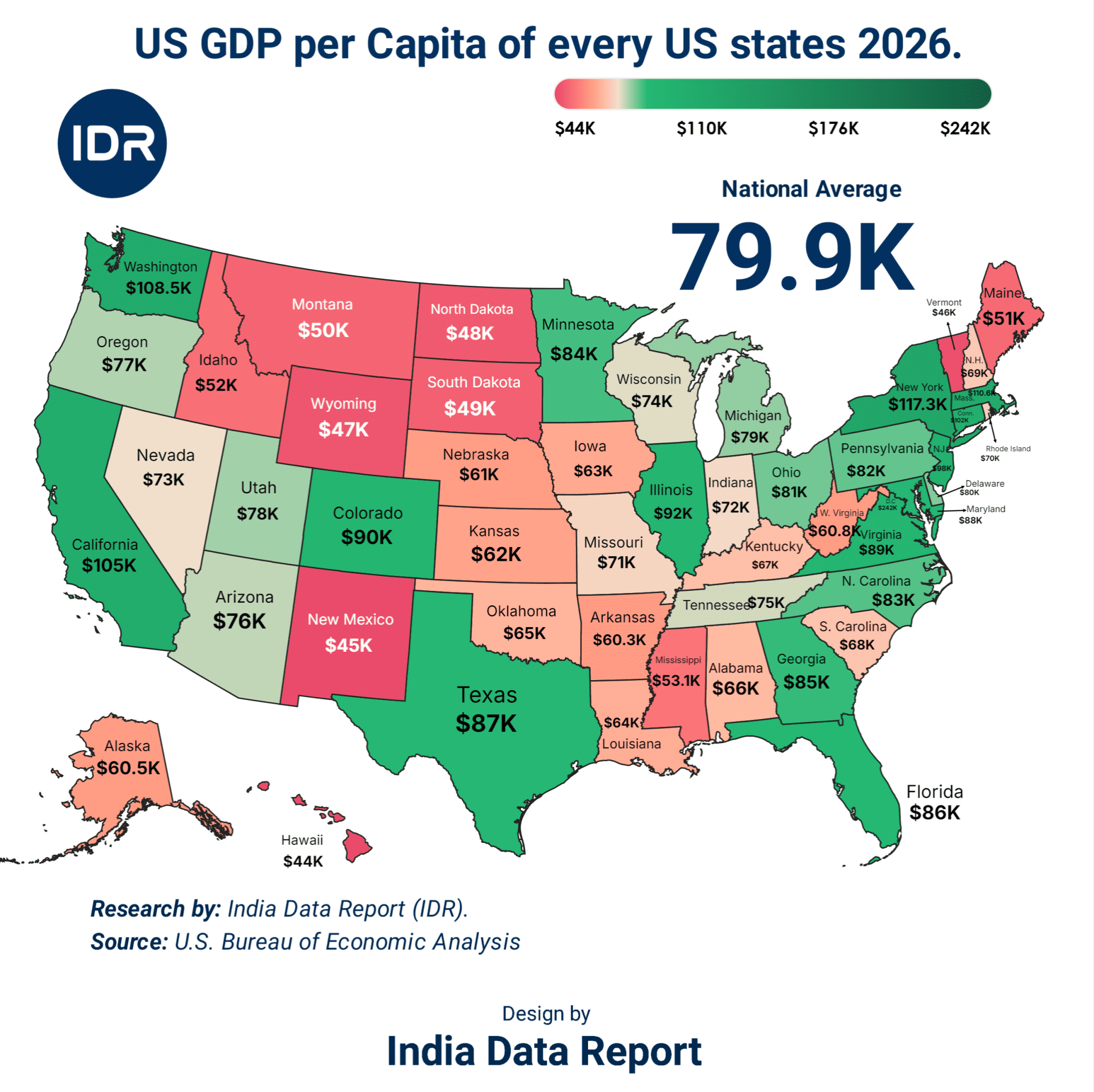
| Rank | State | GDP per Capita |
|---|---|---|
| 1 | New York | $117.3K |
| 2 | Washington | $108.5K |
| 3 | California | $105K |
| 4 | Illinois | $92K |
| 5 | Colorado | $90K |
| 6 | Texas | $87K |
| 7 | Florida | $86K |
| 8 | Georgia | $85K |
| 9 | Minnesota | $84K |
| 10 | North Carolina | $83K |
| 11 | Pennsylvania | $82K |
| 12 | Michigan | $79K |
| 13 | Utah | $78K |
| 14 | Oregon | $77K |
| 15 | Arizona | $76K |
| 16 | Wisconsin | $74K |
| 17 | Nevada | $73K |
| 18 | Ohio | $68K |
| 19 | South Carolina | $68K |
| 20 | Alabama | $66K |
| 21 | Oklahoma | $65K |
| 22 | Iowa | $63K |
| 23 | Kansas | $62K |
| 24 | Nebraska | $61K |
| 25 | Alaska | $60.5K |
| 26 | Arkansas | $60.3K |
| 27 | Virginia | $58K |
| 28 | Louisiana | $58K |
| 29 | Mississippi | $53.1K |
| 30 | Idaho | $52K |
| 31 | Maine | $51K |
| 32 | Montana | $50K |
| 33 | South Dakota | $49K |
| 34 | North Dakota | $48K |
| 35 | Wyoming | $47K |
| 36 | New Mexico | $45K |
| 37 | Hawaii | $44K |
National Average: $79.9k
The American Dream is flatlining on a hospital bed, and the chart attached to its monitor shows a fatal arithmetic. We have been spoon-fed a grand narrative of a unified superpower, a single economic engine roaring ahead of the rest of the world. It is a lie. There is no singular American economy. Instead, we are looking at a fragmented, deeply polarized landscape where a handful of hyper-capitalist enclaves are cannibalizing the rest of the nation. When the national average sits at an impressive-looking $79.9K per capita, it masks a grotesque reality: a citizen in New Mexico or Hawaii is economically closer to a developing nation’s upper tier than to their compatriot walking the streets of Manhattan or Seattle.
Politicians love to boast about macroeconomic resilience, but they deliberately look away from the structural rot underneath. If you live in Wyoming or Mississippi, the roaring stock market is a spectator sport. You are watching a game you cannot afford to play, using equipment you aren’t allowed to touch. Let’s strip away the corporate propaganda and look at the hard, cold numbers provided by the U.S. Bureau of Economic Analysis.
The spread between the apex of American productivity and its baseline is no longer a gap it is a canyon. New York leads the pack at an astronomical $117.3K per capita, closely followed by Washington at $108.5K and California at $105K. These are not just states; they are global economic empires. They trade on intellectual property, financial engineering, tech monopolies, and speculative capital. They attract the world’s brightest minds and chew them up, spitting out massive GDP figures that look spectacular on a Treasury report.
But move down the ladder. By the time you hit the mid-tier states the Michigans, the Utahs, the Oregons the numbers drop to the national average or just below it. And then comes the structural collapse. The bottom tier of the United States is trapped in a permanent economic winter, with states like New Mexico ($45K) and Hawaii ($44K) producing less than 40% of what a New Yorker generates.
This is not a minor statistical variance. This is an existential crisis for a democracy. When one part of a country possesses three times the economic leverage of another, the political union becomes a toxic arrangement of resentment, exploitation, and mutual distrust.
Why do New York, Washington, and California hold a absolute monopoly on prosperity? Because they have successfully institutionalized the extraction of value from the rest of the country. New York dominates through financial plumbing; every swipe of a credit card in Idaho pays a micro-toll to Wall Street. Washington state extracts capital through cloud computing, logistics, and operating systems every business from Maine to New Mexico pays a digital tax to Seattle just to keep their computers running. California owns the cultural narratives and the algorithmic infrastructure that dictates how every human in the nation consumes information, buys products, and visualizes reality.
This is a modern corporate feudalism. The serfs live in the hollowed-out manufacturing hubs and agricultural fields of the Midwest and South, while the lords reside in coastal penthouses. The wealth does not trickle down; it flows upward and outward, escaping into offshore tax havens or concentrated real estate bubbles that price out the very people who built the underlying value.
+------+----------------+------------------------+
| Rank | State          | GDP per Capita (USD)   |
+------+----------------+------------------------+
| 1    | New York       | $117.3K                |
| 2    | Washington     | $108.5K                |
| 3    | California     | $105K                  |
| 4    | Illinois       | $92K                   |
| 5    | Colorado       | $90K                   |
| 6    | Texas          | $87K                   |
| 7    | Florida        | $86K                   |
| 8    | Georgia        | $85K                   |
| 9    | Minnesota      | $84K                   |
| 10   | North Carolina | $83K                   |
+------+----------------+------------------------+
The top ten states are aggressively decoupling from the rest of the nation. They operate on a high-octane mix of global venture capital, sovereign wealth investment, and tech-financial monopolies that treat the remaining forty states as mere consumption markets rather than economic partners.
Look at the states hovering around the national average of $79.9K. Michigan sits at $79K, Utah at $78K, Oregon at $77K, and Arizona at $76K. To the uninitiated, these numbers look stable. They look like the safe, comfortable middle class of America.
Do not be fooled. This middle tier is the most vulnerable zone in the entire geopolitical framework. These states are caught in a pincer movement. On one side, they face soaring living costs driven by the overflow of remote workers fleeing the unliveable housing markets of California and New York. On the other side, their local economies are still heavily dependent on legacy industries, regional logistics, and traditional manufacturing—sectors that are being systematically automated or consolidated by the tech elite.
Take Arizona or Nevada ($73K). Their economies are heavily reliant on real estate development, hospitality, and logistics. These are low-margin, high-vulnerability sectors. When consumer confidence falters, these states do not just experience a slowdown; they face a structural freeze. The humans living here are running on a treadmill that keeps speeding up, working longer hours just to maintain a standard of living that their parents secured with a single blue-collar wage.
What happens to the human psyche when you realize you have been left behind by your own country? It mutates into a volatile cocktail of fear, anger, and deep-seated paranoia. When an individual in Mississippi ($53.1K) or North Dakota ($48K) turns on the television, they see a version of America that is sleek, progressive, hyper-wealthy, and utterly unrecognizable to them. They see a coastal elite obsessed with abstract cultural debates while their own local infrastructure crumbles, their schools lose funding, and their youth flee to the very cities that are draining their hometowns of life.
This economic apartheid creates a profound psychological fracture. Fear drives people to hoard what little they have left, leading to anti-globalization sentiments and deep skepticism toward institutional authorities. Greed, on the other hand, manifests in speculative mania—desperate attempts by the struggling population to gamble their way into wealth via crypto scams, sports betting, or predatory multi-level marketing schemes. They are looking for an escape hatch because the traditional escalator of hard work and meritocracy has been dismantled.
+------+----------------+------------------------+
| Rank | State          | GDP per Capita (USD)   |
+------+----------------+------------------------+
| 11   | Pennsylvania   | $82K                   |
| 12   | Michigan       | $79K                   |
| 13   | Utah           | $78K                   |
| 14   | Oregon         | $77K                   |
| 15   | Arizona        | $76K                   |
| 16   | Wisconsin      | $74K                   |
| 17   | Nevada         | $73K                   |
| 18   | Ohio           | $68K                   |
| 19   | South Carolina | $68K                   |
| 20   | Alabama        | $66K                   |
+------+----------------+------------------------+
The American middle is an endangered species. The states in this bracket are one major macroeconomic shock away from slipping into the bottom tier, as their local industries lack the structural defenses and intellectual property monopolies enjoyed by the coastal giants.
Let us speak plainly about the bottom twenty states. When you look at North Dakota ($48K), Wyoming ($47K), New Mexico ($45K), and Hawaii ($44K), you are looking at regions that are treated essentially as colonies by the coastal economic centers.
Wyoming and North Dakota are resource-extraction fields. Their wealth is ripped out of the ground in the form of oil, gas, and minerals, only for the financial profits to be booked in Houston, Chicago, or New York banks. The environmental degradation stays local; the capital flies away.
Hawaii is an even more tragic example of this structural distortion. On paper, it is a paradise. In economic reality, it is a playground for the global wealthy where the indigenous and local population cannot afford the basic cost of groceries. Its low per capita GDP reveals the truth: an economy hyper-optimized for tourism and real estate speculation produces mostly low-wage service jobs, while importing almost everything it consumes. It is an economy built for visitors, maintained by a population that is being priced out of its own ancestral land.
+------+----------------+------------------------+
| Rank | State          | GDP per Capita (USD)   |
+------+----------------+------------------------+
| 21   | Oklahoma       | $65K                   |
| 22   | Iowa           | $63K                   |
| 23   | Kansas         | $62K                   |
| 24   | Nebraska       | $61K                   |
| 25   | Alaska         | $60.5K                 |
| 26   | Arkansas       | $60.3K                 |
| 27   | Virginia       | $58K                   |
| 28   | Louisiana      | $58K                   |
| 29   | Mississippi    | $53.1K                 |
| 30   | Idaho          | $52K                   |
+------+----------------+------------------------+
For bold capital allocators, these undervalued states represent a massive arbitrage opportunity. As infrastructure costs in the top-tier enclaves become unmanageable, states like Oklahoma, Iowa, and Kansas offer a clean slate for high-tech manufacturing, localized energy grids, and decentralized data infrastructure if local governments can break free from their legacy mindsets.
The standard solution offered by the technocrats in Washington D.C. is federal wealth redistribution, infrastructure bills, and targeted tax incentives. These policy papers are not worth the digital ink they are written with. Why? Because they do not address the fundamental architecture of the modern economy.
When the federal government pumps billions into an infrastructure project in a state like Mississippi or New Mexico, where does that money actually go? The engineering firm hired is likely headquartered in California or Texas. The specialized equipment is manufactured by corporations based in Illinois or Minnesota. The digital software used to manage the project is licensed from Washington state. The local population gets short-term, low-skilled construction jobs, but the structural, long-term wealth generated by that federal spending flows right back to the top-tier enclaves.
It is an old proverb brought to life: The rich get richer, and the poor get public works that they can’t afford to maintain. The system is working exactly as it was designed to aggregate wealth at the nodes of highest intellectual and financial complexity while leaving the periphery to survive on crumbs.
+------+----------------+------------------------+
| Rank | State          | GDP per Capita (USD)   |
+------+----------------+------------------------+
| 31   | Maine          | $51K                   |
| 32   | Montana        | $50K                   |
| 33   | South Dakota   | $49K                   |
| 34   | North Dakota   | $48K                   |
| 35   | Wyoming        | $47K                   |
| 36   | New Mexico     | $45K                   |
| 37   | Hawaii         | $44K                   |
+------+----------------+------------------------+
The bottom of the barrel represents a systemic failure of national economic integration. These seven states are operating at less than half the economic efficiency of the national leaders, creating an internal third-world reality wrapped inside the world’s largest military superpower.
We are currently transitioning into an era defined by fractured supply chains, resource nationalism, and escalating geopolitical friction. In this new world order, the structural imbalances between American states will shift from an economic problem to an active security threat.
The top-tier states are heavily dependent on global trade, seamless international financial markets, and open immigration pipelines for talent. The bottom-tier states are dependent on domestic stability, low energy costs, and tangible physical assets. When global supply chains fracture, the coastal elites see their stock valuations drop. But the truck driver in Arkansas or the farmer in Iowa sees their entire livelihood collapse overnight due to skyrocketing fertilizer and fuel costs.
This divergence of material interests means that a unified national economic policy is no longer possible. What benefits Silicon Valley ruins the Rust Belt. What protects the energy sector in Wyoming starves the consumer markets of New York. We are witnessing the slow-motion balkanization of the American economic identity, where states are beginning to view each other not as compatriots, but as predators and competitors for a dwindling pool of real resources.
The data provided by the U.S. Bureau of Economic Analysis is not a snapshot of a healthy, diverse federation; it is a diagnostic report of an empire in advanced structural decay. The national average of $79.9K is a mathematically correct but humanly fraudulent metric.
Over the next four years, the divergence will accelerate violently. As artificial intelligence and automated algorithmic systems become the primary drivers of corporate profitability, capital will concentrate even more aggressively in Washington, California, and New York. The mid-tier states that fail to rapidly digitize will see their per capita output decline in real terms, dropping below the $70K mark as inflation outpaces nominal wage growth. We will see the emergence of “gated states” regions that implement aggressive local tax structures and digital zoning laws to protect their wealth from fleeing to or being drained by desperate federal authorities.
By the centenary of the mid-20th century economic boom, the United States will exist as a single nation in name only. On one side will be the Coastal Technocracy a highly automated, hyper-wealthy network of city-states with per capita GDP figures exceeding $200K, operating entirely on sovereign tech platforms and green energy grids. On the other side will be the Sovereign Resource Periphery the vast interior of the country, stuck at a stagnant $50K–$60K per capita, plagued by underfunded infrastructure, structural unemployment, and an economy restricted to primary resource extraction and defensive agriculture.
The central bank will no longer be able to manage this duality with a single interest rate. Monetary policy will become weaponized, favoring one zone while actively destroying the other, leading to a permanent state of domestic economic warfare.
For individuals, businesses, and global investors, the directive is clear: stop analyzing the United States as a single market.
For Capital Allocators: Treat lower-tier states not as consumer markets, but as low-cost manufacturing and sovereign asset plays. Invest in tangible, defensive infrastructure local energy grids, water rights, and automated agricultural systems that cannot be inflated away or devalued by coastal financial engineering.
For Talents and Enterprises: If you are operating in the middle or bottom-tier states, you must decouple your revenue streams from your geographic location. Build digital pipelines to extract value from the hyper-enclaves (New York, Washington, California) while maintaining a low-overhead physical footprint in the interior.
The gravy train of automatic national prosperity is over. The numbers have laid bare the truth. The system will not save you, because the system is busy feeding the giants at the top of the ladder. Position your capital, your business, and your family where the real value is produced, or prepare to be swept into the forgotten statistical basement of history.