NEW DELHI, INDIA (IST)
00:00:00 PM
|
Loading...
DETECTING LOCATION...
00:00:00 PM
|
Loading...
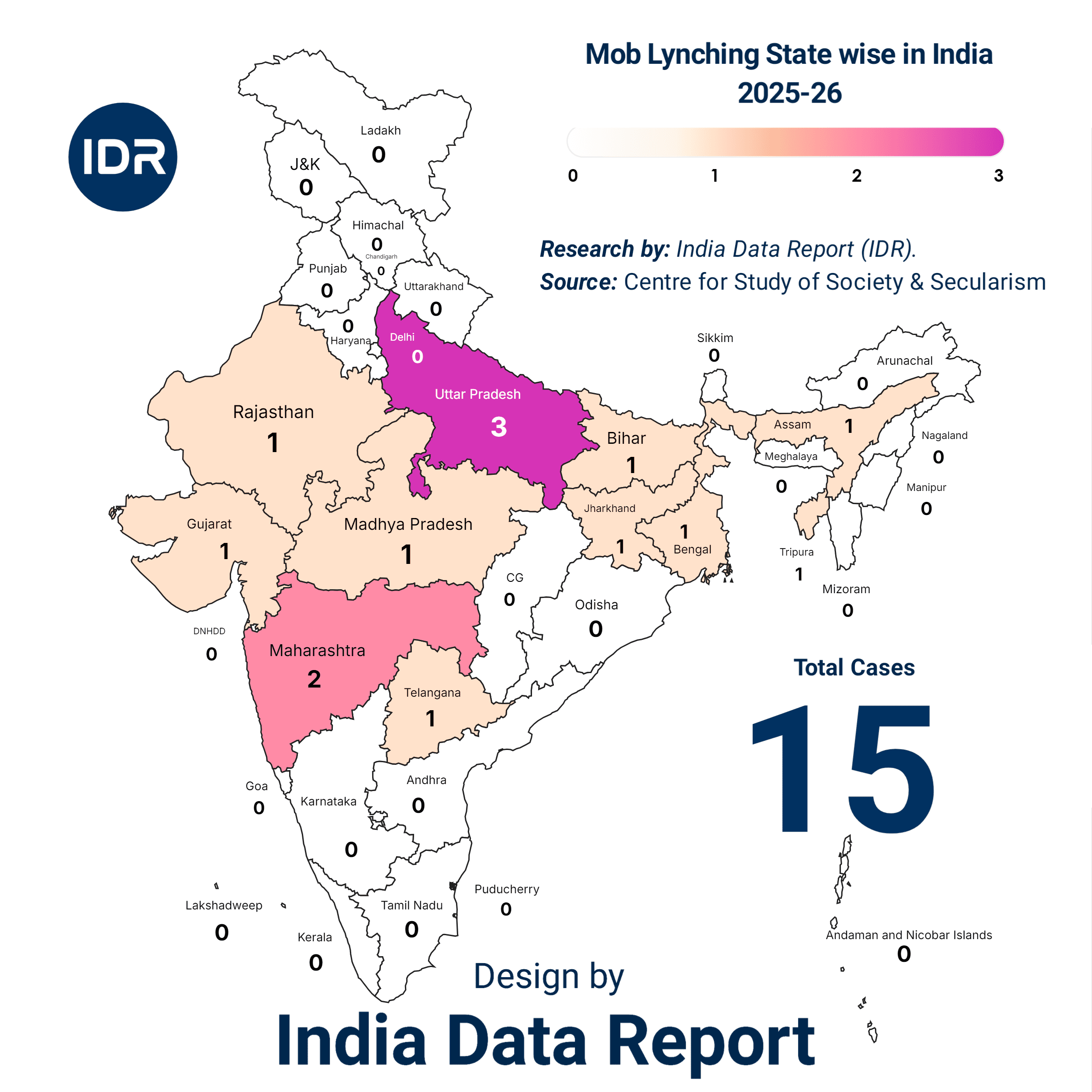
| State / UT | Mob Lynching Cases |
|---|---|
| Uttar Pradesh | 3 |
| Maharashtra | 2 |
| Rajasthan | 1 |
| Madhya Pradesh | 1 |
| Bihar | 1 |
| West Bengal | 1 |
| Telangana | 1 |
| Assam | 1 |
| Delhi | 1 |
| Jammu & Kashmir | 0 |
| Ladakh | 0 |
| Himachal Pradesh | 0 |
| Punjab | 0 |
| Haryana | 0 |
| Uttarakhand | 0 |
| Gujarat | 0 |
| Dadra & Nagar Haveli and Daman & Diu | 0 |
| Goa | 0 |
| Karnataka | 0 |
| Kerala | 0 |
| Tamil Nadu | 0 |
| Andhra Pradesh | 0 |
| Puducherry | 0 |
| Lakshadweep | 0 |
| Chhattisgarh | 0 |
| Odisha | 0 |
| Jharkhand | 0 |
| Sikkim | 0 |
| Arunachal Pradesh | 0 |
| Nagaland | 0 |
| Manipur | 0 |
| Mizoram | 0 |
| Tripura | 0 |
| Meghalaya | 0 |
| Andaman & Nicobar Islands | 0 |
| Rank | State / UT | Cases |
|---|---|---|
| 1 | Uttar Pradesh | 3 |
| 2 | Maharashtra | 2 |
| 3 | Rajasthan | 1 |
| 4 | Madhya Pradesh | 1 |
| 5 | Bihar | 1 |
| 6 | West Bengal | 1 |
| 7 | Telangana | 1 |
| 8 | Assam | 1 |
| 9 | Delhi | 1 |
| 10–35 | All remaining States/UTs | 0 |
Total Cases: 15
The social fabric of a nation isn’t torn by grand wars; it is shredded by the silent, localized explosions of a mob’s fury. We are looking at a ledger of blood that is as cold as it is calculated. While the corridors of power in New Delhi talk about a $5 trillion economy and “Viksit Bharat 2047,” the ground beneath their feet is stained with the results of a primitive, decentralized form of execution.
Let’s be blunt: 15 cases of mob lynching across the Indian landscape in the first half of 2026 is not a “law and order issue.” It is a systemic hemorrhage. It is a sign that the state’s monopoly on violence is being auctioned off to anyone with a smartphone and a grudge. When a crowd decides to play judge, jury, and executioner, the Constitution isn’t just violated it is rendered irrelevant.
If you look at the data provided by the Centre for Study of Society & Secularism, a pattern emerges that defies simple “North vs. South” narratives. It reveals a deeper, more sinister concentration of administrative failure.
| Rank | State / Union Territory | Mob Lynching Cases (Jan-June 2026) | The Ground Reality |
| 1 | Uttar Pradesh | 3 | The epicenter of “instant justice” where the police presence often feels like an afterthought to the mob’s momentum. |
| 2 | Maharashtra | 2 | A shocking surge in a state that prides itself on industrial progression and urban sophistication. |
| 3 | Rajasthan | 1 | Border regions and rural pockets remain high-voltage zones for communal and caste-based friction. |
| 4 | Madhya Pradesh | 1 | Traditional flashpoints involving cattle and land disputes continue to ignite. |
| 5 | Bihar | 1 | A lethal mix of low literacy and high political polarization. |
| 6 | West Bengal | 1 | Where political rivalry often disguises itself as spontaneous mob anger. |
| 7 | Telangana | 1 | A warning shot for the South; technology-driven rumors are no longer a Northern phenomenon. |
| 8 | Assam | 1 | Ethnic anxieties and the “insider-outsider” debate remain a tinderbox. |
| 9 | Delhi | 1 | Even the capital, under the nose of the Supreme Court, is not immune to the madness of the crowd. |
| 10 | Others (26 States/UTs) | 0 | A fragile peace that could shatter with a single viral WhatsApp forward. |
LABEL: The Bitter Truth
Silence in 26 states does not mean safety; it means the fuse hasn’t been lit yet. The concentration in UP and Maharashtra shows that where political stakes are highest, the human life is cheapest.
Why does a farmer, a shopkeeper, or a student join a mob to beat a stranger to death? As a strategist who has watched markets and minds for decades, I can tell you: it’s not about the victim. It’s about the perceived impotence of the system.
When the judiciary takes 20 years to settle a land dispute, and the police are seen as tools of the ruling elite, the common man seeks a “shortcut” to justice. This is “Fast-Food Jurisprudence”—deadly, inefficient, and ultimately self-destructive. The mob provides a sense of belonging and anonymity. In a crowd of a hundred, no one is a murderer, yet everyone is.
We are witnessing a Crisis of Credibility. The average Indian in 2026 feels that the law protects the powerful and entangles the weak. Lynchings are the gruesome manifestation of a society that has lost faith in the black robes and the khaki uniforms.
You might ask, “I am an investor, why should I care about a lynching in a remote village?”
Because capital is a coward. Money does not flow into regions where the rule of law is a suggestion rather than a mandate. International institutional investors look at social stability indices. When images of mob violence from Uttar Pradesh or Maharashtra hit the front pages of the Financial Times or The Economist, the “India Premium” vanishes.
How can we pitch India as the “Global Back Office” or the “Manufacturing Hub of the Future” if we cannot guarantee that a technician or a truck driver won’t be pulled out of a vehicle based on a rumor? Social volatility is the ultimate hidden tax on GDP.
| Metric | Impact of Stability | Impact of Mob Violence (Current Trend) |
| Foreign Direct Investment (FDI) | Increases 15-20% Y-O-Y with clear legal frameworks. | Stagnates in “High-Risk” states; capital migrates to safer, more stable zones. |
| Internal Migration | Skilled labor moves freely to demand centers. | Labor “Ghettoization” as workers fear traveling to certain regions. |
| Social Insurance/Security | Lower state spending on paramilitary deployments. | Massive diversion of taxpayer money to “Control” rather than “Construct.” |
| National Brand Value | “Viksit Bharat” (Developed India) perception. | “Fragile State” perception; loss of soft power in international forums. |
We are burning billions in future investments to satisfy the bloodlust of a few hours. The “Mob Economy” is a zero-sum game where everyone loses.
We must address the elephant in the room: the Silicon Valley connection. In 10 out of these 15 cases, the trigger was not a physical confrontation, but a digital ghost. Child-lifting rumors, organ harvesting myths, or communal provocations these are the “High-Frequency Trading” equivalent of social destruction.
The government’s response has been to shut down the internet. This is like cutting off a patient’s head to cure a headache. It stops commerce, education, and communication, but it doesn’t stop the hate. We have a 19th-century police force trying to manage 21st-century technology. The result is the 15 bodies currently lying in our morgues.
There is a dangerous sentiment among the urban elite: “It doesn’t happen in our neighborhoods.”
Look at the data again. Delhi: 1 Case. Maharashtra: 2 Cases. These are not “remote village” issues. The mob is moving into the suburbs. The psychological distance between a Twitter (X) “pile-on” and a physical lynching is shrinking. When we normalize digital lynching canceling people, calling for their heads over a post we provide the moral justification for the physical act.
We are teaching an entire generation that “Truth” is whatever the majority believes at 2:00 PM on a Tuesday.
As we look toward 2030 and the ultimate goal of 2047, India stands at a crossroads. We can either be a “Superpower with a Soul” or a “Market with a Mob.”
The current trajectory is unsustainable. If we reach 2047 with high-speed rails but no social trust, we will have built a house of cards. A nation is not a collection of buildings; it is a contract between citizens.
2026-2030: The Fracturing. If the current lack of accountability continues, we will see “Gated States.” Just as we have gated communities, certain states will become pariahs for investment, while others (likely in the South and West) will implement draconian digital surveillance to prevent violence, sacrificing privacy for a semblance of peace.
2030-2040: The Judicial Reckoning. Expect a massive overhaul of the Indian Penal Code (or its successors) to include “Collective Liability.” If a lynching occurs, the entire local administration—from the Sarpanch to the DSP—will be held financially and legally responsible. The only way to stop a mob is to make the cost of being a bystander higher than the cost of intervening.
2047: The Two Indias. We will either see a “United India” that has used education to dismantle the mob mentality, or a fragmented landscape where “Viksit Bharat” is an island of wealth surrounded by a sea of unpredictable rage.
We need more than just “condemnation.” We need a National Protocol on Mob Violence (NPMV).
The 15 names on that list are not just statistics. They were sons, fathers, and brothers. Their deaths are a stain on our claim to civilization. To the reader: your silence is the mob’s greatest weapon.
We must demand that our leaders prioritize Social Infrastructure as much as they prioritize physical infrastructure. You cannot run a bullet train on a track made of glass.
Wake up. Before the mob decides that you are the next rumor.
My Verdict:
The state of India’s soul is currently “Critical.” We have the wealth, we have the ambition, but we are losing our humanity. 2047 will be a hollow celebration if we don’t fix the 2026 ledger today.