NEW DELHI, INDIA (IST)
00:00:00 PM
|
Loading...
DETECTING LOCATION...
00:00:00 PM
|
Loading...
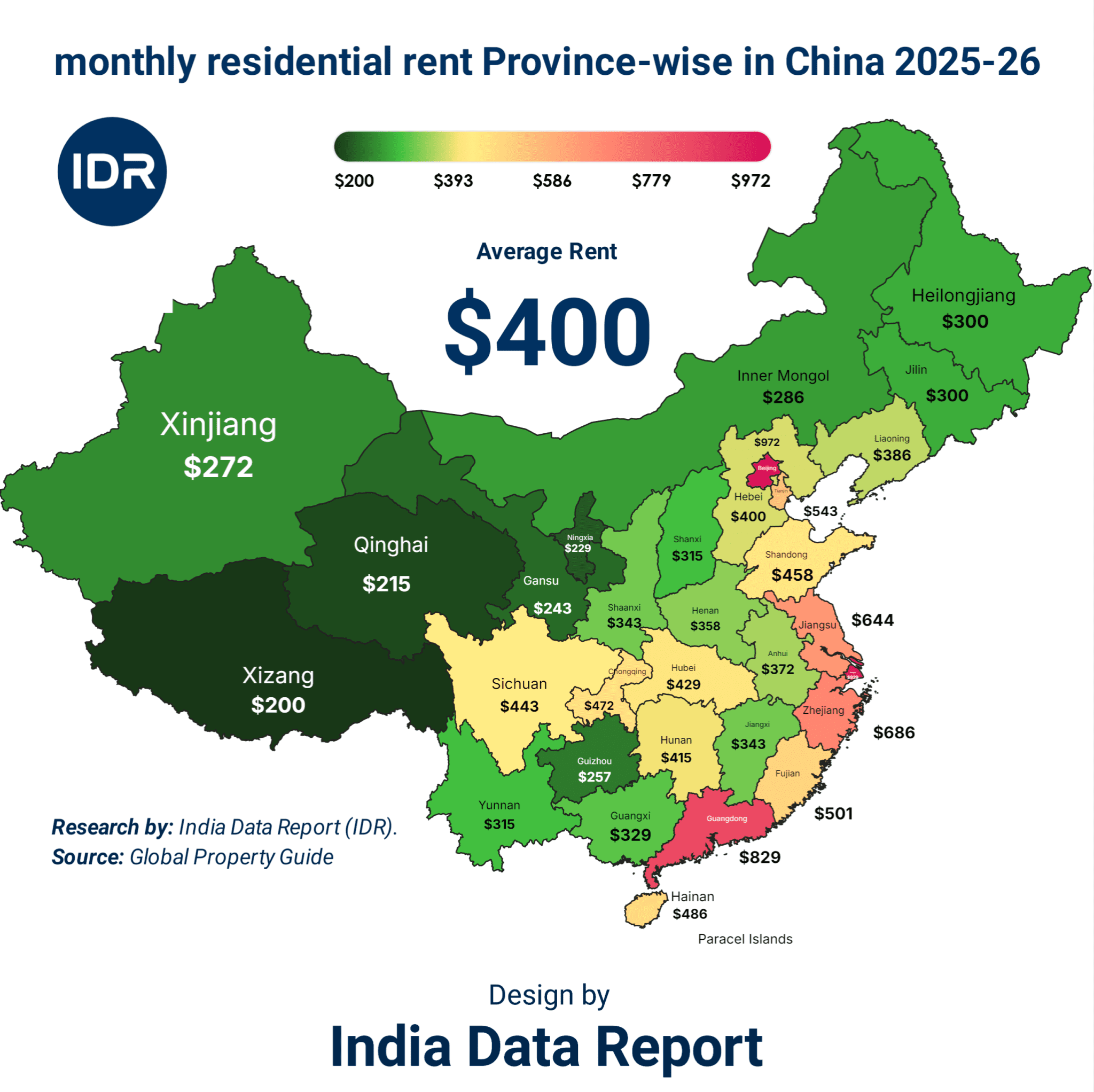
| Province | Monthly Residential Rent (USD) |
|---|---|
| Shanghai | $972 |
| Beijing | $866 |
| Guangdong | $829 |
| Zhejiang | $686 |
| Jiangsu | $644 |
| Fujian | $501 |
| Tianjin | $458 |
| Sichuan | $443 |
| Hubei | $429 |
| Inner Mongolia | $400 |
| Shandong | $386 |
| Hebei | $372 |
| Liaoning | $343 |
| Jiangxi | $343 |
| Gansu | $343 |
| Guangxi | $329 |
| Yunnan | $315 |
| Henan | $313 |
| Jilin | $300 |
| Heilongjiang | $300 |
| Shaanxi | $286 |
| Xinjiang | $272 |
| Guizhou | $257 |
| Gansu | $243 |
| Ningxia | $229 |
| Qinghai | $215 |
| Xizang (Tibet) | $200 |
The skyscrapers of Shanghai don’t touch the clouds; they pierce the lungs of the common man. If you believe the official GDP narratives coming out of Beijing, you are looking at a polished mirror designed to hide the cracks in the foundation. Here is the cold, hard truth that no developer wants you to hear: China’s urban miracle is being cannibalized by its own rental market. When a single professional in Shanghai hands over $972 a month just for the right to sleep within city limits, we aren’t talking about “growth.” We are talking about a sophisticated form of modern feudalism.
For decades, the world watched in awe as China’s real estate market became the engine of global commodity demand. But that engine is now choking on its own exhaust. The data isn’t just a list of numbers; it’s a map of a looming demographic and economic collapse. We are witnessing the systematic erosion of the Chinese dream, one monthly payment at a time.
Let’s look at the predatory nature of the top-tier markets. Shanghai leads the pack at $972, followed closely by Beijing at $866 and Guangdong at $829. On paper, these figures might seem manageable compared to New York or London, but economics is a game of relativity, not absolute numbers. When you calculate the rent-to-income ratio for a mid-level manager in these hubs, the math stops making sense.
The “Lying Flat” (tang ping) movement wasn’t a sudden burst of laziness. It was a calculated response to the realization that no matter how hard you work, the landlord is the ultimate beneficiary of your labor. In Guangdong, the manufacturing heart of the world, a rent of $829 is a tax on productivity. We are seeing a brain drain where the brightest minds are fleeing the Tier-1 pressure cookers, not because they lack ambition, but because they refuse to spend 60% of their paycheck on a 30-square-meter concrete box.
| Rank | Province | Rent (USD/Month) | Economic Pressure Level |
| 1 | Shanghai | $972 | Critical / High-Risk |
| 2 | Beijing | $866 | Critical / High-Risk |
| 3 | Guangdong | $829 | High |
| 4 | Zhejiang | $686 | Elevated |
| 5 | Jiangsu | $644 | Elevated |
| 6 | Fujian | $501 | Moderate |
| 7 | Tianjin | $458 | Moderate |
| 8 | Sichuan | $443 | Moderate |
(The Bitter Truth): High rent in Tier-1 cities is acting as a “biological barrier.” Young couples cannot afford to marry, let alone raise children, in cities like Shanghai or Beijing. The real estate market is effectively a more efficient birth control than any government policy ever was.
The national average rent stands at $400. To a casual observer, this looks reasonable. But averages are the favorite tools of liars and statisticians. The gap between Shanghai ($972) and Xizang ($200) tells a story of two Chinas. One is a high-tech, hyper-inflated dystopia; the other is a struggling hinterland trying to catch up while its youth population migrates toward the very cities that will exploit them.
Provinces like Shandong ($386) and Henan ($313) are the real battlegrounds. These are the industrial and agricultural backbones. When rents in these regions creep toward the $400 mark, the cost of living forces wages up, which in turn makes Chinese exports less competitive. It’s a self-inflicted wound. If the cost of living in Henan a province with nearly 100 million people continues to rise, the “Made in China” tag will soon be a relic of the past, replaced by cheaper alternatives in Southeast Asia or Mexico.
| Province | Rent (USD/Month) | Impact on Local Consumption |
| Inner Mongolia | $400 | Low Disposable Income |
| Shandong | $386 | Stagnant Retail Growth |
| Hebei | $372 | Industrial Labor Shortage |
| Liaoning | $343 | Rust Belt Decay |
| Jiangxi | $343 | Youth Outward Migration |
| Gansu | $343 | Economic Fragility |
(The Golden Opportunity): For savvy investors, the real play isn’t in the overvalued coastal hubs anymore. The decentralized “Remote Work” culture if the CCP allows it to flourish—could breathe life into provinces like Liaoning or Jiangxi. However, this requires a massive shift in infrastructure that the current debt-laden local governments might not be able to afford.
We must look beyond the ledgers. Economic strategy is, at its core, human psychology. What happens to a society when the basic human need for shelter becomes a luxury good?
The Death of Innovation: When your primary concern is making rent on the 1st of every month, you don’t take risks. You don’t start a business. You don’t innovate. You cling to the safest, most soul-crushing job available.
The Erosion of Trust: The younger generation sees the property-owning “Boomer” equivalent in China getting rich off their rent while the economy slows down. This creates a generational rift that is a ticking time bomb for social stability.
The Ghost Town Paradox: We see rents staying high even as “Ghost Cities” sit empty. Why? Because the market is rigged by local governments who rely on high land prices to pay off their massive hidden debts (LGFVs).
The current trajectory is unsustainable. If the rent-to-income gap isn’t addressed by 2030, the “Common Prosperity” goal will be nothing more than a slogan on a dusty billboard. By 2047 the centenary of the PRC China will either be a nation that successfully socialized its housing or a nation that choked on its own bricks and mortar.
The government is trying to pivot toward “Rental Housing” as a legitimate long-term solution, moving away from the “Buy at all costs” mentality. But they are fighting decades of cultural conditioning. In China, a home isn’t just a place to live; it’s the price of entry for marriage and social status. Breaking that link is like trying to turn a supertanker in a bathtub.
| Province | Rent (USD) | Rank | Regional Significance |
| Guangxi | $329 | 16 | Trade Gateway to ASEAN |
| Yunnan | $315 | 17 | Tourism Hub |
| Henan | $313 | 18 | Agricultural Core |
| Jilin | $300 | 19 | Heavy Industry |
| Heilongjiang | $300 | 20 | Grain Security |
| Shaanxi | $286 | 21 | Tech/Historical Hub |
| Xinjiang | $272 | 22 | Strategic Border |
| Guizhou | $257 | 23 | Big Data/Cloud Center |
| Ningxia | $229 | 24 | Resource Rich |
| Qinghai | $215 | 25 | Energy Reservoir |
| Xizang | $200 | 26 | Frontier Buffer |
(The Bitter Truth): The low rents in Xinjiang ($272) and Xizang ($200) aren’t a sign of affordability; they are a sign of total economic isolation. Without high-value jobs, even $200 is an insurmountable mountain for a local herder or laborer.
As an economist who has spent years tracking the movement of capital across borders, I don’t see a “soft landing.” I see a “forced recalibration.”
2026-2030 (The Correction): Expect a massive crackdown on institutional landlords. The government cannot afford a revolution of the renters. We will see the introduction of a national property tax, which will paradoxically push some rents higher in the short term as landlords try to pass on the cost, before a total market correction occurs.
2030-2040 (The Great Migration): The “Reverse Migration” will peak. People will flee Shanghai and Beijing not for better opportunities, but for survival. Secondary hubs like Chengdu (Sichuan – $443) and Wuhan (Hubei – $429) will become the new centers of the Chinese middle class.
2040-2047 (The New Normal): By 2047, China’s population will be significantly older and smaller. The rental market will finally crash not because of policy, but because of a lack of demand. The empty apartments of today will be the liabilities of tomorrow.
If you are an expat or a local professional, stop chasing the Tier-1 ghost. The “prestige” of a Shanghai address is a vanity metric that is currently liquidating your future. Look at the $400-$500 zones Sichuan, Hubei, Tianjin. These are the places where the next chapter of China’s story will be written, away from the suffocating grip of the coastal property bubble.
The truth is uncomfortable: the Chinese economic miracle was built on land. Now, that same land is the very thing holding its people hostage. You can either be the one paying the ransom, or you can find a way to exit the game before the gate closes.