NEW DELHI, INDIA (IST)
00:00:00 PM
|
Loading...
DETECTING LOCATION...
00:00:00 PM
|
Loading...
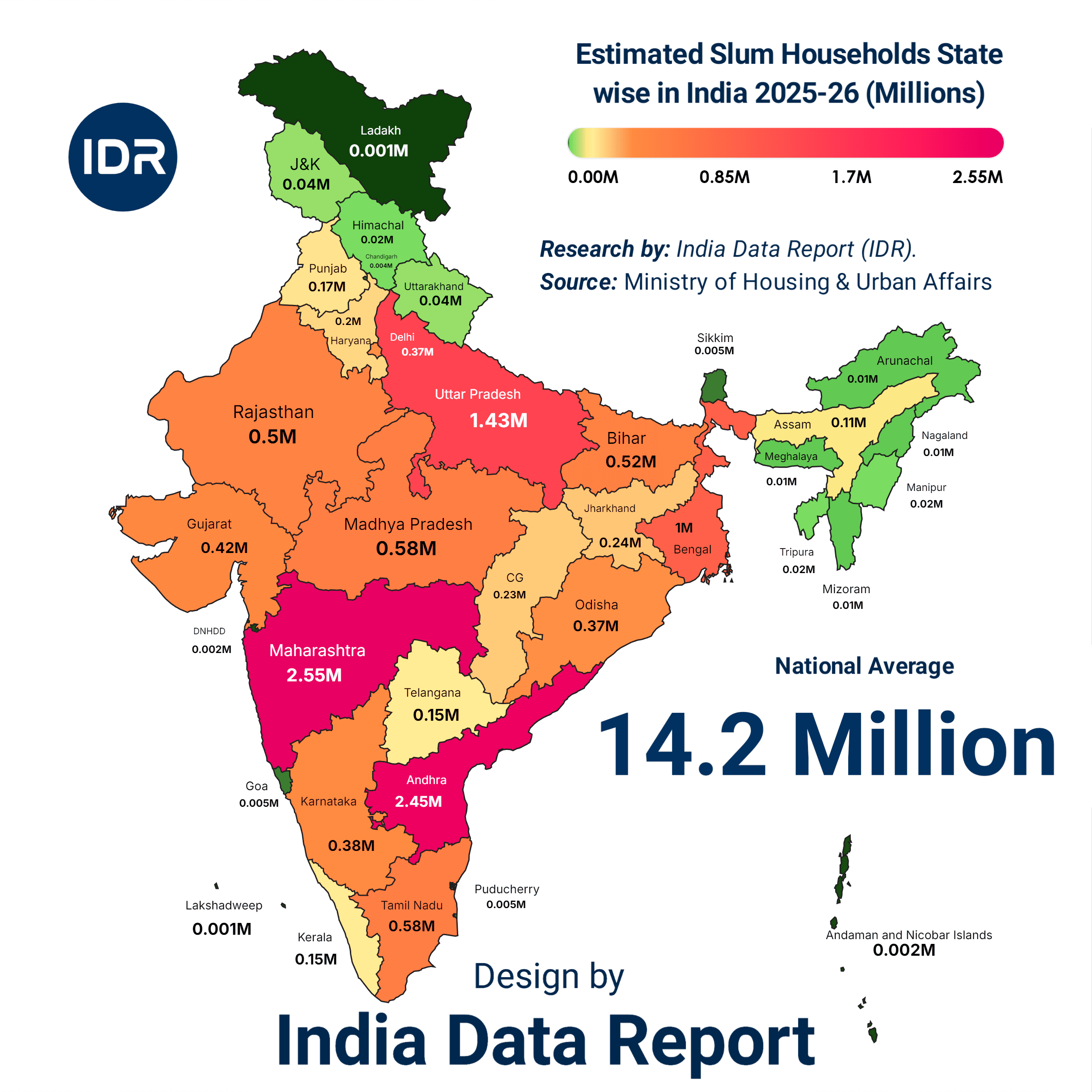
| S.N. | State / UT | Households (Million) |
|---|---|---|
| 1 | Maharashtra | 2.55M |
| 2 | Andhra Pradesh | 2.45M |
| 3 | Uttar Pradesh | 1.43M |
| 4 | Madhya Pradesh | 0.58M |
| 5 | Tamil Nadu | 0.58M |
| 6 | Bihar | 0.52M |
| 7 | Rajasthan | 0.50M |
| 8 | Gujarat | 0.42M |
| 9 | Odisha | 0.37M |
| 10 | Delhi | 0.37M |
| 11 | Karnataka | 0.38M |
| 12 | Jharkhand | 0.24M |
| 13 | Chhattisgarh | 0.23M |
| 14 | Telangana | 0.15M |
| 15 | Kerala | 0.15M |
| 16 | Punjab | 0.17M |
| 17 | Assam | 0.11M |
| 18 | Haryana | 0.20M |
| 19 | Uttarakhand | 0.04M |
| 20 | Jammu & Kashmir | 0.04M |
| 21 | Himachal Pradesh | 0.02M |
| 22 | Manipur | 0.02M |
| 23 | Tripura | 0.02M |
| 24 | Nagaland | 0.01M |
| 25 | Arunachal Pradesh | 0.01M |
| 26 | Mizoram | 0.01M |
| 27 | Meghalaya | 0.01M |
| 28 | Goa | 0.005M |
| 29 | Puducherry | 0.005M |
| 30 | Sikkim | 0.005M |
| 31 | Dadra & Nagar Haveli and Daman & Diu (DNHDD) | 0.002M |
| 32 | Andaman & Nicobar Islands | 0.002M |
| 33 | Lakshadweep | 0.001M |
| 34 | Ladakh | 0.001M |
Numbers don’t just talk; they scream if you listen closely enough. We’ve been fed a steady diet of “fastest-growing economy” and “digital revolution” headlines, yet the 2025–26 data on slum households serves as a violent reality check. We are looking at 14.2 million households—not individuals, but entire families—crammed into the fractures of our urban expansion. This isn’t just an infrastructure failure; it is a systematic economic ghettoization that we’ve ignored while chasing GDP ghosts.
Look at Maharashtra. The crown jewel of Indian industry, the home of Dalal Street, and yet it sits atop a mountain of 2.55 million slum households. It’s a cruel irony that the state generating the most wealth also harbors the most despair. We’ve built skyscrapers that cast long, dark shadows over tin roofs. If this is the “Maharashtra Model,” then the model is fundamentally broken. We are witnessing a classic case of Spatial Inequality, where the proximity of extreme wealth and crushing poverty creates a volatile socio-economic cocktail.
| State | Households (Million) | Economic Contribution (GSDP Share) | The Verdict |
| Maharashtra | 2.55M | High | Economic Engine fueled by exploited labor. |
| Andhra Pradesh | 2.45M | Moderate | High urbanization without inclusive housing. |
| Uttar Pradesh | 1.43M | High | Massive migration meeting zero urban planning. |
| Madhya Pradesh | 0.58M | Moderate | Centralized poverty moving to the city. |
| Tamil Nadu | 0.58M | High | Industrial success with a lingering shadow. |
The Bitter Truth: For every gleaming IT park we inaugurate, we are tacitly approving three new shantytowns. The data reveals that the states with the highest economic activity are precisely where the housing crisis is most lethal.
We love to talk about the “demographic dividend,” but let’s be honest: a dividend requires investment. What we have here is a Demographic Debt. When 2.45 million households in Andhra Pradesh are living on the fringes, they aren’t participating in the formal economy; they are surviving it. They are the “invisible hands” that build our cities but can never afford to live in them.
The psychological toll is even heavier. Imagine a generation of children growing up in the 0.37 million slum households of Delhi, the nation’s capital. They see the power corridors every day, yet they are separated by an unbridgeable chasm of policy apathy. This is how you breed resentment, not growth. We are sitting on a powder keg of inequality, and the fuse is getting shorter as we approach 2030.
| Region | Slum Concentration | Dominant Cause | Future Risk (2030) |
| West (MH, GJ) | 2.97M | Industrial Over-concentration | Urban Gridlock |
| South (AP, TN, KA, etc.) | 3.71M | Tech-Led Migration | Gated Community Apartheid |
| North/Central (UP, MP, RJ) | 2.51M | Agrarian Collapse | Slum-based Vote-bank Politics |
Why does Rajasthan have 0.50 million households in slums despite having vast land? It’s simple: Lopsided Urbanization. We’ve created “islands of excellence” like Jaipur or Jodhpur, forcing the rural poor to migrate into a vacuum of affordable housing. They leave the drought for the drain.
The most terrifying part of this 14.2 million figure is its stickiness. Slums aren’t temporary transit points anymore; they are permanent legacies. In Maharashtra and Andhra Pradesh, these households represent a “locked-in” poverty trap. Our policy “mentors” in AC rooms call this “unorganized sector growth,” but let’s call it what it is: a failure of the state to provide the most basic human dignity—a roof that doesn’t leak and a door that locks.
Are we actually progressing, or are we just rearranging the deck chairs on a sinking ship? If 14 million households are struggling for air in 2026, the 2030 vision of a “Viksit Bharat” (Developed India) will remain a hallucination for anyone earning less than a six-figure salary.
If you think the numbers in the previous section were just “unfortunate,” you’re missing the forest for the trees. This isn’t a glitch; it’s a feature. The Maharashtra-Andhra Pradesh corridor alone accounts for a staggering 5 million households. Think about that. Two states, often touted as the twin engines of India’s progress, house more slum dwellers than the entire populations of many European nations.
Let’s strip away the corporate jargon. Why does Maharashtra lead with 2.55 million? Because Mumbai and Pune act as giant magnets for desperation. The state has mastered the art of “Extractive Urbanism.” It welcomes the cheap labor required to build its luxury high-rises but offers no space for that labor to exist. We call it a “real estate boom,” but for the man living in a 10×10 shanty in Dharavi or Kurla, it’s a life sentence in a concrete cage.
| Metric | High-Growth Urban Areas (MH/AP) | The Slum Reality | The “Hidden” Tax |
| Real Estate Index | +12% Annual Growth | 0% Equity for Residents | High Rent to Slum Lords |
| Water Access | 24/7 in Gated Communities | 2 Hours at a Shared Tap | Health “Tax” (Diseases) |
| Electricity | Subsidized for Industry | Often Pirated/Unsafe | 1.5x Market Rate via Middlemen |
The Golden Opportunity (for the few): Developers capitalize on the scarcity of land while the “Slum Rehabilitation” schemes (SRA) often turn into land-grabbing mechanisms where the poor are pushed further to the peripheries, increasing their commute costs and killing their productivity.
Andhra Pradesh, with 2.45 million households, presents a different, perhaps more modern, tragedy. The state has undergone radical shifts in its capital-city narratives. From the tech-dreams of Cyberabad to the flux of Amaravati and Visakhapatnam, the common denominator has been the displacement of the rural poor. They aren’t moving to the cities to become coders; they are moving to be the delivery boys, the security guards, and the maids for the coders.
We talk about India’s $5 Trillion ambition, but we ignore the Productivity Leak. A worker living in the 0.38M slum households of Karnataka or the 0.58M in Tamil Nadu spends 3 hours a day just navigating the logistical nightmare of a slum—fetching water, fighting for sanitation, and commuting via broken transit.
If we calculate the lost man-hours due to “slum-related inefficiencies,” we aren’t looking at a booming economy; we’re looking at an engine running on 50% capacity because the spark plugs are covered in soot.
| State | Manufacturing Output Rank | Slum Household Rank | The Paradox |
| Gujarat | 1 | 8 | Relatively better urban management? Or just better hidden? |
| Tamil Nadu | 2 | 5 | Industrial success hasn’t trickled down to housing. |
| Maharashtra | 3 | 1 | Total disconnect between GDP and living standards. |
Bitter Truth: Gujarat’s 0.42M households vs. Maharashtra’s 2.55M shows that “industrialization” isn’t a valid excuse for slums. It’s about political will and urban foresight—two commodities currently in short supply.
The psychology of the slum dweller in 2026 is no longer one of “hopeful migration.” It is one of Urban Entrapment. In the past, you came to the city to “make it.” Today, you come to the city because the village has nothing left, only to find that the city wants your sweat, but not your presence. This is the truth behind the 14.2 million. We aren’t building “Smart Cities”; we are building “Fortress Cities” surrounded by trenches of poverty.
The data for Uttar Pradesh (1.43 million) and Bihar (0.52 million) tells a story of an exodus. These are the “exporting” states. But look at the destination states—the numbers are rising there too. This means the cycle of poverty isn’t being broken; it’s just being relocated.
If Maharashtra and Andhra Pradesh are the “extractive engines,” then the North-Central belt—comprising Uttar Pradesh (1.43M), Madhya Pradesh (0.58M), and Rajasthan (0.50M)—is the reservoir of broken promises. We’re looking at over 2.5 million households in these three states alone that have transitioned from rural distress to urban despair. This isn’t just a housing shortage; it’s a failure of the “Rurban” dream.
The case of Uttar Pradesh is particularly galling. With 1.43 million slum households, the state proves that “political muscle” and “infrastructure spending” (expressways, airports, and grand corridors) do not automatically translate into human dignity. You can pave a ten-lane highway through the state, but if the people building it are retiring into a plastic-sheet shanty in Noida or Lucknow, your “development” is a facade. It’s lipstick on a pig.
| State | Slum Households (Millions) | Agricultural Growth Rate | Migration Driver |
| Uttar Pradesh | 1.43M | Volatile | Fragmentation of land holdings. |
| Madhya Pradesh | 0.58M | Stagnant | Climate-induced crop failure. |
| Rajasthan | 0.50M | Low | Lack of non-farm employment. |
The Bitter Truth: The North isn’t urbanizing; it’s “slum-ifying.” People aren’t moving to cities because they are pulled by opportunity; they are being pushed by the death of the village economy. We’ve turned our cities into refugee camps for the economically displaced.
In Madhya Pradesh and Rajasthan, we see a combined 1.08 million households living in conditions that make social distancing a dark joke. These are states that have spent billions on “Smart City” missions. But here is the catch: “Smart Cities” are designed for the top 10%. They feature sensor-based lighting and fancy parks while the 0.58 million households in MP struggle for a functional sewer line.
We are creating a Two-Tier Republic.
The psychology here is driven by Relative Deprivation. When a worker in a Jaipur slum sees a luxury SUV pass by his shanty every morning, the “hunger” isn’t just for food; it’s for justice. By 2030, this gap won’t just be an economic statistic; it will be a source of civil friction.
| Feature | The “Ghetto” Reality | The Government “Paper” Reality |
| Housing Tenure | Permanent Fear of Eviction | “Housing for All” (PMAY) targets met on paper. |
| Health Index | High Respiratory/Water-borne issues | “Jan Aushadhi” centers (often miles away). |
| Education | High Drop-out rates (Child labor) | “Right to Education” (nominal enrollment). |
The Golden Opportunity (For Politicians): Slums are the ultimate vote banks. By keeping people in a state of “legal limbo”—where they have an Aadhaar card but no land title—politicians ensure a population that is forever dependent on the next “freebie” or “regularization” promise before an election.
Let’s talk about Rajasthan (0.50M) and Gujarat (0.42M). They share a border and a similar dry climate, yet Gujarat has managed slightly better containment. Why? Because Gujarat’s industrialization was spread across smaller hubs (Surat, Vapi, Ankleshwar), whereas Rajasthan’s growth is hyper-concentrated. Concentration is the parent of the slum. When you put all your eggs in one urban basket, the basket breaks.
We are witnessing the Death of the Middle Class Dream for the bottom 40%. The ladder has been pulled up. If you are born into one of the 0.52 million slum households in Bihar today, the odds of you owning a legal, brick-and-mortar home by 2030 are statistically near zero. That is the truth the “Economic Strategists” won’t tell you in their Davos presentations.
We’ve reached the nerve center of modern India—the high-tech hubs and the political throne. If you thought the “North-Central collapse” was a tragedy, the situation in the South and Delhi is a calculated, cold-blooded abandonment. Here, the data for Karnataka (0.38M), Telangana (0.15M), and Delhi (0.37M) reveals a terrifying trend: The Gated Community Apartheid.
Let’s look at Delhi. The national capital, the seat of the Supreme Court and Parliament, houses 0.37 million households in slums. That is nearly 2 million people living in what can only be described as a perpetual shadow. While the elite debate “Air Quality Indices” in Lutyens’ Delhi, the residents of these 675 slum clusters are breathing the literal dust of the construction sites they labor on. They are the “Ghost Citizens” of the capital—eligible to vote but ineligible for a dignified life.
| State/UT | Slum Households (Million) | IT Exports / Economic Power | Housing Strategy |
| Delhi | 0.37M | National Political Hub | PPP models stuck in red tape for a decade. |
| Karnataka | 0.38M | Global Tech Giant | Peripheral dumping of the poor. |
| Telangana | 0.15M | Real Estate Sensation | Vertical growth for the rich, shanties for the rest. |
The Bitter Truth: In Bangalore (Karnataka) and Hyderabad (Telangana), the “Tech Boom” has hyper-inflated land prices to a point where a 350 sq. ft. tenement is now a luxury. By 2026, the cost of “affordable” housing has crossed ₹50-70 Lakhs in these cities, effectively telling the 0.53 million households in these two states: “You are not welcome here except to work.”
Look at the bottom of your list. Kerala (0.15M). Despite high population density and expensive land, Kerala’s slum footprint is minimal compared to its GSDP. Why? It isn’t magic; it’s Decentralization. Kerala didn’t put all its eggs in one “Mega-City” basket. By distributing growth across smaller towns and prioritizing the Kudumbashree network and local self-governance, they prevented the formation of massive urban ghettos.
The Economic Survey of 2025–26 recently identified “Dead Capital”—unclear land titles and restrictive Floor Space Index (FSI) norms—as the killers of urban India.
Under the PPP (Public-Private Partnership) model, the government gives land to a developer. The developer builds a small “pigeon-hole” block for the slum dwellers and a massive luxury tower on the rest of the land to recover costs. Result? The poor are physically present but socially erased, living in the backyard of the people they serve.
| City Project | High-End Benefit | The Slum Impact |
| Delhi Metro Phase IV | Connectivity for the Middle Class | Displacement of clusters along the track. |
| Bangalore Peripheral Ring Road | Real Estate price hike for investors | Pushing 0.38M households further into the “unseen” zones. |
| Hyderabad Pharma City | Industrial Growth | Influx of migrant labor with zero housing plan. |
The Golden Opportunity (The Scam): We are seeing a “Rental Trap” in the South. Since the poor cannot buy, they pay exorbitant rents for illegal, unsafe shacks. In cities like Bangalore, the “Slum Landlord” is often more powerful (and richer) than a corporate CEO.
We are building a Digital Fortress. On the inside: high-speed internet, smart lighting, and 15-minute delivery. On the outside: the 14.2 million households who make that 15-minute delivery possible but can’t afford the meal themselves. This isn’t progress; it’s a Socio-Economic Time Bomb. When the “Delivery Class” can no longer afford to live within 20 kilometers of the “Consuming Class,” the system will seize up.
We’ve dissected the data, we’ve exposed the “mirage” of the high-growth states, and we’ve looked into the dark corners of our Silicon Valleys. Now, it’s time for the unfiltered truth. As a strategist, I don’t deal in hope; I deal in trends. And the trend for the 14.2 million households is not an upward trajectory—it’s a horizontal crawl through the mud.
The current “Housing for All” schemes are akin to putting a Band-Aid on a chainsaw wound. We are building 200,000 houses while 2,000,000 more people fall into the “urban poor” category due to the collapse of the rural economy. We are fighting a flood with a teaspoon.
| Variable | Current Impact (2026) | Projected Loss (2030) | The “Hidden” Toll |
| Public Health | 3.5% of GSDP lost to sanitation-related illness. | 5.2% of GSDP | Productivity drain from chronic illness. |
| Social Stability | High crime in “Transition Zones.” | Risk of Civil Unrest | The erosion of the “Social Contract.” |
| Labor Mobility | Workers trapped by high urban rents. | Labor Shortages in High-end Services | The “service class” will flee the cities. |
The Bitter Truth: There is an old proverb: “The forest was shrinking, but the trees kept voting for the Axe.” Our urban planning is the Axe. We prioritize the flow of capital over the flow of human life, forgetting that capital has no value if there is no one left to do the work.
We are currently operating on a “Disposable Labor” model. We use the 2.55 million households in Maharashtra to keep our malls running and our streets clean, but we treat their housing as a “private problem.” Economics 101 dictates that this is unsustainable. You cannot have a $10 Trillion economy with a 19th-century living standard for 15% of your urban population.
The “Golden Opportunity” isn’t in another tech IPO. It’s in the Unlocking of Urban Land. Give these 14.2 million families a legal stake in the city, and you will see an explosion of micro-entrepreneurship that no “Startup India” scheme can ever match. Deny them, and you are simply building a very expensive monument to inequality.
The clock is ticking. 2030 is not a distant dream; it’s the day the bill comes due.
Wealth and squalor are two sides of the same coin in an Extractive Economy. Maharashtra’s growth is hyper-centralized in the Mumbai-Pune belt. This creates a “gravity well” that sucks in millions of rural migrants, but the real estate market—rigged by a developer-politician nexus—only builds for the elite. The result? The wealthy get skyscrapers, and the workers get blue-tarpaulin roofs. It’s not a lack of money; it’s a lack of spatial justice.
On paper, yes. In reality, it’s a drop in the ocean. While the government celebrates “sanctioning” houses, the velocity of slum formation is outpacing construction. Most new “affordable” housing is built on the city fringes, miles away from where the jobs are. A worker would rather live in a 0.37M-ranked Delhi slum cluster near their workplace than in a “free” house 40km away that eats 4 hours of their day in commuting.
Not necessarily, but their models are different. Kerala (0.15M) succeeded through Decentralization—people don’t have to flee to one single “Mega-City” to survive. Gujarat (0.42M) utilized a more spread-out industrial model. However, a lower number can also be deceptive; it often means the poor have been pushed so far out of the city limits that they no longer qualify as “urban slums,” even though their struggle remains identical.
We hit the “Urban Ceiling.” When the cost of living in a slum exceeds the earning potential of a manual laborer, the labor supply will collapse. You’ll see “Labor Droughts” in big cities. More importantly, the psychological gap between the “Digital Elite” and the “Ghettoized Millions” will lead to massive social friction. We aren’t just looking at an economic statistic; we are looking at the future site of India’s greatest internal challenge.