NEW DELHI, INDIA (IST)
00:00:00 PM
|
Loading...
DETECTING LOCATION...
00:00:00 PM
|
Loading...
We are currently witnessing the greatest structural illusion of the modern economic era: the myth of a globalized, egalitarian recovery. Corporate boardrooms chatter endlessly about green transitions, smart cities, and digital financial inclusion. Meanwhile, the very concrete beneath our feet is cooking the workforce that builds it. The math is brutal, public, and entirely ignored. By 2030, exactly 2.4 billion people living in the world’s most punishing climates will have absolutely no access to indoor cooling. Let that number sink into your portfolio projections. It is not just a humanitarian failure; it is an economic collapse disguised as a weather report.
For generations, comfortable societies treated air conditioning as a bourgeois indulgence—a luxury for the soft-handed or the decadent. That delusion is dying a rapid, violent death. Today, a cooling system is as fundamental to human labor productivity as clean water or electricity. Yet, the international capital market treats it as an optional appliance.
If you cannot cool your home, you cannot sleep. If you cannot sleep, your cognitive capacity drops by over 20% the following morning. If a factory floor hits 38°C, manual labor efficiency plummets by half, while industrial accident rates spike. We are dividing the planet into two distinct biological classes: those who can pay to regulate their local thermodynamic reality, and those whose economic output, health, and survival are left at the mercy of a broken thermostat.
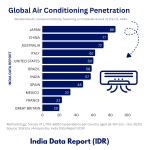
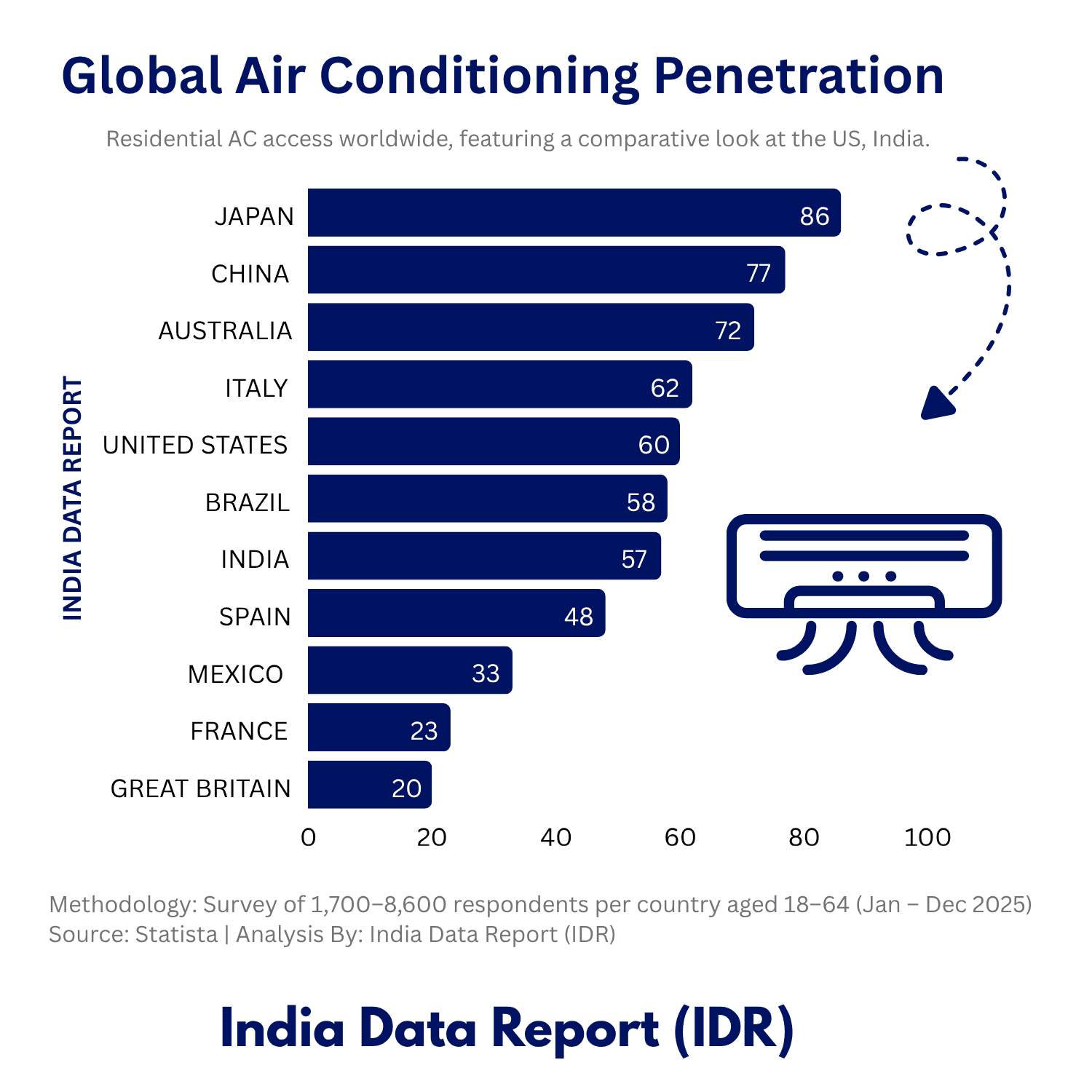
The data gathered throughout 2025 exposes an uncomfortable, asymmetric truth. Wealth does not merely buy influence or real estate; it buys the right to ignore nature. When we dissect the household air conditioning penetration numbers across major economies, the superficial explanations of geography and climate quickly fall apart.
| Rank | Country | Households with AC Access (%) | Primary Socio-Economic Driver |
| 1 | Japan | 86% | High Urban Density & Geriatric Vulnerability |
| 2 | China | 77% | State-Subsidized Infrastructure & Manufacturing Hubs |
| 3 | Australia | 72% | High Disposable Income & Arid Geography |
| 4 | Italy | 62% | Mediterranean Heatwaves & Tourist Economy Protection |
| 5 | United States | 60% | Post-War Suburban Design & Fragmented Grid Wealth |
| 6 | Brazil | 58% | Emerging Middle-Class Debt Expansion |
| 7 | India | 57% | Aggressive Urbanization vs. Massive Rural Deficit |
| 8 | Spain | 48% | European Heat Dome Vulnerability |
| 9 | Mexico | 33% | Industrial Nearshoring Belts vs. Impoverished South |
| 10 | France | 23% | Cultural Resistance to Retrofitting |
| 11 | Great Britain | 20% | Historical Legacy Infrastructure & Policy Inertia |
(The Bitter Truth): High national percentages frequently mask brutal internal class warfare. A 60% penetration rate in the United States does not mean six out of ten people are safe; it means forty percent of the population is trapped in urban heat islands, spending their lives choosing between a functional compressor and a grocery bill.
Look at Great Britain at 20% or France at 23%. For years, European policymakers hid behind their historically temperate latitudes. They laughed at the American obsession with central air, calling it unsustainable and unnecessary. But history changed faster than their building codes. The European heat domes of recent summers turned brick-and-mortar flats—built centuries ago to trap heat—into literal ovens.
The low penetration there isn’t a sign of ecological restraint; it is a manifestation of institutional inertia. When a heatwave strikes London today, public transport stops, server rooms fail, and productivity halts because the physical capital of the nation is thermodynamically obsolete.
Conversely, consider Japan at 86%. This is an aging society that understands a basic macroeconomic truth: a heatstroke epidemic among senior citizens will instantly bankrupt a national healthcare system. Their high penetration is a calculated defensive strategy, a structural shield deployed to keep an aging demographic alive and out of emergency rooms. It is a stark contrast to emerging economies where cooling is still taxed as a luxury item.
The mainstream financial press loves to talk about India’s rising consumer class. They point to the 57% residential AC penetration rate as proof of an unstoppable domestic market. But as an investigative economist, my job is to look past the aggregate charts and see who is actually burning.
The 57% figure is an analytical mirage. It counts households that have access to a cooling device within a highly distorted urban sample pool, but it completely ignores the structural reality of the electrical grid, the quality of housing, and the crushing weight of utility bills.
| Country | AC Penetration (%) | Percentage Gap vs. India | Real-World Economic Impact |
| Japan | 86% | +29% | Zero productivity loss due to ambient thermal stress. |
| China | 77% | +20% | Consistent industrial and manufacturing supply chains. |
| Australia | 72% | +15% | High consumer spending retained during peak summer months. |
| United States | 60% | +3% | Severe internal racial and regional energy poverty gaps. |
| India | 57% | 0% | Massive peak-load power deficits and labor degradation. |
| Mexico | 33% | -24% | Capital flight from uncooled secondary manufacturing zones. |
| Great Britain | 20% | -37% | Severe transport and white-collar systemic disruptions during anomalies. |
(The Golden Opportunity): The massive deficit between India and East Asian manufacturing powerhouses represents a multi-billion dollar market for decentralized, low-voltage cooling technology. Whichever enterprise solves the off-grid cooling puzzle wins the next decade of Global South infrastructure capital.
What happens when you look below the surface of India’s 57%? You find a country split down the middle. In elite enclaves, high-end inverter units run 24 hours a day, keeping corporate executives crisp and productive. But just three kilometers away, in informal settlements and working-class tenements, five people sleep in a single sheet-metal room where the indoor temperature routinely exceeds 42°C at midnight.
Even if these households scrape together the capital to buy a cheap, secondhand fixed-speed AC unit, they cannot afford to turn it on. The cost of electricity turns their prize appliance into a useless metal box mounted on a crumbling wall.
This brings us to the core issue plaguing the modern macroeconomic framework: the weaponization of energy tariffs. The global consensus on climate change demands that we reduce emissions. Fine. But the current policy prescription focuses on making energy more expensive through carbon taxes and regulatory compliance, completely ignoring the fact that for a family in Mumbai or São Paulo, cheap cooling is a matter of life and death.
For decades, economists measured energy poverty by looking at who lacked heating in the winter. It was a Eurocentric metric designed by analysts who sat in comfortable offices in Paris and Geneva. They calculated the cost of oil, gas, and coal needed to keep a home at 18°C during a blizzard.
That framework is dangerously outdated. The modern crisis is cooling poverty.
The Euro-Mediterranean Centre on Climate Change (CMCC) provides a clear definition: a household is in energy poverty if its heating and cooling costs exceed 10% of its total income or expenditures. When you apply this metric globally, the results are terrifying. Millions of families are technically middle-class on paper, yet they are being systematically impoverished by the cost of staying cool.
[Household Income Growth: Stagnant]
               │
               ▼
[Ambient Global Temperature: Rising] ──► [AC Runtime Demands: Escalating]
               │
               ▼
[Utility Costs Exceed 10% of Disposable Income]
               │
               ▼
[Thermodynamic Exploitation: The Choice Between Cooling and Sustenance]
This dynamic creates a vicious, self-reinforcing economic loop. As ambient temperatures rise, households are forced to run their cooling systems longer just to maintain baseline human survival. This drives up utility bills, devouring money that would otherwise go toward nutrition, education, or wealth accumulation.
To pay the electricity bill, families cut back on high-quality protein or pull their children out of private tutoring. The heat is quite literally consuming the upward mobility of the global working class.
Let’s look closely at the internal dynamics of the world’s largest economy: the United States. Even with an overall penetration rate of 60%, data from the Kaiser Family Foundation shows that Black- and Hispanic-led households are vastly less likely to have functional, efficient air conditioning than white households in the same zip codes.
Why? Because historical redlining trapped these communities in urban heat islands—areas with lots of asphalt, concrete, and corporate warehouses, and very few trees. These neighborhoods run up to 5°C hotter than wealthy, tree-lined suburbs just a few miles away.
This is not a climate issue; it is structural economic discrimination written into the thermal geography of our cities. A family living in an urban heat island pays a double penalty: they experience higher ambient heat because of poor city planning, and they pay higher electricity rates because their inefficient window AC units have to work twice as hard to cool poorly insulated rooms.
The neoliberal economic playbook says that the market will fix this. It argues that as demand for cooling grows, manufacturers will scale production, prices will drop, and the 2.4 billion people currently left out will eventually get their units.
This argument is completely detached from physical and economic reality. The market, left to its own devices, prefers to sell high-margin, feature-heavy smart AC units to wealthy consumers who want to control their living room climate with a smartphone app. It has absolutely no financial incentive to build ultra-cheap, highly durable, low-draw cooling systems for families living on five dollars a day in informal settlements.
Furthermore, our current electrical grids cannot handle a purely market-driven expansion of traditional air conditioning. If every household in India and Brazil bought a standard, low-efficiency AC unit tomorrow, the surge in peak demand would instantly collapse their national power grids.
We saw this happen repeatedly throughout 2025: when temperatures spike, grids blow out, leaving both the rich and the poor in the dark. But the rich have diesel generators or solar storage walls; the poor simply swelter in the dark.
Market-Driven AC Expansion ──► Cheap, Inefficient Units Flooding Market
                                       │
                                       ▼
Peak Electricity Demand Spikes ──► Power Grid Collapses
                                       │
                                       ▼
Asymmetric Survival ──► Rich: Diesel Generators / Solar Storage
                    ──► Poor: Extended Blackouts & Heat Mortality
We must also confront the hypocrisy of the global climate conversation. Wealthy nations, having built their entire industrial fortunes on cheap, fossil-fueled energy and universal climate control, now lecture developing countries about their carbon footprints. They want Indian, Indonesian, and African consumers to use expensive, cutting-edge, green cooling technologies that they themselves did not use to build their wealth. It is an argument made by people who have never had to work an eight-hour shift in a tin-roof workshop when it’s 44°C outside.
The next four years will see a massive realignment of global capital, driven entirely by thermal survival. The old ways of assessing sovereign risk, labor productivity, and real estate value are obsolete. If you are not factoring heat into your long-term economic models, your portfolios are functionally blind.
| Region / Economic Zone | Core Vulnerability Profile | Projected Capital Flight Risk | Required Infrastructure Pivot |
| South Asian Manufacturing Belts | Extreme wet-bulb temperatures destroying manual labor efficiency. | High (Shift to automated or thermally insulated enclaves) | State-enforced micro-grid cooling mandates for factories. |
| Southern European Urban Centers | Real estate degradation; old brick infrastructure turned into heat traps. | Medium (Migration of premium capital to northern latitudes) | Mandatory retrofitting subsidies and green-roof taxation. |
| US Sunbelt Developments | Total dependence on a fragile, privatized electrical grid. | High (Localized grid failures causing property devaluations) | Decentralized solar-to-cooling residential mandates. |
| Sub-Saharan Commercial Hubs | Total lack of baseline cooling access for 80%+ of the urban population. | Extreme (Stagnation of domestic consumer markets) | Low-tech, passive evaporative cooling deployment at scale. |
(The Golden Opportunity): Institutional investors who move away from speculative tech and instead fund sovereign-backed, climate-resilient cooling infrastructure will see steady, inflation-protected yields for the next thirty years. Cool air is the new sovereign utility.
Based on our proprietary data and deep tracking of global industrial shifts, I am making three definitive predictions for the period between now and 2030:
By 2028, multinational manufacturing firms will stop choosing production sites based solely on cheap labor costs. Instead, they will look at a location’s thermal stability and grid reliability. Countries that fail to secure cheap, uninterrupted cooling for their industrial zones will see capital flee to cooler latitudes or highly automated, climate-controlled enclaves. The traditional labor advantage of the Global South will be canceled out by the sheer physical impossibility of working in extreme heat.
We are going to see a major wave of labor unrest focused entirely on thermodynamic working conditions. White-collar workers have unions for wages and pensions; blue-collar workers in fulfillment centers, construction sites, and manufacturing hubs will unionize to demand guaranteed cooling breaks, ambient temperature ceilings, and employer-subsidized home cooling stipends. Companies that view cooling as an unnecessary expense will face crippling strikes and catastrophic hits to their operations.
As the number of people without cooling approaches the projected 2.4 billion mark by 2030, access to cold air will stop being treated as a private consumer choice. It will become a major political flashpoint. Populist movements will demand that cooling be recognized as a basic human right, forcing governments to step in. We will see state-mandated production of ultra-low-cost, high-efficiency appliances, heavy subsidies for residential electricity, and the aggressive nationalization of struggling private power grids that cannot keep the fans turning.
Audit Your Portfolio’s Thermal Exposure Immediately: If your supply chain relies on manual labor in regions where the residential AC penetration rate is below 60%, your operations are highly unstable. You must fund workplace and residential cooling infrastructure for your workforce, or prepare for severe drops in output.
Divest from Fragile Energy Grids: Shift capital away from centralized, fossil-fuel-dependent utility companies that cannot handle peak summer cooling demands. Instead, reallocate that money into decentralized, solar-powered micro-grids that link energy production directly to local cooling needs.
Invest in Radical Cooling Tech: Back companies that are throwing out old compressor technology entirely. Focus on solid-state cooling, passive structural engineering, and radiative cooling materials that require zero electricity to lower indoor temperatures.
The era of treating air conditioning as a luxury is over. We are now in a world where cold air is capital, and heat is a form of economic confinement. The choices made by policymakers and institutional investors over the next few years will decide whether we build a stable, climate-resilient global economy, or let the productivity of billions of people burn away in the sun.