NEW DELHI, INDIA (IST)
00:00:00 PM
|
Loading...
DETECTING LOCATION...
00:00:00 PM
|
Loading...
The trillion-dollar alternative protein industry is facing a quiet, agonizing reality check. For the past decade, venture capitalists, Silicon Valley tech-evangelists, and aggressive marketing campaigns have hammered a singular narrative into our collective consciousness: the traditional meat industry is a relic of the past, and engineered plant-based substitutes are the inevitable future of human nutrition. They promised an overnight revolution. They built massive factories, flooded supermarket shelves with hyper-processed soy-and-pea patties, and projected hockey-stick growth curves that looked magnificent in boardroom PowerPoint presentations.
But there is a fatal flaw in their algorithms. They forgot to account for human nature, deep-seated cultural psychology, and the raw economic survival instincts of ordinary consumers.
The latest global consumer data covering the full cycle from April 2025 to March 2026 exposes a massive, unvarnished truth that boardroom executives are desperately trying to ignore. Look past the glossy corporate sustainability reports and the paid influencer campaigns, and the raw numbers reveal an undeniable paradox: humanity’s ancient, hardwired appetite for real meat remains completely unshaken, while the actual market adoption of meat substitutes is stuck in a stagnant, low-single-digit rut across the globe.
We are not witnessing a dietary revolution. We are witnessing the costly collision between expensive corporate marketing and the stubborn reality of human biology.
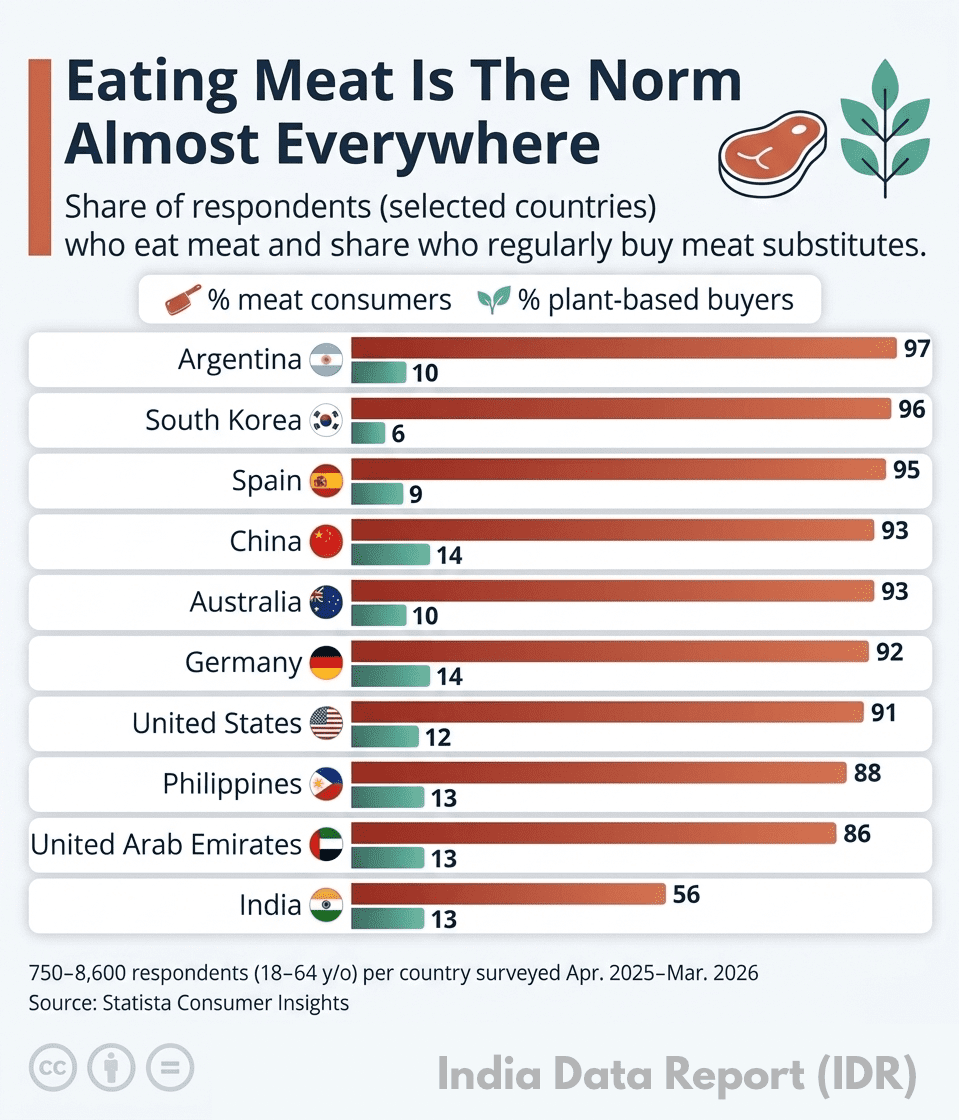
To understand how deep this disconnect goes, we must look at the raw foundation of global dietary habits. The table below represents the actual percentage of the population across ten major, distinct geopolitical markets who explicitly state that they eat meat.
| Rank | Country | Meat Eaters (%) | Market Vulnerability Level |
| 1 | Argentina | 97% | Ultra-Low |
| 2 | South Korea | 96% | Ultra-Low |
| 3 | Spain | 95% | Low |
| 4 | China | 93% | Medium |
| 5 | Australia | 93% | Low |
| 6 | Germany | 92% | Medium |
| 7 | United States | 91% | Low |
| 8 | Philippines | 88% | Medium-High |
| 9 | United Arab Emirates | 86% | Medium |
| 10 | India | 56% | High (Cultural Split) |
The Bitter Truth: Despite a decade of relentless anti-meat rhetoric, aggressive carbon-tax proposals, and celebrity-backed vegan campaigns, meat consumption remains a near-universal human constant. In seven out of the ten powerhouse economies surveyed, over 90% of the human population actively rejects a meat-free lifestyle. Culturally entrenched food habits do not bend to corporate dictates.
Let’s analyze the cultural psychology driving these numbers. Look at Argentina at 97%. In Buenos Aires, the asado is not just a meal; it is a secular religion, a foundational pillar of national identity, and a psychological anchor. You cannot replace centuries of gaucho culture with a chemically bound, laboratory-extruded textured vegetable protein disc. The same applies to South Korea at 96%, where the meteoric rise of K-BBQ culture is directly linked to modern affluence and social status. For these nations, eating real meat is an explicit declaration of prosperity and community.
When a Western alternative-protein startup enters these markets with a condescending tone, telling consumers that their cultural identity is ethically flawed, they aren’t just selling food—they are committing marketing suicide. The data shows that the global consumer is looking at these highly engineered products, looking back at their traditional plates, and making a definitive, rational choice: they are sticking with the real thing.
Now, let us turn to the data that makes venture capitalists sweat through their bespoke suits. The alternative protein lobby loves to conflate “consumer curiosity” with “sustained market adoption.” They point to a spike in trial purchases and declare victory. But a one-time trial driven by a discount coupon is a vanity metric. True economic viability requires repeated, habitual, full-price purchases.
The next dataset ranks these exact same ten countries by the percentage of consumers who actually purchase meat substitutes on a regular, consistent basis.
| Rank | Country | Regular Substitute Purchasers (%) | The Hype-to-Reality Gap |
| 1 | China | 14% | 79% Market Disconnect |
| 2 | Germany | 14% | 78% Market Disconnect |
| 3 | Philippines | 13% | 75% Market Disconnect |
| 4 | United Arab Emirates | 13% | 73% Market Disconnect |
| 5 | India | 13% | 43% Market Disconnect |
| 6 | United States | 12% | 79% Market Disconnect |
| 7 | Argentina | 10% | 87% Market Disconnect |
| 8 | Australia | 10% | 83% Market Disconnect |
| 9 | Spain | 9% | 86% Market Disconnect |
| 10 | South Korea | 6% | 90% Market Disconnect |
The Bitter Truth: The ceiling for alternative protein is incredibly low. Even in the most progressive, hyper-marketed eco-conscious nations like Germany, or massive tech-forward consumer bases like China, regular adoption refuses to cross the 14% threshold. For the vast majority of the developed world, alternative meat is nothing more than an occasional, peripheral novelty item.
Let’s dissect the profound economic friction hidden within these figures. Why is there such a massive chasm between the 91% of Americans who eat meat and the miserable 12% who regularly buy substitutes? It comes down to two inescapable factors that no clever branding campaign can solve: Price Parity and The Clean Label Dilemma.
For years, the alternative protein sector promised that scaling up production would bring prices down below the cost of conventional animal meat. That promise has systematically failed. In 2026, on a per-ounce basis, premium plant-based substitutes remain significantly more expensive than standard ground beef or chicken. In an era of persistent global inflation, shrinking real wages, and rising utility bills, asking a working-class mother to pay a 30% premium for an engineered plant patty out of sheer ideological benevolence is an insult to her economic intelligence. When money is tight, virtue signaling is the very first luxury item to be thrown out of the grocery cart.
Furthermore, today’s consumer is far more sophisticated than they were five years ago. The modern shopper is deeply suspicious of long, unpronounceable chemical ingredient lists. They look at the back of a plant-based package and see methylcellulose, high-sodium binding agents, heavily processed fractions of isolated proteins, and industrial seed oils used to mimic animal fat. They realize they are being asked to pay a premium price for a highly processed chemical matrix that masquerades as a health food. The basic human instinct for whole, single-ingredient food is overriding the corporate narrative of synthetic wellness.
To truly understand where the global capital is flowing, we must zoom in on the specific regional battlegrounds where these numbers tell a deeper story of human survival and cultural adaptation.
China and Germany sit at the absolute top of the substitute market, but they reached this 14% peak through radically different psychological pathways.
In Germany, the driver is deep-seated institutionalized eco-anxiety and highly coordinated political pressure. The German political establishment has actively subsidized plant-based initiatives and penalized traditional livestock farming through regulatory red tape. Yet, despite this intense top-down pressure, 92% of Germans still eat meat, and the substitute market has hit a hard, unyielding ceiling at 14%. Why? Because the German consumer, known for cold economic rationality, realizes that giving up their traditional culinary heritage for overpriced substitutes does not make sense when energy costs are crippling their household budgets.
China’s 14%, on the other hand, is driven by a completely different beast: state-directed food security fears and historical culinary habits. The Chinese consumer has a centuries-old tradition of eating mock meats made from tofu and wheat gluten (Mian Jin) within Buddhist culinary frameworks. The Western alternative protein brands arrived in Shanghai and Beijing thinking they were introducing a revolutionary concept. In reality, they were trying to resell an expensive, over-engineered version of something the Chinese had been making in clay pots for a thousand years. Furthermore, the Chinese middle class associates the consumption of real pork and beef with hard-won upward mobility. They are not about to trade away their economic status symbol for a Western corporate trend.
Now, let us address India, the favorite case study of every ill-informed Western market analyst. Look at the numbers: 56% meat consumption, 13% substitute purchase.
To the untrained eye sitting in a London or New York office, India looks like a golden, untapped paradise for alternative proteins. They see a massive population where nearly half the country avoids meat, and they think, “Ah! If we build a plant-based chicken nugget, they will flock to it!”
This is an egregious, fundamental misunderstanding of Indian society.
[Total Population: 100%]
   │
   ├──► Meat Eaters (56%) ──► Deeply attached to traditional poultry/mutton flavors.
   │                          Refuse to pay a premium for synthetic substitutes.
   │
   └──► Traditional Lacto-Vegetarians (44%) ──► Culturally/Religiously averse to the
                                               concept, texture, and taste of meat.
                                               Reject anything that mimics flesh.
The 44% of Indians who do not eat meat are not secular, trendy Western vegans who miss the taste of bacon. They are traditional, generational lacto-vegetarians whose entire culinary worldview is built around whole foods like lentils, chickpeas, fresh paneer, and local vegetables. They do not want their food to taste like chicken. In fact, the very idea of a product that looks, bleeds, and tastes like animal flesh is deeply unappealing to them.
Meanwhile, the 56% of Indians who do eat meat treat it as a hard-earned luxury or a deeply ingrained regional tradition (such as coastal fish curries or traditional mutton dishes). They have absolutely zero interest in paying a premium price for an industrial soy duplicate when they can buy fresh, locally sourced poultry from the wet market. The 13% who buy substitutes in India are confined entirely to a hyper-elite, Westernized sliver of the population in Tier-1 metropolitan areas like South Mumbai and Bengaluru. It is a fashion statement, not a structural shift in national nutrition.
To see the complete picture, we must overlay these two distinct metrics—meat consumption against substitute adoption—to identify exactly where the corporate narrative collapses under the weight of financial reality.
| Country | Meat-Eating Population (%) | Regular Substitute Buyers (%) | Net Cultural Resistance Gap |
| Argentina | 97% | 10% | 87% |
| South Korea | 96% | 6% | 90% |
| Spain | 95% | 9% | 86% |
| Australia | 93% | 10% | 83% |
| United States | 91% | 12% | 79% |
| China | 93% | 14% | 79% |
| Germany | 92% | 14% | 78% |
| Philippines | 88% | 13% | 75% |
| United Arab Emirates | 86% | 13% | 73% |
| India | 56% | 13% | 43% |
The Golden Opportunity: For agile FMCG brands and smart agricultural players, the massive “Resistance Gap” across the world is a clear signal. The true wealth over the next decade lies not in trying to force consumers to stop eating meat, but in improving the efficiency, sustainability, and quality of the traditional, real-food supply chain. Capital is fleeing speculative foodtech and returning to tangible, asset-backed agricultural reality.
Let’s be brutally honest about these resistance gaps. Look at South Korea with a staggering 90% gap, or Spain with an 86% gap. These numbers represent an insurmountable cultural fortress. The human brain is an incredibly advanced survival machine that has evolved over hundreds of thousands of years to seek out nutrient-dense, bioavailable animal proteins and fats. When a consumer walks down a grocery aisle, their subconscious mind is weighing cost, sensory satisfaction, and nutritional density.
Alternative protein companies tried to bypass this evolutionary programming using clever graphic design, slick PR campaigns, and celebrity endorsements. But as the macroeconomic environment soured between 2024 and 2026, the consumer’s tolerance for expensive experimentation evaporated. The data proves that when push comes to shove, the global consumer values their wallet and their biological preferences over corporate eco-maternalism.
The era of cheap venture capital is over, and with it dies the delusion of an all-plant-based future. If you are an investor, an agricultural strategist, or an entrepreneur holding overvalued equity in highly engineered foodtech startups, it is time to face the music and pivot. The data from 2025–26 makes the trajectory for the remainder of this decade crystal clear.
Expect a massive wave of bankruptcies, distressed asset sales, and consolidations within the alternative protein sector over the next 18 months. The current 12% to 14% ceiling observed in top markets is not a temporary plateau; it is a permanent structural boundary. Companies that cannot survive on low-volume, niche-market margins will collapse. The venture capital money that fueled endless R&D for hyper-processed meat alternatives is already drying up, moving toward more urgent technological infrastructure.
The smart money is moving away from total meat replacement and toward optimization. Forward-thinking food companies will stop trying to eradicate meat and instead focus on high-quality, whole-food blending (e.g., premium ground beef blended naturally with mushrooms or lentils to reduce costs while retaining culinary integrity). This respects the consumer’s desire for real food without forcing an ideological lifestyle change that they clearly reject.
For those pinning their hopes on lab-grown (cultivated) meat as the savior to replace plant-based failures, prepare for a long, cold winter. The bioreactor infrastructure required to scale cultivated meat to price parity with traditional livestock is economically unviable in the current high-interest-rate environment. It will remain an ultra-premium, novelty item for high-end restaurants in places like Singapore and San Francisco through 2030, completely failing to impact mainstream global meat numbers.
The ultimate winners of the next decade will be the traditional agricultural enterprises that integrate modern technology to make real animal protein production more efficient, transparent, and sustainable. Regenerative grazing, AI-optimized livestock health tracking, and advanced, localized feed logistics are where the real, defensive, inflation-protected returns are waiting.
Stop chasing ideological fantasies designed in Silicon Valley echo chambers. The global consumer has spoken through the cold, hard data of 2025–26. If your capital is locked up in companies whose entire survival depends on converting the 90% meat-eating population into synthetic-food consumers, you are holding a burning fuse.
Divest from over-engineered, ultra-processed foodtech brands that rely on continuous cash injections and have no path to organic profitability.
Pivot your capital toward high-yield, tangible agricultural assets, modernized real-food supply chains, and businesses that respect, rather than insult, deep-rooted human food cultures.
The market always rewards truth over hype. Align your strategy with immutable human biology and economic reality, or watch your capital dissolve in the furnace of corporate delusion. The choice is yours.