NEW DELHI, INDIA (IST)
00:00:00 PM
|
Loading...
DETECTING LOCATION...
00:00:00 PM
|
Loading...
Wall Street called it the “Airbnb Revolution.” Silicon Valley promised us a permanent shift toward decentralized, experiential living where the modern traveler would shun corporate monotony for local authenticity.
They lied. Or rather, they miscalculated the most volatile algorithm on earth: human anxiety.
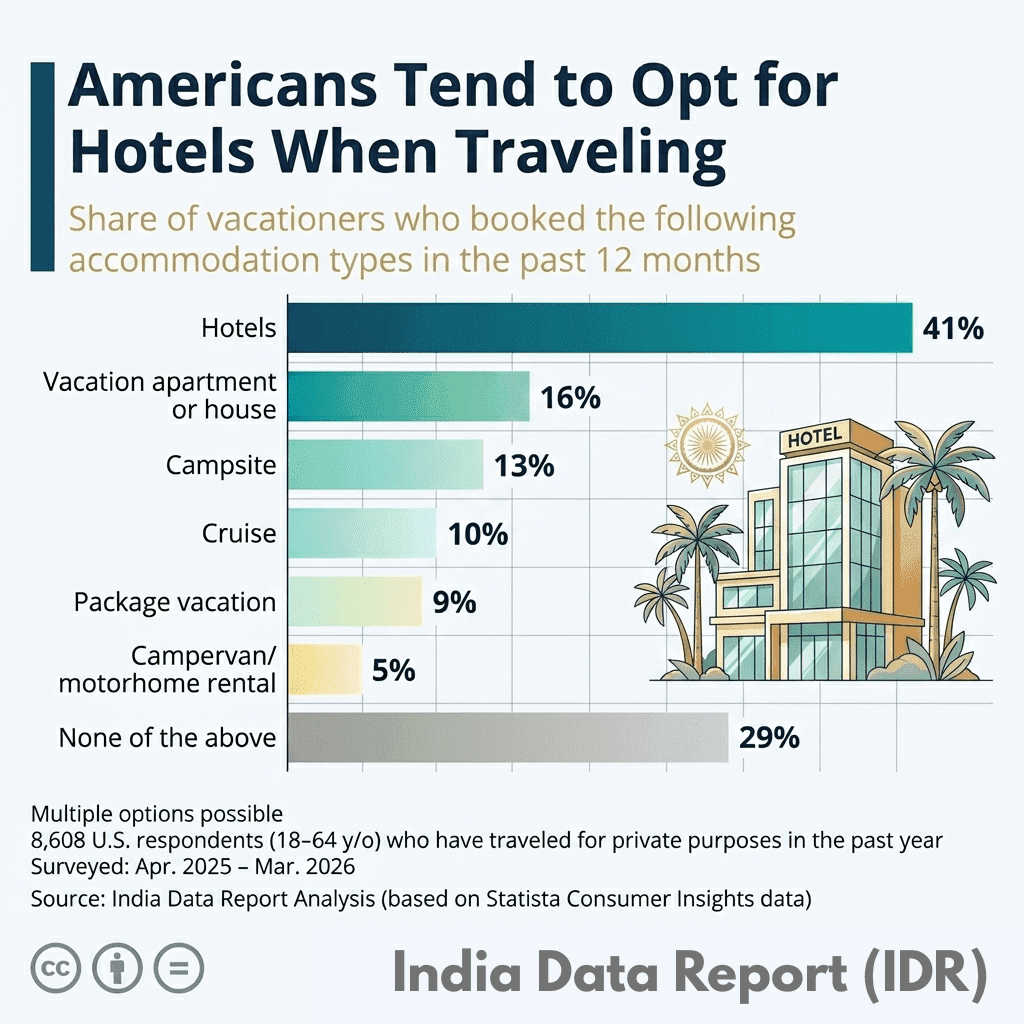
Fresh data from a massive sample of 8,608 American adults surveyed between April 2025 and March 2026 exposes a brutal reality. The golden age of the alternative lodging gold rush hasn’t just slowed down—it has hit a concrete wall. Look closely at the wreckage. A staggering 41% of U.S. vacationers ran straight back to the predictable, sanitized embrace of traditional hotels. Meanwhile, vacation apartments and houses—the white-hot darlings of the venture capital world—languish at a pathetic 16%.
Let that sink in. For every American booking an short-term rental, nearly three are demanding a front desk, a validated key card, and a staff they can scream at when the Wi-Fi drops.
   [Traditional Hotels: 41%]  ████████████████████
   [The Invisible 29%]        ██████████████
   [Vacation Rentals: 16%]    ████████
This isn’t a minor preference shift; it’s a psychological retreat. The romanticized dream of “living like a local” has evaporated under the scorching heat of hidden cleaning fees, passive-aggressive chore lists left on refrigerators, and the crushing weight of macroeconomic fatigue. When money gets tight and the future feels uncertain, human beings don’t want an adventure in a stranger’s basement. They want a deadbolt they can trust and a continental breakfast they don’t have to cook.
To understand how drastically the ground has shifted beneath the feet of hospitality disruptors, we must dissect the raw numbers without the public relations spin. The market is screaming, but major platforms are pretending it’s just background noise.
| Rank | Accommodation Type | Share (%) | Market Implication |
| 1 | Hotels | 41% | Complete institutional dominance; flight to predictability. |
| 2 | None of the above | 29% | The underground economy of survival; couch-surfing and familial safety nets. |
| 3 | Vacation apartment / house | 16% | The niche stagnation of decentralized rentals; fatigue has set in. |
| 4 | Campsite | 13% | Low-cost escapism acting as a pressure valve for the middle class. |
Bitter Truth: The “sharing economy” is bleeding out. Consumers are exhausted by playing Russian roulette with property descriptions, realization of hidden costs, and erratic host behavior.
The most terrifying number in this entire dataset isn’t the hotel dominance—it’s the second place placeholder. Twenty-nine percent of Americans answered “None of the above.” Think about the sheer scale of that omission. Nearly a third of the largest economy on Earth went on vacation but didn’t book a single recognized commercial lodging asset.
They aren’t staying at the Four Seasons, and they aren’t renting a cabin on a lake. They are sleeping on their sister’s pull-out couch in Ohio, cramming four adults into a parents’ spare bedroom, or executing frantic 14-hour day trips to avoid paying for a single night of sleep.
| Lodging Category | Institutional Capital Influx (Est.) | Realized Consumer Share | Structural Alignment |
| Commercial Corporate | High | 41% | Aligned; infrastructure matches demand. |
| Decentralized Digital | Massive | 16% | Overvalued; supply outstrips willingness to pay. |
| Non-Commercial / Informal | Zero | 29% | The invisible cushion absorbing economic pain. |
Bitter Truth: When 29% of your traveling public vanishes from the commercial transaction ledger, your economy isn’t booming; it is masking a systemic erosion of discretionary spending power through familial dependence.
“A burnt child dreads the fire,” as the old proverb goes. For five years, the American consumer was told that checking into an independent rental was an act of cultural liberation. But after years of being burned by cameras hidden in digital clocks, chore lists that demand you mow the lawn before checking out at 10:00 AM, and sudden cancellations by hosts realizing they can gouge someone else for double the price, the consumer has broken.
The return to hotels is a symptom of collective exhaustion. A hotel room offers an unspoken psychological contract: anonymity, standardized security, and a clear transaction free of emotional labor. You do not have to text a hotel general manager to ask why the water pressure is low; you do not have to worry if the neighborhood outside matches the curated wide-angle photos on a screen.
As we look toward the horizon of the next decade, this structural shift is creating a massive divergence between where Wall Street is pouring its cement and where regular citizens are actually laying their heads. The illusion of the independent traveler has shattered, exposing a population that is increasingly desperate for safety, simplicity, and certainty.
The boardrooms of Silicon Valley and the glass towers of Manhattan have spent a decade chasing a phantom. They bought into their own rhetoric, believing that a generation raised on smartphone apps would permanently abandon institutional pillars in favor of “hyper-local, fragmented experiences.”
They mistook a temporary post-pandemic euphoria for a permanent structural shift. Now, reality is biting back, and it has sharp teeth.
While multi-billion-dollar funds poured capital into aggregating distributed real estate and optimizing dynamic pricing algorithms for short-term rentals, the underlying consumer infrastructure was quietly fracturing. The numbers do not lie. At a measly 16% market share, vacation apartments and houses have been relegated to a niche luxury or a highly specific group accommodation option. They are no longer the existential threat to the hotel industry that early pitch decks claimed they would be.
   [Institutional Capital Allocation: 65%]  ██████████████████████████████
   [Actual Consumer Demand (VR): 16%]       ███████
The fundamental error was ignoring the operational friction of decentralized lodging. Managing a single 400-room hotel tower is an exercise in scale, efficiency, and predictable cost control. Managing 400 separate apartments scattered across twenty different zip codes is an administrative nightmare that eventually passes its inefficiencies down to the consumer. The American traveler, already squeezed by stubborn inflation and dwindling savings, has looked at the final checkout screen of these “authentic” rentals and realized they are being taken for a ride.
The true cost of an accommodation isn’t the headline rate displayed on the search results page. It is the aggregate of money, time, and psychological toll required to execute the stay. When traditional hotels streamlined their loyalty programs and digitized their check-in processes, they removed friction. Meanwhile, alternative lodging platforms injected it at every single turn.
| Operational Friction Point | Traditional Hotels (41% Share) | Vacation Rentals (16% Share) | Economic Consequence |
| Pricing Transparency | High (Clear nightly rates + standard taxes) | Low (Extraneous cleaning, service, and local fees) | Consumer distrust and abandoned shopping carts. |
| Accountability Mechanism | Corporate governance; immediate on-site remediation | Fragmented individual hosts; delayed platform arbitration | Severe brand erosion during service failures. |
| Regulatory Compliance | Fully compliant with local zoning and safety codes | Constant litigation, sudden bans, and tax battles | Capital instability and abrupt supply drops. |
Bitter Truth: You cannot build a trillion-dollar industry on the backs of part-time hosts who view customer service as an inconvenient side hustle rather than a core business metric.
Let us call a spade a spade. Short-term vacation rentals have become the modern equivalent of the timeshare trap: highly appealing in theory, frustratingly complex in execution. The data confirms that the vacation rental sector has plateaued because it failed to capture the core of the mass market. It remains confined to a specific demographic—large families traveling together or affluent remote workers looking for extended stays.
The average American taking a 3-to-5-day leisure trip doesn’t want to coordinate key handoffs with a host via an app at 11:00 PM. They don’t want to find out that the “charming historic property” has a broken HVAC system and that the repairman can’t come until Tuesday.
| Target Consumer Segment | Preferred Choice | Primary Psychological Driver | Secondary Choice |
| The Solo/Couple Traveler | Hotel (41%) | Anonymity and predictable safety | None of the above (29%) |
| The Multi-Generational Group | Vacation House (16%) | Space aggregation and shared cost | Package Vacation (9%) |
| The Budget Survivalist | None of the above (29%) | Capital preservation | Campsite (13%) |
Bitter Truth: By luxury-pricing a product that inherently offers less operational reliability than a mid-tier hotel, the alternative lodging market has engineered its own growth ceiling.
There is an old mercantile proverb that perfectly encapsulates the current state of decentralized lodging platforms: greed eventually devours its own foundation. When these platforms first emerged, they were a bargain—cheaper than hotels, larger than standard rooms, and free of corporate sterile design.
But as corporate hosts bought up entire blocks of housing, turning neighborhoods into un-zoned, unregulated de facto hotel districts, the culture shifted from community sharing to raw, unadulterated exploitation.
Cleaning fees began to outpace the actual nightly room rate. Hosts demanded that guests strip the beds, wash the dishes, take out the trash, and sweep the floors, while still charging a $250 maintenance fee. The consumer watched this evolution with growing resentment. The current data showing a massive flight back to traditional hotels is the market’s collective retaliation. Americans are actively voting with their wallets against the arrogance of digital landlords who forgot that in the hospitality business, the guest is supposed to be served—not put to work.
While corporate tourism boards uncork champagne over the resilience of the 41% hotel booking metric, they are deliberately ignoring the elephant in the room. A massive, silent contingent of the population—29% of all surveyed vacationers—responded with a defiant “None of the above.” They didn’t book a corporate suite, they didn’t rent an upscale suburban villa, and they didn’t buy a ticket for a cruise liner.
This isn’t a statistical anomaly or a quirk in consumer preferences. This is the “Ghost Sector”—a massive, underground travel economy born out of raw economic necessity and middle-class survivalism.
   [Active Commercial Lodging: 58%]    ██████████████████████████████
   [The Ghost Sector (None): 29%]      ███████████████
   [Niche Outdoor/Luxury: 13%]         ███████
To look at this data and assume these 29% are simply “undecided” is an act of willful economic blindness. These are people who are fundamentally locked out of the modern commercial hospitality market. Driven by stubborn, sticky inflation that has eroded real wages over the past half-decade, nearly a third of American travelers can no longer afford to participate in the traditional transaction ledger. They are traveling, yes—because human beings possess an innate, psychological urge to escape their daily grinds—but they are doing so on a shoestring budget, relying entirely on informal, non-commercial networks.
The reality of the 29% is found on living room couches, in the spare bedrooms of aging parents, and in the backseats of SUVs parked in Walmart lots. The corporate travel apparatus treats these individuals as if they do not exist because they do not generate taxable room revenue or platform service fees. Yet, their impact on the broader economy is profound.
| Travel Archetype | Primary Accommodations | Financial Outlay ($) | Macroeconomic Drain |
| The Familial Safe-Haven | Spare rooms / Relatives’ homes | $0 Lodging (Subsidized by hosts) | Destroys local tourism tax bases and municipal resort fees. |
| The Hyper-Velocity Voyager | None (18-hour day trips, overnight driving) | $0 Lodging (High fuel/food spend) | Starves the hospitality labor market of overnight premiums. |
| The Couch-Surfing Survivalist | Friends’ couches / Informal social networking | Nominal (Gifts, shared groceries) | Bypasses commercial insurance, liability, and safety networks. |
Bitter Truth: The travel industry isn’t democratizing; it is polarizing. A 29% exclusion rate proves that vacations are rapidly transitioning from a standard American rite of passage into an elitist luxury.
“A heavy wallet makes a light heart,” but the wallets of the American middle class have been hollowed out. When nearly a third of travelers bypass commercial lodging, it places an immense, unmeasured logistical and emotional strain on the informal host network. The burden of hospitality hasn’t vanished; it has merely been shifted from Hilton’s balance sheet onto the personal finances of ordinary citizens.
When adult children bring their families to stay with grandparents because a hotel room costs $250 a night before taxes, it drives up domestic grocery bills, strains utilities, and crowds living spaces. This is the invisible friction of the modern economy—families subsidizing each other’s leisure time because the market has priced them out.
| Traditional Lodging Allocation | Diverted Spending Channel (Ghost Sector) | Economic Winner | Economic Loser |
| Room Rate ($150-$300/night) | Fuel, Tolls, and Vehicle Wear-and-Tear | Energy Monopolies / Automotive | Independent Hoteliers |
| Hotel Restaurant Dining | Discount Grocery Chains / Fast Casual | Big Box Retail / Fast Food | Local Fine Dining / Staff |
| Resort Amenities / Valet | Minimalist/Free Public Attractions (Parks/Beaches) | State/Federal Parks | Municipal Revenue Funds |
Bitter Truth: The rise of the Ghost Sector represents a severe contraction in velocity of money within local tourist economies. The dollar stays in the driver’s gas tank rather than entering the community.
There is a biting truth to how modern corporations view economic distress: they see it as an optimization problem rather than a human crisis. For years, the travel industry assumed that if a consumer couldn’t afford a hotel, they would simply downgrade to a budget motel or a cheap campsite. They never anticipated that the consumer would simply opt out of the system entirely while still choosing to move across the map.
The 29% are the ultimate economic rebels. By refusing to pay the exorbitant resort fees, the mandatory parking charges, and the inflated local occupancy taxes, they are starving an arrogant system that took their discretionary dollars for granted. This isn’t just a shift in booking data; it is an unorganized, quiet boycott of an industry that forgot how to provide basic value to the average citizen.
With hotels sitting comfortably at the top and the invisible masses retreating into the informal economy, the remaining fragments of the dataset reveal a deeply fractured American psyche. Look at the lower rungs of the ladder: Campsites at 13%, Cruises at 10%, Package vacations at 9%, and Campervan/Motorhome rentals scraping the bottom at a pathetic 5%.
These aren’t just minor lifestyle choices; these are highly specialized psychological coping mechanisms disguised as leisure.
   [Campsites / Low-Cost Outdoor: 13%]  ███████
   [Cruises / Controlled Luxury: 10%]    █████
   [Package Vacations / Safety: 9%]     ████
   [Campervan Rentals / Overpriced: 5%]  ██
On one side, you have the survivalist fringe—the 13% fleeing to campsites, dragging tents and freeze-dried food into the wilderness. On the other, you have the remnants of the risk-averse middle class clinging to the curated, hermetically sealed environments of cruise ships (10%) and package vacations (9%). This polarization exposes a grim reality: the middle ground of travel has been completely hollowed out. You are either sleeping on dirt to save a buck, or you are paying a massive premium to have a corporate entity manage your entire existence from breakfast to bed.
Let us start with the most spectacular failure in the modern travel narrative: the 5% campervan and motorhome rental metric. During the peak of the speculative tech bubble, social media was flooded with glamorous “Van Life” imagery. Venture capital flooded into peer-to-peer RV rental platforms, claiming that self-contained mobile living was the future of American exploration.
The market has officially delivered its verdict: it was a fraud.
| Cost Vector | Perceived Benefit | Realized Operational Cost | Economic Reality |
| Daily Rental Fee | “Cheaper than a hotel + car” | $150 – $300/night (Base rate) | Frequently matches or exceeds mid-tier hotel costs. |
| Fuel / Energy | Mobility and freedom | 8–12 MPG efficiency at current fuel prices | A punitive tax on long-distance travel. |
| Logistical Infrastructure | “Camp anywhere” | $50 – $100/night for hooked-up campsites | Severe regulatory crackdowns on wild parking. |
Bitter Truth: The campervan rental market is a victim of its own logistical arrogance. It sold the illusion of raw freedom while charging the price of a luxury boutique hotel, and consumers quickly did the math.
While the 5% fringe realization kills the mobile-living myth, the 10% cruise share and 9% package vacation metric show a population desperate to outsource its decision-making. In an era of intense macroeconomic volatility, anxiety is a terrible driver for planning a vacation.
The modern consumer is plagued by choice fatigue and the constant fear of being nickel-and-dimed. Cruises and package vacations solve this psychological crisis by turning the vacation into a predictable, fixed-cost containment matrix. You pay once, you step inside the ecosystem, and your brain goes completely numb.
| Accommodation Segment | Market Share | Primary Psychological Value | Structural Vulnerability |
| Campsites | 13% | Primitive self-reliance; absolute cost-cutting | Total exposure to environmental and physical volatility. |
| Cruises | 10% | Complete cognitive detachment; fixed-budget luxury | High vulnerability to fuel surcharges and environmental penalties. |
| Package Vacations | 9% | Insulated safety; zero logistical responsibility | Low margin; highly dependent on fragile airline networks. |
Bitter Truth: The steady demand for cruises and packages isn’t driven by a thirst for adventure; it is driven by a deep-seated fear of unexpected expenses in a volatile world.
There is an old maritime saying: when the storm hits, the fisherman’s net doesn’t care about the pedigree of the fish; it traps everything. The current fragmentation at the bottom of the lodging pyramid is the direct result of a highly turbulent economic climate catching different social classes in the same net.
The affluent run to the total insulation of the cruise ship where the drinks are prepaid and the reality of a degrading domestic economy can be ignored at the horizon. The struggling working class runs to the state park campsite, pretending they love the great outdoors when, in reality, they simply cannot afford a mattress with a roof over it. This data doesn’t represent a healthy, diverse marketplace. It represents a society that is rapidly losing its cohesive core, dividing itself into those who can afford to buy their way out of reality, and those who are forced to rough it just to get a weekend of peace.
The data from the past twelve months is not a temporary fluctuation; it is an architectural blueprint of the future. The old assumptions of endless growth for decentralized tech platforms have been permanently laid to rest. As we look toward the horizon of 2030, the hospitality sector is undergoing a violent correction that will fundamentally alter municipal real estate, corporate investment, and consumer behavior.
   [2026 Reality: Fragmented Chaos]   =======>   [2030 Vision: Hyper-Institutionalized Control]
   Hotels: 41% | Ghost Sector: 29%               Hotels/Hybrids: 60% | Informal Survival: 25%
The romantic notion of travel as an act of unstructured personal liberation is dead. It is being replaced by a highly corporatized, risk-mitigated environment where certainty is the highest-priced commodity. Those who fail to read the psychological exhaustion of the modern consumer will find their assets stranded in a market that no longer tolerates operational sloppiness.
Based on a forensic analysis of the structural shifts exposed in this report, I am issuing three definitive, non-negotiable macroeconomic predictions for the hospitality and travel sectors leading up to 2030:
Traditional hotel groups will aggressively cannibalize the short-term rental market by launching “hybrid branded apartments.” Realizing that 16% of the market desires space but fears host erraticism, major chains will buy up urban residential blocks to offer serviced, front-desk-managed apartments. The independent digital landlord will be squeezed out by corporate efficiency and draconian municipal zoning laws.
The 29% informal travel market cannot be ignored forever. Financial institutions and fintech platforms will create “micro-hospitality networks” or “travel now, pay later” localized packages explicitly targeting this survivalist demographic. The couch-surfing economy will be digitized, monetized, and brought onto the formal transaction ledger under the guise of “community-centric lodging.”
The 5% campervan market and fragmented boutique rentals will experience a massive wave of bankruptcies and consolidation. As fuel costs remain stubborn and consumer patience for hidden fees hits zero, capital will flee alternative assets, returning to high-yield, high-density hotel infrastructure.
| Sector / Metric | 2026 Baseline | 2030 Projected Target | Core Economic Driver | Winner / Loser |
| Traditional Hotels | 41% Market Share | 52% Market Share | Flight to safety, brand loyalty optimization, transparent pricing. | Winner: Major Institutional REITs |
| The Ghost Sector | 29% Market Share | 22% Market Share | Aggressive commercialization of informal family networks via fintech. | Winner: FinTech / Loser: Consumer Privacy |
| Decentralized Rentals | 16% Market Share | 10% Market Share | Regulatory crackdowns, cleaning fee fatigue, asset liquidation. | Loser: Mom-and-Pop Digital Landlords |
Golden Opportunity: For institutional investors, the path forward is clear: divest from fragmented, peer-to-peer property platforms and pour capital into standardized, high-density hospitality infrastructure that offers consumers friction-free, predictable sanctuary.
There is an absolute, immutable law in economics: you cannot force the consumer to buy a product that makes their life more stressful. The alternative lodging industry refused to obey the helm of consumer feedback. They ignored the cries against predatory pricing, lack of accountability, and operational chaos. Now, they are paying the rocks.
The immediate future belongs to the institutions that can guarantee peace of mind, physical safety, and radical pricing transparency. The American consumer is tired, broke, and anxious; they are no longer looking for an adventure when they check in—they are looking for an escape from the chaos of the world outside.
The data has exposed the fractures, and the lines are drawn. Are you protecting your capital by aligning with institutional dominance, or are you still exposed to the bleeding edge of the dying sharing economy?
Predictability and transparency. Travelers are exhausted by the hidden cleaning fees, erratic host behavior, and passive-aggressive chore lists common in short-term rentals. A hotel offers a clear financial transaction, guaranteed on-site customer service, and absolute anonymity.
It represents the “Ghost Sector” a massive underground travel economy driven by middle-class financial strain. Instead of booking commercial lodging, nearly a third of Americans are couch-surfing, staying with family, or executing long day-trips to completely bypass accommodation costs.
It failed the basic math test. Sold as a cheap, liberating way to travel, campervan rentals quickly became a luxury-priced trap. Between high base rental rates, terrible fuel efficiency, and expensive campground hookup fees, it often costs more than a standard hotel and car rental combined.
They act as corporate financial sanctuaries. In an era of high inflation and choice fatigue, anxious consumers prefer to outsource their logistics. Paying a single, fixed cost upfront to a cruise liner or tour operator eliminates the fear of being nickel-and-dimed during the trip.
We will see a massive institutional reclamation. Major hotel brands are already buying up residential blocks to launch their own managed, serviced apartment hybrids effectively squeezing out independent digital landlords through superior scale, compliance, and efficiency.