NEW DELHI, INDIA (IST)
00:00:00 PM
|
Loading...
DETECTING LOCATION...
00:00:00 PM
|
Loading...
We have been fed a comforting lie. For over a decade, elite economic forums and slick government presentations have parroted the same intoxicating narrative: India’s demographic dividend is a golden ticket to global economic dominance. They tell us that a young nation, bursting with millions of energetic souls entering college, will automatically translate into an unstoppable army of white-collar professionals, tech innovators, and wealth creators.
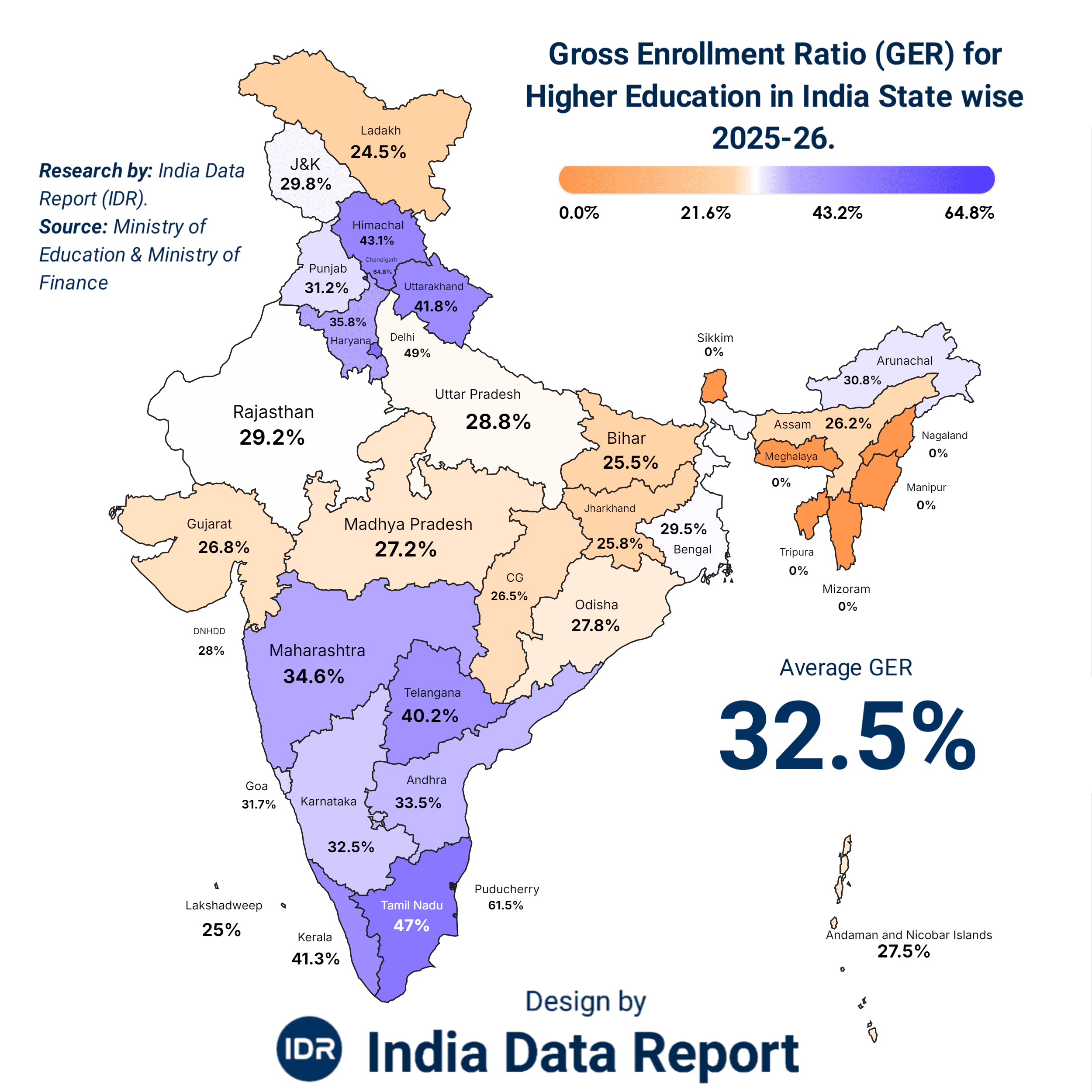
But look closer at the concrete data coming straight out of the Ministry of Education and the Ministry of Finance. The latest Gross Enrollment Ratio (GER) figures for higher education across India slice through this euphoria like a cold scalpel.
The national average GER sits at a mediocre 32.5%. Let that sink in. Out of every 100 young Indians who finish school and stand on the precipice of adulthood, nearly 68 are left out in the cold. They are locked out of the lecture halls, denied the certificates that act as entry tickets to the modern economy, and left to fend for themselves in an increasingly automated, unforgiving job market.
To make matters worse, this average hides a deeply fractured reality. We are looking at an educational civil war where geography dictates destiny. If you are born in Puducherry or Tamil Nadu, your chances of entering higher education are phenomenally higher than if you happen to grow up in the political heartlands of Uttar Pradesh, Bihar, or Jharkhand.
This isn’t just an educational failure; it is an economic time bomb. We are building a two-tier republic where a minority of states leap ahead into the knowledge economy, while a massive, disenfranchised population in the Hindi belt is left to survive on gig-work, casual labor, and state-funded freebies. “A house divided against itself cannot stand.” If we do not fix these subterranean fractures, the demographic dividend we boast about will mutate into a demographic disaster long before we hit 2047.
| Rank | State / UT | GER (%) | Economic Risk Classification |
| 1 | Puducherry | 61.5% | Hyper-Advanced / Saturated |
| 2 | Delhi | 48.0% | High Enrollment / Infrastructure Strain |
| 3 | Tamil Nadu | 47.0% | Mature Knowledge Economy |
| 4 | Himachal Pradesh | 43.1% | High Access / Low Industrial Absorption |
| 5 | Kerala | 41.3% | Brain-Drain Susceptible |
| 6 | Telangana | 40.2% | Tech-Centric Concentrated Growth |
| 7 | Haryana | 35.3% | Real-Estate Driven Growth Vulnerability |
| 8 | Maharashtra | 34.6% | Regional Imbalance (Mumbai vs Vidarbha) |
| 9 | Andhra Pradesh | 33.5% | Agrarian-to-Services Transition State |
| 10 | Karnataka | 32.5% | Tech-Hub Dependency Satiation |
| 11 | Goa | 31.7% | Tourism-Heavy Service Economy |
| 12 | Punjab | 31.2% | Agrarian Stagnation Threat |
| 13 | Arunachal Pradesh | 30.8% | Border Infrastructure Dependent |
| 14 | Jammu & Kashmir | 29.8% | Geopolitical Stablization Phase |
| 15 | West Bengal | 29.5% | De-industrialized Stagnation |
| 16 | Rajasthan | 29.2% | Resource-Rich / Skill-Poor Paradox |
| 17 | Uttar Pradesh | 28.8% | Mass Population Crudeness Risk |
| 18 | Odisha | 27.8% | Mineral-Rich / Human Capital Deficit |
| 19 | Andaman & Nicobar | 27.5% | Isolated Logistical Containment |
| 20 | Madhya Pradesh | 27.2% | Under-industrialized Vulnerability |
| 21 | Gujarat | 26.8% | Capital-Intensive / Low-Skill Trap |
| 22 | Chhattisgarh | 26.5% | Tribal Belt Marginalization |
| 23 | Assam | 26.2% | Flood-Disrupted Academic Calendar |
| 24 | Jharkhand | 25.8% | Resource Curse Stagnation |
| 25 | Bihar | 25.5% | Chronic Structural Paralysis |
| 26 | Lakshadweep | 25.0% | Geographically Constrained |
| 27 | Ladakh | 24.5% | High Altitude Logistical Freeze |
| 28 | Uttarakhand | 21.8% | Topographical Migration Strain |
| 29 | Sikkim | 20.0% | Eco-Protected / Limited Corporate Base |
| 30 | Chandigarh | 18.8% | Administrative Bureaucratic Inertia |
| 31-34 | Nagaland, Manipur, Mizoram, Tripura | 0.0%* | Data Blackout / Institutional Severance |
Let us look directly at the raw, unvarnished numbers. The ranking of states by their Gross Enrollment Ratio reveals a truth that politicians would rather brush under the rug. The southern states are not just winning the race; they are running a completely different marathon, leaving the rest of the subcontinent choking on their dust.
(The Bitter Truth): The top ten slots are aggressively guarded by Southern states and rich Union Territories, creating an institutional monopoly over elite human capital. Meanwhile, states containing over 40% of India’s youth population—like Bihar, Uttar Pradesh, and Madhya Pradesh—languish deep below the national average. This is not a slow-moving developmental curve; it is a structural apartheid that guarantees a highly polarized economic future.
*Note: The 0% metric for certain northeastern states signifies an institutional failure in data aggregation and reporting by local authorities, not a literal absence of students, exposing a dangerous bureaucratic disconnect.
Look at Puducherry sitting on top with 61.5%. Look at Tamil Nadu at 47.0% and Delhi at 48.0%. These regions have spent decades building an ecosystem of accessible colleges, state-subsidized transport, and a societal culture that views higher education as a non-negotiable rite of passage.
Now cast your eyes down to the bottom half of the table. Uttar Pradesh sits at 28.8%. Gujarat, the economic powerhouse of industrial manufacturing, is at a shocking 26.8%. Bihar crawls at 25.5%, and Jharkhand is at 25.8%.
What does this mean in human terms? It means that in the very regions where the birth rates are highest—where the largest concentration of India’s future workforce is being born the doors to higher education are firmly shut. We are minting millions of teenagers every single year who will enter the workforce with nothing more than a high school certificate, completely unequipped for an economy that demands data analysis, coding, complex problem-solving, and advanced linguistic skills. They are being set up to fail.
The most damning revelation in this dataset is the performance of India’s industrial engine: Gujarat. For years, the “Gujarat Model” has been sold as the ultimate blueprint for economic success. Factories hum, ports expand, highways cut through the landscape, and billions of dollars in capital investment pour into massive chemical plants and renewable energy parks.
Yet, Gujarat’s Higher Education GER stands at an incredibly low 26.8%, well below the national average of 32.5%, and vastly trailing behind states like Himachal Pradesh (43.1%) and Kerala (41.3%). How do we explain this paradox?
It is the classic trap of a capital-intensive economy that forgets its people. Gujarat has mastered the art of drawing massive investments that require heavy machinery and automated plants, but it has systematically underinvested in the intellectual cultivation of its youth. The state’s economy relies heavily on traditional family business setups and blue-collar manufacturing labor. But here is the catch: blue-collar manufacturing is highly susceptible to automation. In a world dominated by AI and robotic precision, relying on low-skilled labor is like bringing a knife to a gunfight.
[Industrial Investment High] ----> [Low Focus on Higher Education]
                                            |
                                            v
[AI/Automation Disruption]  ----> [Massive Mid-Level Structural Unemployment]
Human psychology is driven by incentives. In regions where immediate, low-skilled employment is available right after school, parents and students choose short-term cash over long-term educational investments. “A bird in the hand is worth two in the bush.” Why spend four years and lakhs of rupees on a college degree when you can join a manufacturing unit or an assembly line at eighteen?
This logic works beautifully in a stable, unchanging world. But in the current era of rapid technological disruption, it is economic suicide. By the time these eighteen-year-olds hit their thirties, their roles will be automated out of existence, and they will lack the foundational intellectual framework required to reskill themselves.
| State | GER (%) | Primary Economic Driver | Risk of Underemployment |
| Puducherry | 61.5% | Service & Institutional Allocations | Extreme (Lack of Local Corporate Base) |
| Delhi | 48.0% | Corporate Services & Public Sector | High (In-migration Over-saturation) |
| Tamil Nadu | 47.0% | Balanced Manufacturing & Tech | Moderate (Sustained Ecosystem) |
| Himachal Pradesh | 43.1% | Hydro-Power, Tourism & Agri | High (Educated Unemployment) |
| Kerala | 41.3% | Remittance & Consumption Services | Extreme (Severe Local Brain Drain) |
(The Golden Opportunity):
States with a high GER but a low local industrial base (like Kerala and Himachal Pradesh) have a massive window to pivot into remote-first knowledge hubs. If they can build state-of-the-art digital infrastructure and offer fiscal incentives for global tech companies to set up distributed satellite offices, they can retain their highly educated youth and stop the catastrophic brain drain that depletes their local tax base.
Let us address the elephant in the room: the absolute silence from the Northeast. The official data charts list Nagaland, Manipur, Mizoram, and Tripura at 0%.
Anyone with a shred of sanity knows that the actual enrollment in colleges in these states is not zero. The youth of Mizoram and Manipur are highly literate, deeply expressive, and intensely aspirational. This 0% does not represent a lack of students; it represents a complete and total breakdown of institutional machinery. It means the bureaucratic communication lines between these border states and the central data collection agencies in New Delhi have snapped.
This data blackout is occurring in a highly sensitive border region that has faced historic alienation and ethnic friction. When a state cannot even log its student enrollment numbers into the national database, it signals an institutional rot that runs dangerously deep.
We cannot govern what we do not measure. If New Delhi is blind to the student dynamics in the Northeast, how will it allocate funds? How will it plan universities? How will it generate jobs? “Out of sight, out of mind” seems to be the underlying philosophy here, and it is a recipe for deep-seated socio-economic unrest.
To truly understand why our national GER is stuttering at 32.5%, we must stop looking at charts and start looking into the minds of the people. Go to the coaching hubs of Old Rajinder Nagar in Delhi, the cramped student rooms of Kota, or the crowded lanes of Prayagraj. What you will find is not a thirst for knowledge, but a toxic mixture of paralyzing fear and desperate greed.
The Indian youth is terrified of the future. They see an economy that claims to grow at 7% annually, but they do not see that growth translating into stable, dignified jobs. This fear drives them into the arms of the “Degree Factories”—unaccredited, sub-standard private colleges that have sprouted across the country like mushrooms after rain. These institutions do not sell education; they sell pieces of paper called degrees.
[Desperation for Credentials] ---> [Predatory Private Colleges]
                                             |
                                             v
[Zero Skill Acquisition]       ---> [Massive Unemployable Graduate Surplus]
This dynamic creates a vicious cycle that actively damages the GER. As millions of graduates realize that their expensive degrees cannot even land them a basic corporate desk job, a deep sense of cynicism sets in. Parents look at their unemployed neighbor who holds an MBA and think, “Why should I spend my life savings on my daughter’s college education if the end result is the same?”
The systemic failure to provide quality, industry-relevant education has broken the public’s faith in higher learning. The low GER in massive states like Bihar (25.5%) is a direct reflection of this psychological shift. Education is no longer seen as an guaranteed elevator to the middle class; it is increasingly viewed as an expensive gamble where the house always wins.
We must confront the harsh structural realities of Uttar Pradesh (28.8%) and Bihar (25.5%). These states are trapped in a multi-generational bottleneck. The public education infrastructure here is in a state of terminal collapse. Classrooms lack basic amenities, academic sessions are routinely delayed, and faculty shortages are endemic.
But the real crisis is the lack of institutional continuity. A student from a rural district in Bihar who wishes to pursue higher education cannot simply look up local options. They face a massive logistical and financial wall. They must migrate to cities like Patna, Ranchi, or Delhi, incurring heavy living costs that their agrarian families simply cannot sustain.
| Metric Cluster | The Southern Tier (TN, Kerala, Telangana) | The Northern Tier (UP, Bihar, MP) |
| Average GER Range | 40% – 48% | 25% – 29% |
| Primary Funding Source | State Subsidies & Robust Private Supply | Out-of-pocket Private Debt & Failing Public Infrastructure |
| Market Alignment | Global Tech, Auto, and Pharma Ready | Government Exam Obsession & Low-Skill Gig Economy |
| Societal Perception | Higher Education as a Standard Milestone | Higher Education as a Costly Financial Risk |
(The Bitter Truth):
The northern states are treating education as a luxury rather than an infrastructure necessity. If your population is growing exponentially but your college enrollment is stagnant, you are not producing a demographic dividend—you are breeding an army of frustrated, unemployed young men and women. This imbalance will inevitably trigger massive inter-state migration strains, pushing southern urban centers to their absolute breaking point while draining the north of its brightest minds.
We stand at a critical historical crossroads in 2026. The decisions we make over the next four years will determine whether India ascends to the ranks of developed nations by 2047 or collapses under the weight of its own unfulfilled aspirations. The status quo is untenable. “Stagnation is death.” If we do not radically restructure our higher education strategy, the target of achieving a 50% GER by 2035 will remain nothing more than a pipe dream.
Here is exactly how the future will unfold, along with the radical structural shifts required to survive it.
The next four years will see the bursting of the private higher education bubble. The market will mercilessly punish institutions that offer outdated curricula and zero industry connections. We will see a massive shift toward hyper-localized, vocational, and digital-first education models.
By 2047—the centenary of India’s independence—the geopolitical landscape will offer no mercy to nations that rely solely on low-cost labor. If India wants to stand tall alongside global superpowers, our national GER must hit at least 60%, with complete uniformity across all states.
The data is screaming for our attention. The structural cracks in our foundations are wide open for anyone willing to look. We cannot build a high-tech superpower on a foundation of educational exclusion and broken institutional systems. The choice before us is stark, clear, and immediate.
The time for empty rhetoric and celebratory PowerPoint slides is long gone. We must act now, with absolute urgency and unyielding political will, to rebuild our educational architecture. If we fail, our demographic dividend will transform into an existential crisis that will consume our future. The clock is ticking, and history will not forgive our hesitation.