NEW DELHI, INDIA (IST)
00:00:00 PM
|
Loading...
DETECTING LOCATION...
00:00:00 PM
|
Loading...
The boardrooms of New Delhi and Mumbai are buzzing with a single, intoxicating word: Ethanol. The press releases paint a flawless utopian picture a 20% ethanol-blended fuel regime ($E20$) by 2025–26, slashed crude import bills, lower carbon emissions, and smiling farmers reaping the rewards of an agro-industrial revolution.
But look closer. Follow the trail of molasses, broken rice, and political sugarcane cooperatives, and the glossy narrative begins to fracture.
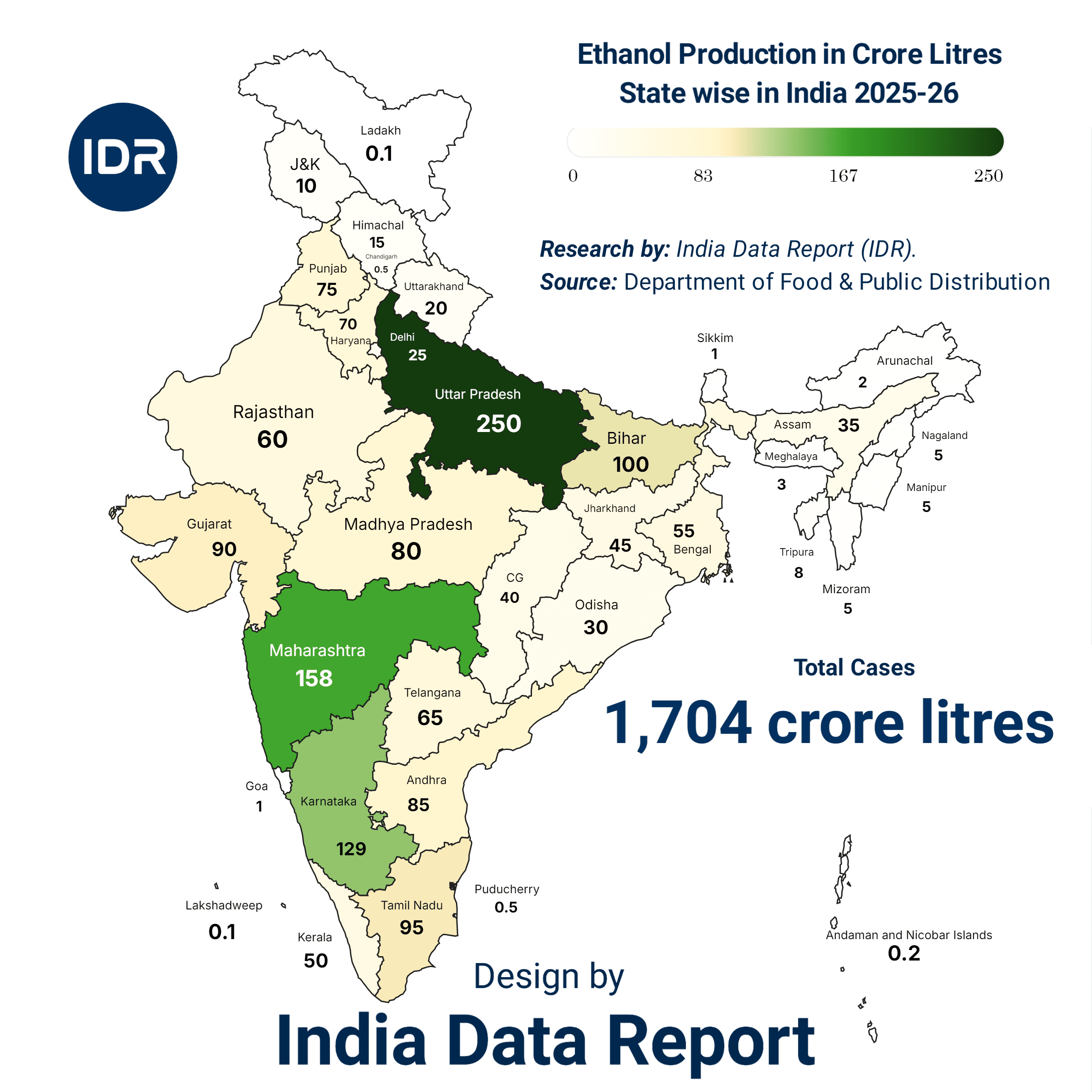
What we are witnessing is not a straightforward green transition; it is a high-stakes reallocation of India’s most precious resources—water, food security, and state subsidies. We are told we are fueling our vehicles with renewable green energy. In reality, we are burning our rapidly depleting groundwater tables to keep the internal combustion engine on life support. The latest production data reveals an uncomfortable truth: India’s blockbuster production of 1,704 crore litres of ethanol is built on a highly volatile, structurally unequal foundation that pits industrial greed directly against human survival.
To understand why this green dream is on thin ice, you have to look at where the juice is actually coming from. It isn’t a pan-India agrarian awakening. It is a hyper-concentrated heavy industry dominated by a handful of politically entrenched geographies.
Uttar Pradesh, Maharashtra, and Karnataka alone drive the lion’s share of the output. This is not a coincidence. These are the traditional sugarcane belts, where massive cash-crop lobbies dictate both state policy and banking credit priorities.
Look at the stark drop-off as we move down the production ladder:
| Rank | State / Union Territory | Annual Ethanol Production (Crore Litres) | Share of National Output (%) | Primary Feedstock Risk |
| 1 | Uttar Pradesh | 250.0 | 14.67% | High (Sugarcane Monoculture / Soil Fatigue) |
| 2 | Maharashtra | 158.0 | 9.27% | Critical (Water Scarcity in Marathwada) |
| 3 | Karnataka | 129.0 | 7.57% | High (Inter-state Water Disputes) |
| 4 | Bihar | 100.0 | 5.87% | Medium (Maize Supply Chain Chokepoints) |
| 5 | Tamil Nadu | 95.0 | 5.57% | High (Severe Groundwater Depletion) |
| 6 | Gujarat | 90.0 | 5.28% | Low (Industrial Diversification) |
| 7 | Andhra Pradesh | 85.0 | 4.99% | Medium (Monsoon Dependency) |
| 8 | Madhya Pradesh | 80.0 | 4.69% | Medium (Logistical Bottlenecks) |
| 9 | Punjab | 75.0 | 4.40% | Critical (Severe Rice-Belt Water Crisis) |
| 10 | Telangana | 65.0 | 3.81% | Medium (Rapid Infrastructure Scaling) |
The Bitter Truth: Just three states control nearly a third of India’s entire ethanol supply. If a severe drought hits the sugarcane belt of Maharashtra or western Uttar Pradesh, the entire national blending mandate collapses like a house of cards. We haven’t built an energy cushion; we’ve built a fragile regional dependency.
When policy architects boast about 1,704 crore litres, they conveniently gloss over this regional asymmetry. What happens to the marginal driver in Kerala (50 crore litres) or West Bengal (55 crore litres) when their local fuel stations rely on ethanol hauled thousands of kilometers across state lines from Uttar Pradesh? The carbon footprint of transporting ethanol via diesel trucks across the subcontinent completely defeats the purpose of using a “green” biofuel in the first place.
The official rhetoric claims that the Ethanol Blended Petrol (EBP) program is a panacea for rural distress across India. The numbers suggest otherwise. For the vast majority of Indian states, particularly the Northeast and the Himalayan regions, the ethanol boom is an invisible phenomenon happening somewhere else.
Consider the baseline production figures for the bottom half of the country’s geographic landscape:
| Group | State / Union Territory | Production (Crore Litres) | Industrial Readiness | Economic Benefit Trajectory |
| The Mid-Tier | Rajasthan | 60.0 | Low | Limited by arid climate and crop choices |
| West Bengal | 55.0 | Medium | Underutilized grain-based distillation cap | |
| Kerala | 50.0 | Low | Dependent on high-value plantation crops | |
| Jharkhand | 45.0 | Low | Infrastructure deficit in rural hinterlands | |
| Chhattisgarh | 40.0 | Medium | High potential for surplus rice diversion | |
| The Peripheral Belt | Assam | 35.0 | Low | Fragmented supply chains |
| Odisha | 30.0 | Low | Vulnerable to extreme weather events | |
| Delhi | 25.0 | Zero | Purely consumer market; zero raw input | |
| Uttarakhand | 20.0 | Low | Terrain limits industrial scale-up | |
| Himachal Pradesh | 15.0 | Zero | Ecologically sensitive zone |
The message is clear: the economic windfall of the ethanol mandate is being funneled into established industrial pockets. Smallholder farmers in the hills, the northeast, or the tribal belts aren’t getting a piece of this pie. They are merely paying the inflation tax at the pump for a fuel blend that subsidizes deep-pocketed sugar mill owners in western and northern India.
Let’s address the elephant in the distillery. To make one litre of sugarcane-based ethanol, you need roughly 2,500 to 3,000 litres of water. When you process that fact against Uttar Pradesh’s 250 crore litres or Maharashtra’s 158 crore litres, the numbers become terrifying.
We are systematically mining ancient aquifers to grow a water-guzzling cash crop, turning that crop into sugar, fermenting that sugar into alcohol, and burning it in urban traffic jams.
This isn’t environmental stewardship. It’s ecological arbitrage.
The pivot toward grain-based ethanol (broken rice and maize) was supposed to fix this. But that fix brought an even deeper moral dilemma: food security. In a country that ranks stubbornly low on the Global Hunger Index, diverting millions of tonnes of food grains from public distribution systems to fuel distilleries is a dangerous gamble. When the government temporarily banned the use of sugarcane juice for ethanol due to domestic sugar shortages, the industry threw a tantrum. Why? Because the entire financial architecture of these distilleries is hooked on cheap, subsidized, state-guaranteed raw materials.
Take a look at the absolute bottom of the production spectrum to see where the policy completely drops off the cliff:
| Region | State / UT | Production (Crore Litres) | The Ground Reality |
| The Borderlands | Jammu & Kashmir | 10.0 | Distillation crippled by political and terrain risks |
| Nagaland | 5.0 | Zero industrial scaling for bio-inputs | |
| Manipur | 5.0 | Supply chains severed by internal disruption | |
| Mizoram | 5.0 | Purely subsistence farming ecosystem | |
| The Marginal Tier | Sikkim | 3.0 | Organic state mandate clashes with heavy chemical distillation |
| Meghalaya | 3.0 | High rainfall but zero infrastructure for biofuel | |
| Arunachal Pradesh | 2.0 | Vast geography, near-zero industrial processing | |
| Tripura | 1.0 | Isolated logistics make export unviable | |
| Goa | 1.0 | Tourism-driven economy; no land for feedstock | |
| The Micro-Franchises | Puducherry | 0.5 | Micro-economy with zero industrial land |
| Andaman & Nicobar | 0.2 | Island logistics make distillation absurd | |
| Ladakh | 0.1 | Arid, high-altitude zone; zero feedstock capability | |
| Lakshadweep | 0.1 | Tiny coral atoll ecosystem; consumer only |
The Bitter Truth: The bottom 15 states and union territories combined do not even produce 3% of India’s total ethanol output. The entire green transition is being engineered on the backs of a few fragile agro-climatic zones, while the rest of the country watches from the sidelines.
Why are we rushing into this headlong despite the glaring ecological warning signs? The answer lies in collective human anxiety.
The state is driven by a deep fear of global oil shocks and macroeconomic vulnerability. Urban consumers are anxious about skyrocketing fuel costs and toxic air quality. The ethanol mandate solves a massive psychological problem for the political class: it offers a visible, tech-forward, patriotic solution. It tells the urban driver, “Look, you’re helping our farmers every time you fill your tank.”
But look at what is happening to the vehicle owner. E20 fuel has a lower energy density than pure petrol. Your car gets lower mileage on an ethanol blend—typically a 5% to 7% drop. Furthermore, older engines not calibrated for high ethanol percentages suffer from material degradation; ethanol is hygroscopic, meaning it absorbs moisture from the air, leading to rust and corrosion in fuel lines. The consumer is paying the same price (or more) for a fuel that delivers less energy and accelerates vehicle wear and tear, all under the banner of environmental virtue.
The greed side of the equation belongs to the industrial distillers. With guaranteed procurement prices set by the government and fixed off-take agreements by Oil Marketing Companies (OMCs), ethanol production has become a risk-free, gold-plated line of business. When you guarantee profits by corporate fiat while socializing the environmental costs (aquifer depletion, soil degradation), capital will flood into that sector every single time. It doesn’t matter if it makes long-term ecological sense.
If India stays on its current trajectory, the ethanol narrative will hit a hard wall long before the centenary of independence in 2047. You cannot out-subsidize nature.
Here is what the hard data and economic gravity tell us about the future:
By 2030: The push to move past E20 to higher blends will trigger a severe food-versus-fuel crisis. As climate volatility makes monsoons increasingly erratic, India will be forced to repeatedly freeze ethanol production to protect domestic food supplies and stabilize sugar prices. The dream of seamless, uninterrupted 20%+ blending across all geographies will remain an elusive target, frequently interrupted by structural supply shocks.
By 2047: The current model of first-generation ($1G$) ethanol—derived directly from food crops and sugar—will be completely unsustainable. Severe groundwater bankruptcy in Punjab, Haryana, and Maharashtra will force a radical policy U-turn. If India does not rapidly shift its entire infrastructure to second-generation ($2G$) ethanol (made from agricultural residue like cotton stalks and straw) or non-crop feedstocks, the entire biofuel program will have to be downscaled significantly to protect drinking water resources.
The path forward requires an immediate, clear-eyed course correction. India must stop incentivizing the expansion of water-guzzling crops in arid zones purely for fuel distillation. The government must tie ethanol subsidies directly to water efficiency and transition away from crop-juice distillation toward genuine waste-to-energy technologies. Until we decouple biofuel production from groundwater depletion, we aren’t driving toward a cleaner future; we are simply burning tomorrow’s water to fuel today’s commute.