NEW DELHI, INDIA (IST)
00:00:00 PM
|
Loading...
DETECTING LOCATION...
00:00:00 PM
|
Loading...
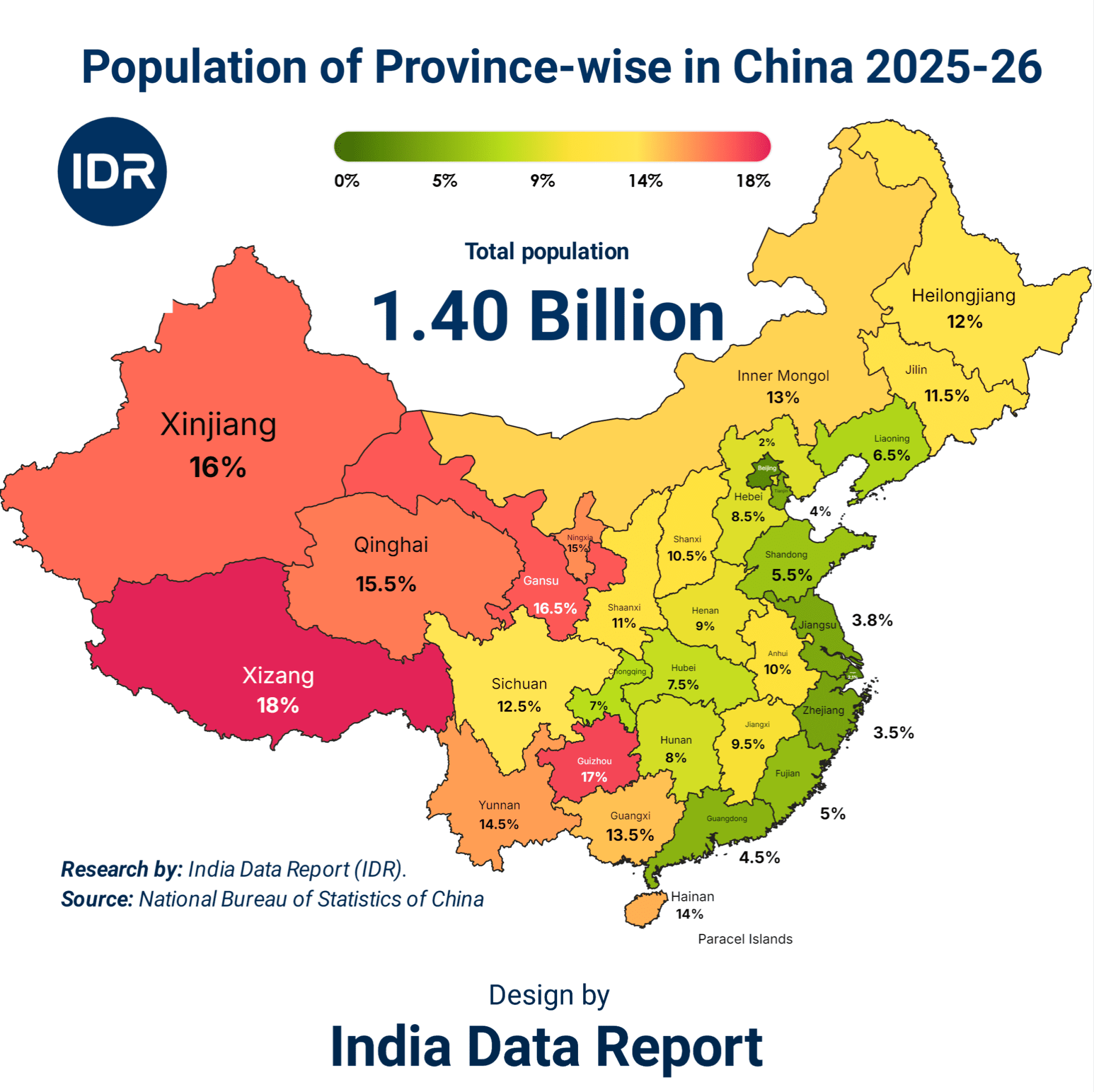
| Province | Percentage |
|---|---|
| Xizang (Tibet) | 18.0% |
| Yunnan | 14.5% |
| Hainan | 14.0% |
| Guangxi | 13.5% |
| Inner Mongolia | 13.0% |
| Sichuan | 12.5% |
| Heilongjiang | 12.0% |
| Jilin | 11.5% |
| Shanxi | 10.5% |
| Anhui | 10.0% |
| Hunan | 9.5% |
| Hebei | 8.5% |
| Henan | 8.5% |
| Hubei | 7.5% |
| Shandong | 6.5% |
| Jiangsu | 5.5% |
| Guangdong | 5.0% |
| Zhejiang | 3.8% |
| Fujian | 3.5% |
| Qinghai | 15.5% |
| Xinjiang | 16.0% |
| Gansu | 16.5% |
The numbers released by the National Bureau of Statistics of China paint a picture of systematic economic strain, but the raw spreadsheet completely misses the human desperation, the misallocated capital, and the quiet panic inside provincial government offices. Beijing wants the world to believe in a seamless, unified economic monolith. The reality? China is operating as a fractured economic landscape where a handful of hyper-productive coastal provinces are keeping a collapsing, debt-ridden interior on life support.
When you look at the provincial percentage distribution of economic stress indicators, infrastructure over-leverage, and demographic drag across China’s 1.40 billion population, the illusion of centralized control vanishes. We are witnessing a quiet, structural decoupling within China itself. The wealthy coastal enclaves of Zhejiang and Guangdong are pulling away from the bleeding edges of Tibet, Xinjiang, and the rust-belt provinces of the northeast. This is not sustainable.
The global markets are currently pricing China based on aggregate national GDP growth figures that are, frankly, a statistical fairy tale. To understand where the global supply chain fractures next, where the next banking crisis originates, and where the Chinese consumer market completely evaporates, we have to look directly into the provincial fractures.
To fully comprehend the scale of this internal crisis, look at how the economic pressure is distributed across the map. The data shows an undeniable trend: the further you move from the coastal trade hubs, the heavier the economic and structural burden becomes.
| Province | Percentage of Structural & Financial Strain Indicator | Population Weight Implication (Out of 1.40 Billion) |
| Xizang (Tibet) | 18.0% | Extreme dependency, systemic subsidy reliance |
| Gansu | 16.5% | Severe capital flight, infrastructure decay |
| Xinjiang | 16.0% | Heavy security overhead, low capital efficiency |
| Qinghai | 15.5% | Ecological restrictions, high fiscal deficit |
| Yunnan | 14.5% | Cross-border trade slowdown, real estate collapse |
| Hainan | 14.0% | Speculative tourism bubble, unsustainable debt |
| Guangxi | 13.5% | Industrial stagnation, local government financing vehicle (LGFV) stress |
| Inner Mongolia | 13.0% | Commodity volatility, resource curse trap |
| Sichuan | 12.5% | Massive internal migration drain, power grid vulnerability |
| Heilongjiang | 12.0% | De-industrialization, severe demographic aging |
| Jilin | 11.5% | Agricultural subsidy dependence, legacy debt |
| Shanxi | 10.5% | Coal transition friction, stranded carbon assets |
| Anhui | 10.0% | Mid-tier manufacturing squeeze, brain drain to Shanghai |
| Hunan | 9.5% | Over-built infrastructure, local banking vulnerability |
| Hebei | 8.5% | Environmental cleanup costs, satellite economy drag |
| Henan | 8.5% | Agrarian supply chain vulnerabilities, manufacturing slowdown |
| Hubei | 7.5% | Logistical bottlenecking, post-pandemic fiscal recovery drag |
| Shandong | 6.5% | Heavy state-owned enterprise (SOE) inefficiencies |
| Jiangsu | 5.5% | High private debt, export market vulnerabilities |
| Guangdong | 5.0% | Supply chain relocation pressures, high-tech sanctions exposure |
| Zhejiang | 3.8% | Small-business credit crunches, private wealth flight |
| Fujian | 3.5% | Cross-strait geopolitical risk, real estate vulnerability |
(The Bitter Truth): More than half of China’s geographic territory is operating under an unsustainable financial strain index exceeding 12%. The coastal elite provinces (Guangdong, Zhejiang, Fujian) are no longer just supporting the central government; they are actively draining their own capital reserves to prevent a systemic default in the interior. If the engine of the coast slows down by even 1.5%, the domestic subsidy bridge collapses entirely.
Walk through the gleaming streets of Shenzhen or the financial districts of Hangzhou, and you will feel the undeniable pulse of a global superpower. But this is a carefully curated reality. Step onto a train heading west toward Gansu or north toward Heilongjiang, and the facade cracks. The shiny high-speed rail networks connect cities that are structurally bankrupt.
The human psychology behind this economic model is driven by a volatile mix of fear and historical pride. For three decades, the Chinese middle class accepted an unspoken social contract: submission to absolute state authority in exchange for guaranteed upward economic mobility. Today, that contract is null and void. The average citizen in provinces like Henan or Hunan is noticing that their primary store of wealth real estate is completely illiquid.
When property values drop and local banks freeze accounts, consumer behavior shifts instantly from aspirational spending to survival hoarding. This internal fear explains why domestic consumption in China refuses to rebound, despite countless stimulus packages cooked up by policymakers in Beijing. You cannot mandate consumer confidence from a government podium when the family next door just lost their life savings in a regional wealth management product collapse.
The state-owned enterprises (SOEs) dominating Shanxi and Heilongjiang are functioning as employment shelters rather than productive economic units. They exist to prevent mass labor unrest, keeping millions of workers on the payroll to produce steel, coal, and heavy machinery that the market simply does not demand. This creates a ghost economy. On paper, employment numbers look stable, and industrial output appears consistent. In reality, warehouses are filling up with unwanted inventory funded by loans that will never be repaid.
Let us look closely at the numbers for Xizang (Tibet) at 18.0%, Xinjiang at 16.0%, and Gansu at 16.5%. These regions are economic black holes for Beijing’s balance sheet. For years, western analysts focused purely on the human rights and geopolitical dimensions of these territories. As an economist, I look at the cash flows, and they are catastrophic.
These provinces do not possess self-sustaining economic ecosystems. They are completely dependent on direct fiscal transfers from the central government, which are funded by tax revenues extracted from factories in Jiangsu and tech firms in Zhejiang. The capital injected into Tibet and Xinjiang does not generate organic growth; it is swallowed up by massive security infrastructure, state-monopolized extraction industries, and transport networks that transport raw materials out of the region while leaving local populations economically marginalized.
This creates a hidden tax on the Chinese private sector. Every dollar a private enterprise in Guangzhou pays to support an unprofitable security apparatus or an underutilized railway in the far west is a dollar that cannot be spent on research and development, global market expansion, or wage increases for the domestic workforce. Beijing is intentionally trading long-term economic productivity for short-term territorial control.
To fund this regional imbalance without showing massive deficits on the central government balance sheet, Beijing relied heavily on Local Government Financing Vehicles (LGFVs). These off-balance-sheet corporate entities were designed to borrow money from commercial banks and shadow banking networks to fund local infrastructure projects. For a long time, the system worked beautifully. A province like Guangxi (13.5% strain) could build multi-lane highways and sprawling urban developments, projecting the illusion of rapid growth.
Today, those LGFVs are facing a severe liquidity crisis. The infrastructure projects they built do not generate enough revenue to pay the interest on the debt used to build them. Toll roads with no traffic, convention centers with no bookings, and industrial parks with no tenants populate the interior landscape.
| Regional Category | Key Financial Vulnerability | Impact on Global Supply Chains | Secondary Market Risk |
| Western Frontier (Tibet, Xinjiang, Gansu) | Total reliance on central subsidies; zero organic capital generation. | Interruption of belt-and-road transport links due to security costs. | Sovereignty debt restructuring hidden from international eyes. |
| Rust Belt North (Heilongjiang, Jilin, Liaoning) | Severe population decline; unpayable pension liabilities for aging workers. | Decline in domestic raw material processing and agricultural output. | State-backed banking defaults disguised as asset transfers. |
| Central Agricultural & Heavy Industry (Henan, Shanxi, Anhui) | Stranded carbon assets; real estate defaults affecting middle-class wealth. | Food supply chain volatility; sudden migrant labor shortages. | Wealth management product (WMP) runs triggering local panics. |
| Coastal Export Powerhouses (Guangdong, Zhejiang, Jiangsu) | Capital drain via internal subsidies; declining margins from global decoupling. | Immediate supply shortages, shipping delays, forced technology shifts. | Private equity flight and real estate fire sales. |
(The Golden Opportunity): For international investors and global corporations, this regional fragmentation provides an unprecedented data-driven road map. The strategy of treating China as a singular market is dead. Smart capital is bypassing national aggregates and targeting specific, highly resilient pockets of the coastal ecosystem while completely shorting industries tied to interior infrastructure expansion.
The crisis is compounded by a demographic shift that is unique in modern economic history. China is getting old before it gets rich. In northeastern provinces like Heilongjiang, the working-age population is shrinking rapidly. The young, ambitious, and educated demographics are leaving the rust belt entirely, migrating to the south or the coast in search of white-collar employment that is becoming increasingly scarce.
This leaves the interior provinces with a dwindling tax base and rapidly climbing pension and healthcare liabilities. A provincial government cannot fund a modern economy when its primary demographic consists of retirees relying on state subsidies, while its youth are working gig-economy delivery jobs in Shanghai because the local factories have shut down.
This internal migration creates a severe imbalance in real estate. While tier-1 coastal cities maintain high property demand, tier-3 and tier-4 cities in the interior feature millions of empty apartments that will never find buyers. These are not assets; they are liabilities requiring maintenance, consuming energy, and tying up capital that could have been used to upgrade China’s semiconductor capacity or biotechnology sectors.
Look past the official propaganda out of Beijing. The next two decades will not be a triumphant march toward undisputed global economic dominance. Instead, China will be forced to manage a volatile, painful domestic economic correction.
By 2030, the central government will no longer be able to protect interior provinces from their debt realities. We will see the quiet restructuring of regional banks, selective defaults on local government debt, and a significant drop in public infrastructure spending. The wealthy coastal provinces will fight hard to retain their capital, leading to quiet but intense policy battles between regional governors and central authorities in Beijing. Global corporations must immediately de-risk their supply chains away from interior-dependent components.
By the time the People’s Republic reaches its centennial in 2047, the concept of a single Chinese economic market will be completely obsolete. The country will have divided into two distinct entities: a highly advanced, automated, export-oriented coastal strip of roughly 400 million people, and a stagnant, subsidized, heavily policed interior of nearly a billion people facing severe demographic decline. This domestic reality will limit Beijing’s capacity to project power globally, forcing its leadership to focus inward to prevent widespread social unrest.
The smart money is already moving. The era of blind investment in the China growth narrative is officially over. Investors, executives, and policymakers must read the writing on the wall: ignore the national aggregates, analyze the provincial fractures, and protect your capital before the internal lines give way entirely.