NEW DELHI, INDIA (IST)
00:00:00 PM
|
Loading...
DETECTING LOCATION...
00:00:00 PM
|
Loading...
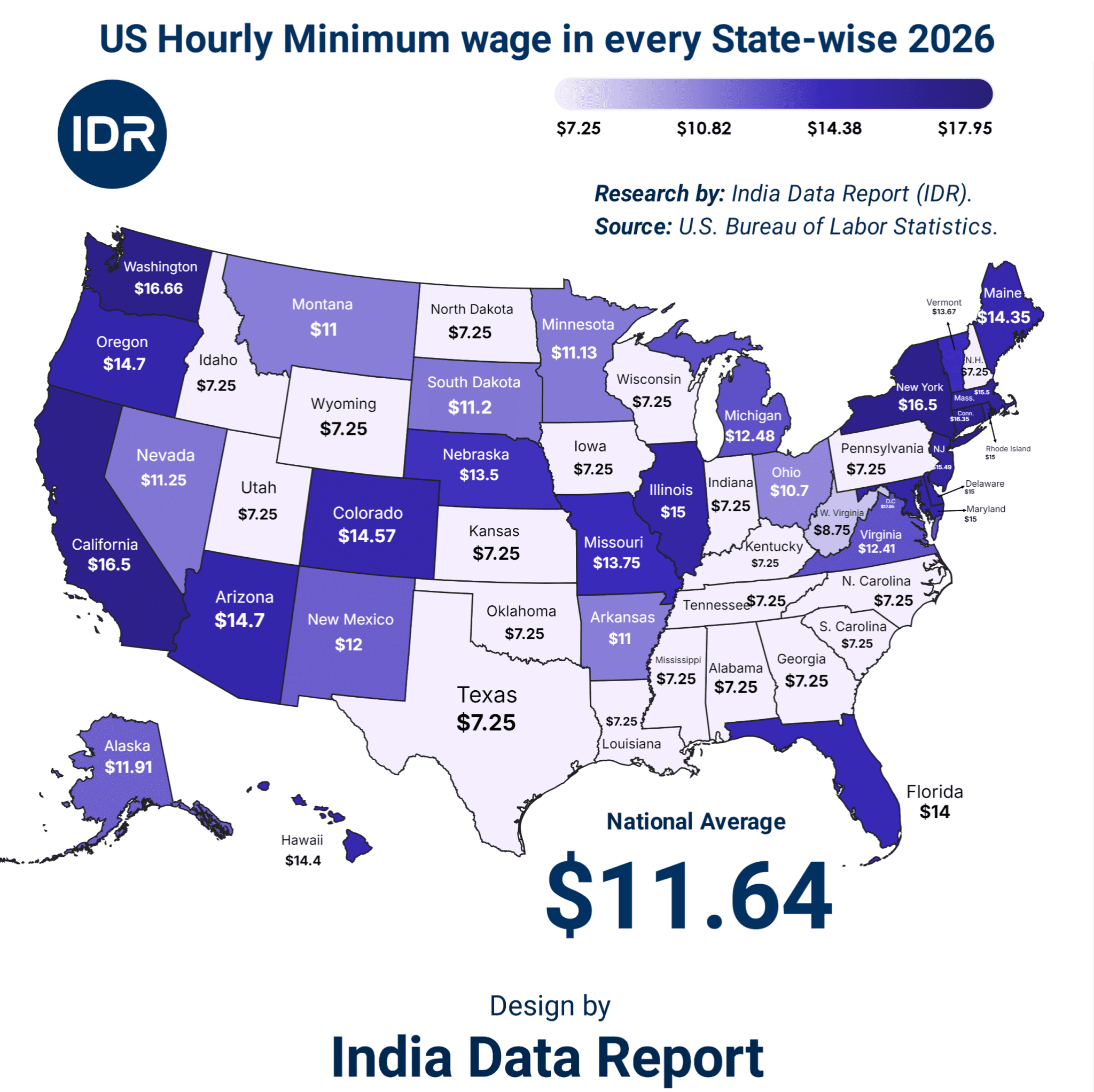
| State | Hourly Minimum Wage (USD) |
|---|---|
| Washington | $16.66 |
| California | $16.50 |
| New York | $16.50 |
| Missouri | $15.00 |
| Colorado | $14.57 |
| Oregon | $14.70 |
| Arizona | $14.70 |
| Maine | $14.35 |
| Florida | $14.00 |
| Nebraska | $13.58 |
| Illinois | $13.75 |
| Michigan | $12.48 |
| New Mexico | $12.00 |
| Minnesota | $11.13 |
| South Dakota | $11.20 |
| Nevada | $11.25 |
| Montana | $11.00 |
| Alaska | $11.91 |
| Ohio | $10.70 |
| Pennsylvania | $7.25 |
| Texas | $7.25 |
| Oklahoma | $7.25 |
| Kansas | $7.25 |
| Iowa | $7.25 |
| Wisconsin | $7.25 |
| Indiana | $7.25 |
| Kentucky | $7.25 |
| Tennessee | $7.25 |
| Mississippi | $7.25 |
| Alabama | $7.25 |
| Georgia | $7.25 |
| South Carolina | $7.25 |
| North Carolina | $7.25 |
| Virginia | $12.41 |
| West Virginia | $8.75 |
| Arkansas | $11.00 |
| Louisiana | $7.25 |
| Utah | $7.25 |
| Wyoming | $7.25 |
| Idaho | $7.25 |
| North Dakota | $7.25 |
| Hawaii | $14.00 |
The idea that the United States operates as a single, cohesive economic superpower is a convenient fiction maintained for international summits and credit rating agencies. In reality, the domestic American economy is a deeply fractured entity, split down the middle by a widening chasm of state-level minimum wages.
As we look at the numbers, a terrifying reality emerges: an American worker in Seattle, Washington, earns more in twenty-five minutes than a worker in Austin, Texas, or Atlanta, Georgia, does in a full, grueling hour of labor.
We are told that the market self-corrects, that supply and demand dictate equilibrium, and that globalization lifts all boats. That is bookish idealism. The cold, hard truth on the pavement is that the federal minimum wage of $7.25 per hour—unchanged since July 2009—has devolved from a baseline safety net into a structural weapon. It is an instrument that keeps certain regions artificially cheap, driving a quiet, domestic race to the bottom while sending shockwaves across oceans, altering how emerging economies like India build their own industrial futures.
When Washington state sets its baseline at $16.66 while Pennsylvania clings stubbornly to $7.25, we are not looking at a mere difference in the cost of living. We are witnessing a fundamental ideological war. The federal floor has become an invisible corporate subsidy for low-margin business models. By keeping the legal minimum at a level that cannot pay for a modest apartment anywhere in the country, the system shifts the burden of human survival onto state welfare, food stamps, and second or third jobs.
Consider the sheer psychological toll of this disparity. A person working forty hours a week at the federal floor brings home a gross weekly salary of $290. Before taxes. In 2026, that does not cover groceries and gas in most towns, let alone rent. Yet, sixteen states refuse to budge a single penny above this threshold. This is not because their local economies cannot bear a higher wage; it is a deliberate policy choice to attract manufacturing, warehousing, and hospitality giants by offering a captive, low-cost workforce.
Let us break down this regional disparity with cold numbers. The table below outlines the stark architecture of the American wage landscape, categorizing states by their economic choices.
| State / Region | Hourly Minimum Wage (USD) | Economic Strategy | Reality Check |
| Washington | $16.66 | High-cost, high-productivity model | Forces automation and high-margin business structures. |
| California | $16.50 | Tech and agricultural heavy-weight | High nominal pay masked by brutal state taxation and housing costs. |
| New York | $16.50 | Financial and service hub | Extreme internal disparity between NYC and upstate realities. |
| National Average | $11.64 | The Statistical Myth | A mathematical midpoint that satisfies neither coast nor heartland. |
| Pennsylvania | $7.25 | Industrial legacy, corporate-friendly | Directly adjacent to high-wage states, bleeding talent across borders. |
| Texas | $7.25 | Deregulated, high-growth magnet | Uses cheap labor to fuel an energy and corporate relocation boom. |
| Georgia | $7.25 | Southern logistics hub | Keeps supply chains cheap at the direct expense of the warehouse floor. |
(The Bitter Truth): The national average of $11.64 is an economic ghost. No one actually lives in a “national average” economy. You either live in a state that forces businesses into modern efficiency, or you live in an economic time capsule where human time is valued less than the electricity running the building.
Look closely at the states stuck at $7.25. Texas, Oklahoma, Kansas, Iowa, Wisconsin, Indiana, Kentucky, Tennessee, Mississippi, Alabama, Georgia, South Carolina, and North Carolina. This is the industrial and agricultural spine of America. By maintaining a wage structure that mirrors the late 2000s, these states have built an internal tax haven for manufacturing.
When a multinational corporation looks to build a new assembly line or a massive fulfillment center, they do not just look at corporate tax tax credits; they look at the cost of human capital. A factory floor in North Carolina running on low-wage dynamics operates at half the labor cost of a similar facility in Oregon or Colorado. This creates an internal migration of capital, draining opportunities from states that value labor and concentrating them in regions where labor has been politically neutered.
What does this mean for the person on the ground? It creates an atmosphere of ambient fear. In a $7.25 state, the worker knows they are replaceable by a long line of desperate peers. This fear keeps heads down, prevents unionization, and silences complaints about unsafe working conditions. The system uses the threat of poverty as its primary management tool.
To understand why a warehouse worker’s wage in Alabama matters to an engineer or a policy planner in New Delhi, we have to look through the lens of globalized labor arbitrage the practice of shifting business operations abroad to take advantage of lower costs.
For the past three decades, India’s economic growth story has been fueled by absorbing the back-office operations, software development, and customer service needs of Western corporations. But the dynamics are shifting. As states like Washington and California push their wages beyond $16.50, the cost of running services within those states skyrockets. This forces high-cost states to export even more white-collar and high-end technical jobs to India to maintain their corporate profit margins.
Conversely, the American states maintaining the $7.25 floor are actively competing with emerging markets for blue-collar investments. When the wage floor in America’s industrial belt remains suppressed, it changes the math for manufacturing supply chains. A global logistics company might choose to keep its distribution hubs in the American South or Midwest rather than outsourcing component assembly to Asia, simply because the cost difference has been squeezed shut by American wage stagnation combined with international shipping vulnerabilities.
The following data illustrates how the domestic American wage divergence creates different tiers of global pressure and economic opportunities across borders.
| U.S. Wage Tier | Representative States | Global Impact | Indian Economic Counter-Strategy |
| The High Tier ($15.00 – $16.66) | Washington, California, New York | Accelerates global outsourcing of tech, R&D, and administrative layers. | High-Value Escalation: Upgrading tech hubs from basic coding to AI architecture and advanced product design. |
| The Mid Tier ($11.00 – $14.57) | Florida, Illinois, New Mexico, Alaska | Drives localized automation; stabilizes domestic consumption. | Niche Supply Integration: Aligning specialized manufacturing components with mid-cost US assembly lines. |
| The Floor Tier ($7.25) | Texas, Pennsylvania, Ohio, Deep South | Retains low-margin manufacturing domestically; competes with global labor. | Scale & Efficiency: Outcompeting through massive logistics infrastructure and unmatchable volume. |
(The Golden Opportunity): For emerging economies, the American wage schism is a map of vulnerability. High-wage states are desperate to offload intellectual and procedural labor, providing a massive runway for sophisticated service exports that go far beyond cheap call centers.
We must look past the columns of numbers and peer into the minds of those living this reality. The human brain is not wired for absolute economics; it is wired for relative status. When a worker in a federal-floor state looks across state lines via social media and sees their exact same role paying double or triple elsewhere, something breaks within the social contract.
This realization breeds a deep, toxic cynicism. It turns work from a source of pride into a transparent game of survival. The old adage “a fair day’s wage for a fair day’s work” sounds like a cruel joke to someone grinding forty hours a week only to realize their paycheck cannot cover their child’s basic medical care or a car repair.
This economic despair transforms into political volatility. When people feel trapped by a system that refuses to adjust its baseline for nearly two decades, they stop believing in institutional solutions. They become susceptible to populist rhetoric, protectionist fallacies, and an underlying anger that erodes the stability required for long-term economic planning. Corporations might cheer for the short-term profits generated by low wages, but they are blind to the long-term systemic risk of an angry, underpaid, and disillusioned populace.
There is a common argument among orthodox economists that raising the minimum wage simply hastens the arrival of the robots. They point to self-checkout kiosks in California and automated burger flippers in Seattle as cautionary tales. This is a classic misdirection.
Automation is happening regardless of the wage floor. The technology giants are not waiting for wages to hit twenty dollars an hour to deploy their algorithms; they are deploying them the moment the technology becomes cheaper than any human labor. By keeping wages at $7.25, states are not saving jobs from automation; they are merely delaying the inevitable while ensuring their workforce remains too poor to retrain for the digital economy.
The high-wage states are actually forcing an evolutionary leap. By making human labor expensive, they compel businesses to invest in productivity-enhancing tools, creating higher-skilled roles to manage those automated systems. The low-wage states are building an economic dead-end—a workforce whose only competitive advantage is being cheaper than a machine, a race that humans are guaranteed to lose.
Let us strip away the diplomatic language and look at where this path inevitably leads over the next few decades.
The current model is unsustainable. Over the next four years, we will see an acute labor flight from the $7.25 states. Human beings are not rocks; they move. The younger generation will migrate toward states that guarantee a living baseline, leaving the American South and Rust Belt with an aging, less productive demographic. States clinging to the federal floor will be forced to either raise their baselines voluntarily to prevent a catastrophic talent drain or rely entirely on highly exploitative, temporary labor models that invite federal scrutiny and social unrest.
By 2047 the centenary of India’s independence and a critical milestone for global economic balance—the myth of cheap American labor will be entirely dead, dissolved by total automation. The countries and regions that thrive will not be those that offered the lowest minimum wage, but those that cultivated the highest human capacity.
The American states that starved their populations via the $7.25 floor will find themselves relegated to economic backwaters, possessing infrastructure built for a low-cost world that no longer exists. Meanwhile, global economic centers that recognized this shift early will dominate the high-value supply chains, treating labor not as an expense to be minimized, but as an asset to be optimized.
The lesson here is stark, brutal, and undeniable: a society that builds its economy on underpaid human time is building on sand. The numbers do not lie, the unrest cannot be hidden, and the future will not wait for a system stuck in 2009.
To properly contextualize how these dynamics impact your own strategic outlook, I need to understand your primary focus. What specific industry or geographic region are you looking to analyze against this evolving wage and labor landscape?